Ickes Melinda J, McMullen Jennifer, Haider Taj, Sharma Manoj
Department of Kinesiology and Health Promotion, College of Education, University of Kentucky, Lexington, KY 40506, USA.
The Legal Aid Society, 199 Water Street, New York, NY 10038, USA.
Int J Environ Res Public Health. 2014 Aug 28;11(9):8940-61. doi: 10.3390/ijerph110908940.
The issue of childhood overweight and obesity has become a global public health crisis. School-based interventions have been developed and implemented to combat this growing concern. The purpose of this review is to compare and contrast U.S. and international school-based obesity prevention interventions and highlight efficacious strategies.
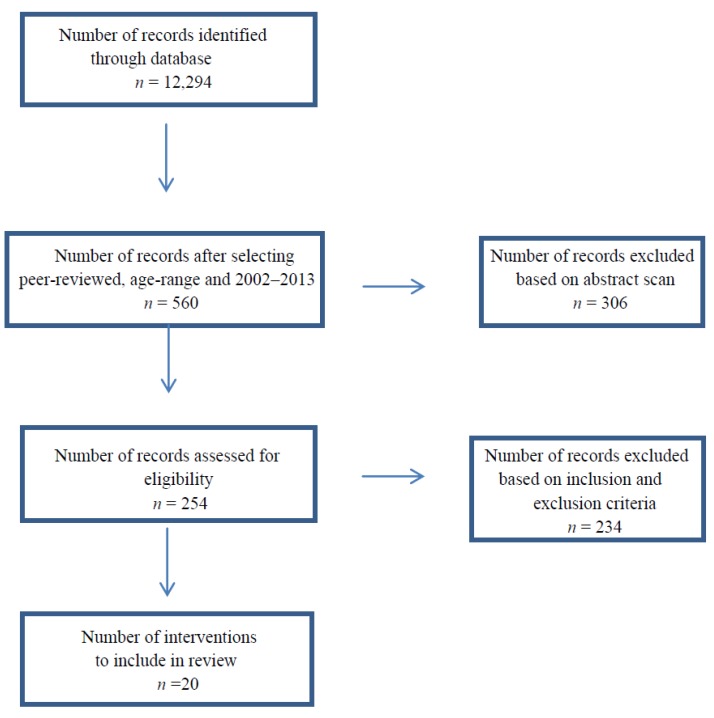
A systematic literature review was conducted utilizing five relevant databases. Inclusion criteria were: (1) primary research; (2) overweight or obesity prevention interventions; (3) school-based; (4) studies published between 1 January 2002 through 31 December 2013; (5) published in the English language; (6) child-based interventions, which could include parents; and (7) studies that reported outcome data.
A total of 20 interventions met the inclusion criteria. Ten interventions each were implemented in the U.S. and internationally. International interventions only targeted elementary-aged students, were less likely to target low-income populations, and were less likely to be implemented for two or more years in duration. However, they were more likely to integrate an environmental component when compared to U.S. interventions.
Interventions implemented in the U.S. and internationally resulted in successful outcomes, including positive changes in student BMI. Yet, varying approaches were used to achieve success, reinforcing the fact that a one-size-fits-all approach is not necessary to impact childhood obesity. However, building on successful interventions, future school-based obesity prevention interventions should integrate culturally specific intervention strategies, aim to incorporate an environmental component, and include parents whenever possible. Consideration should be given to the potential impact of long-term, frequent dosage interventions, and subsequent follow-up should be given attention to determine long-term efficacy.
儿童超重和肥胖问题已成为全球公共卫生危机。已制定并实施了以学校为基础的干预措施来应对这一日益严重的问题。本综述的目的是比较和对比美国和国际上以学校为基础的肥胖预防干预措施,并突出有效的策略。
利用五个相关数据库进行了系统的文献综述。纳入标准为:(1)原始研究;(2)超重或肥胖预防干预措施;(3)以学校为基础;(4)2002年1月1日至2013年12月31日期间发表的研究;(5)以英文发表;(6)以儿童为基础的干预措施,可能包括家长;(7)报告结果数据的研究。
共有20项干预措施符合纳入标准。美国和国际上各实施了10项干预措施。国际干预措施仅针对小学生,针对低收入人群的可能性较小,实施时间持续两年或更长时间的可能性也较小。然而,与美国的干预措施相比,它们更有可能整合环境因素。
在美国和国际上实施的干预措施取得了成功的结果,包括学生体重指数的积极变化。然而,采用了不同的方法来取得成功,这强化了一个事实,即一刀切的方法对于影响儿童肥胖并非必要。然而,在成功干预措施的基础上,未来以学校为基础的肥胖预防干预措施应整合具有文化特异性的干预策略,旨在纳入环境因素,并尽可能包括家长。应考虑长期、频繁剂量干预的潜在影响,并应关注后续随访以确定长期疗效。