Canning Brendan J, Chang Anne B, Bolser Donald C, Smith Jaclyn A, Mazzone Stuart B, McGarvey Lorcan
Johns Hopkins Asthma and Allergy Center, Baltimore, MD.
Queensland Children's Respiratory Centre, Royal Children's Hospital, Brisbane, QLD, Australia, Child Health Division, Menzies School of Health, Darwin, NT, Australia.
Chest. 2014 Dec;146(6):1633-1648. doi: 10.1378/chest.14-1481.
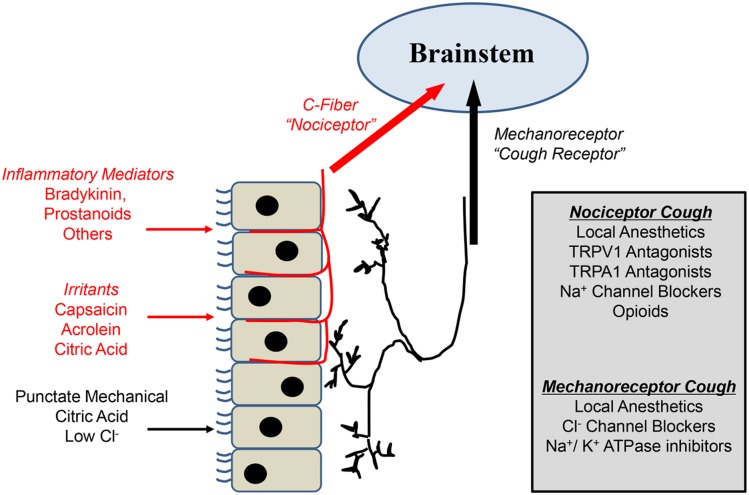
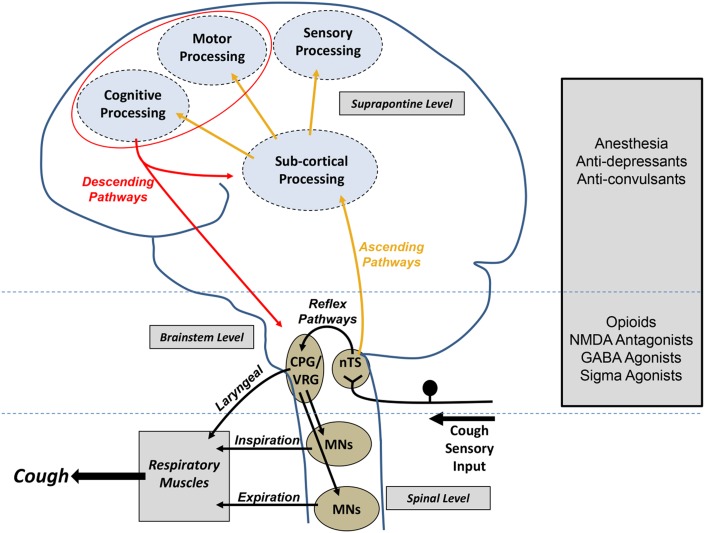
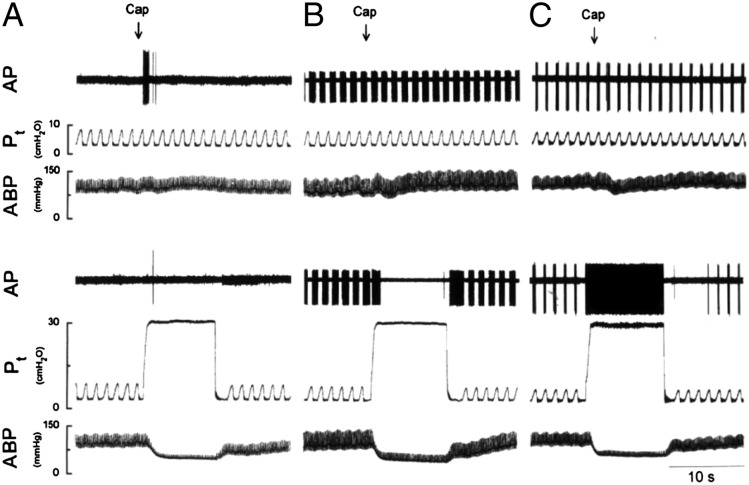
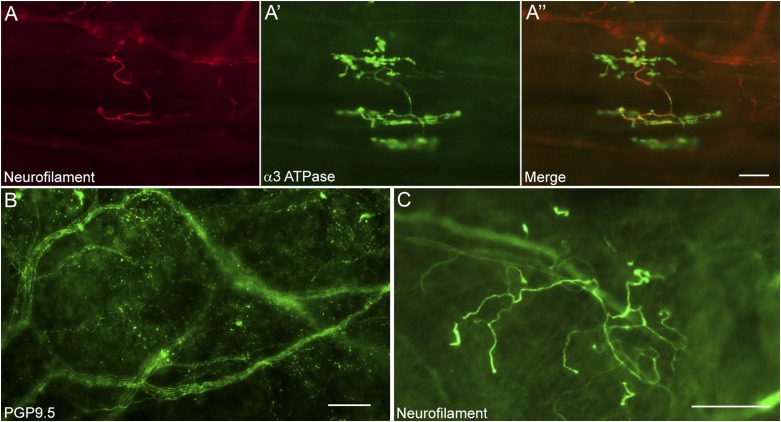
Bronchopulmonary C-fibers and a subset of mechanically sensitive, acid-sensitive myelinated sensory nerves play essential roles in regulating cough. These vagal sensory nerves terminate primarily in the larynx, trachea, carina, and large intrapulmonary bronchi. Other bronchopulmonary sensory nerves, sensory nerves innervating other viscera, as well as somatosensory nerves innervating the chest wall, diaphragm, and abdominal musculature regulate cough patterning and cough sensitivity. The responsiveness and morphology of the airway vagal sensory nerve subtypes and the extrapulmonary sensory nerves that regulate coughing are described. The brainstem and higher brain control systems that process this sensory information are complex, but our current understanding of them is considerable and increasing. The relevance of these neural systems to clinical phenomena, such as urge to cough and psychologic methods for treatment of dystussia, is high, and modern imaging methods have revealed potential neural substrates for some features of cough in the human.
支气管肺C纤维以及一部分对机械刺激敏感、对酸敏感的有髓感觉神经在调节咳嗽中起重要作用。这些迷走感觉神经主要终止于喉、气管、隆突和肺内大支气管。其他支气管肺感觉神经、支配其他内脏的感觉神经以及支配胸壁、膈肌和腹部肌肉组织的躯体感觉神经调节咳嗽模式和咳嗽敏感性。本文描述了调节咳嗽的气道迷走感觉神经亚型和肺外感觉神经的反应性及形态。处理这种感觉信息的脑干和高级脑控制系统很复杂,但我们目前对它们的了解相当多且在不断增加。这些神经系统与临床现象(如咳嗽冲动和治疗咳嗽障碍的心理方法)高度相关,现代成像方法已经揭示了人类咳嗽某些特征的潜在神经基础。