Jung Wi Hoon, Jang Joon Hwan, Park Jin Woo, Kim Euitae, Goo Eun-Hoe, Im Oh-Soo, Kwon Jun Soo
Institute of Human Behavioral Medicine, Seoul National University-Medical Research Center, Seoul, South Korea.
Department of Psychiatry, Seoul National University College of Medicine, Seoul, South Korea.
PLoS One. 2014 Sep 9;9(9):e106768. doi: 10.1371/journal.pone.0106768. eCollection 2014.
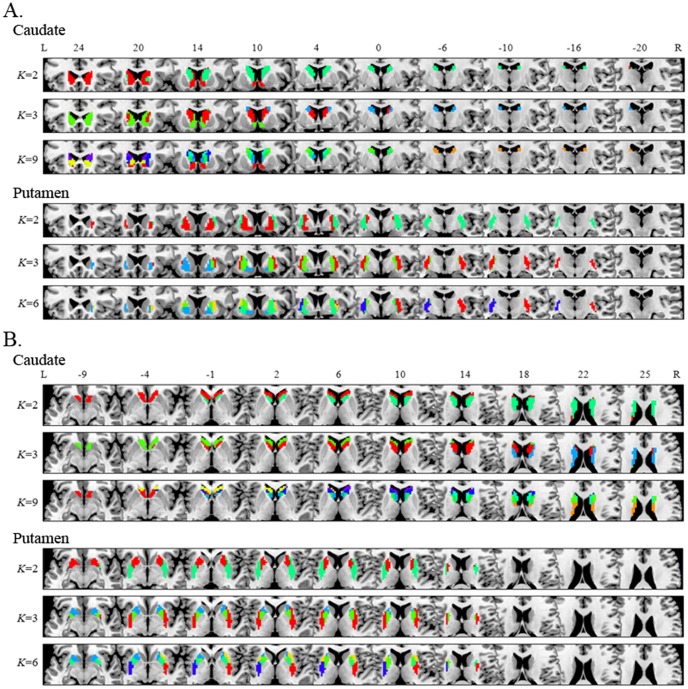
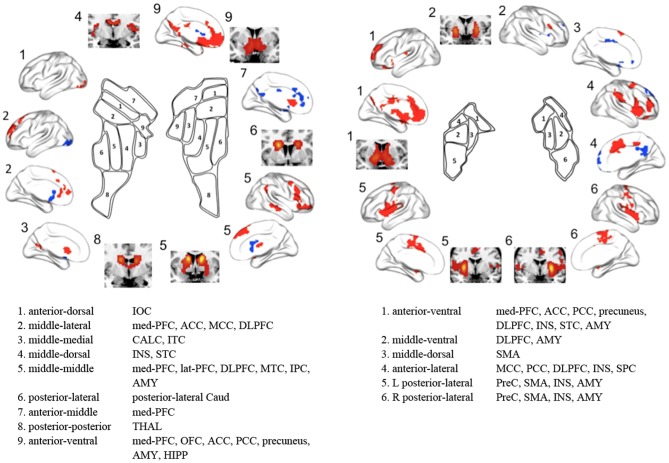
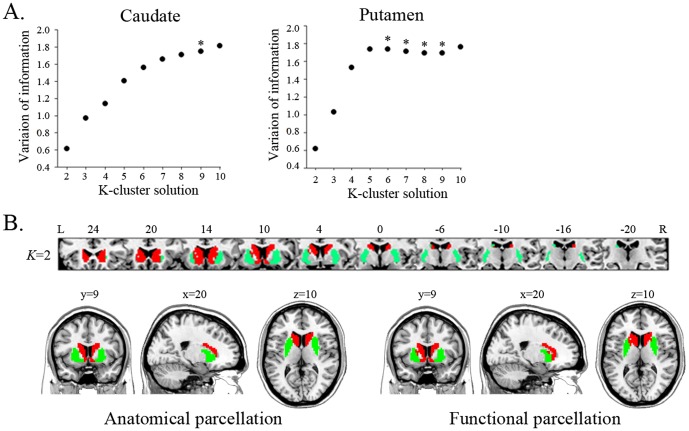
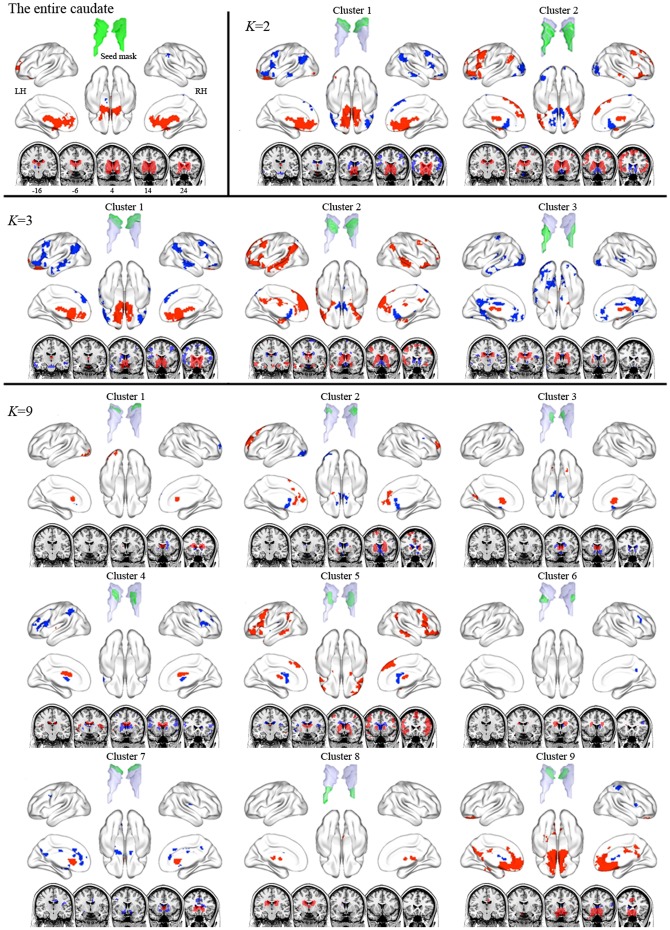
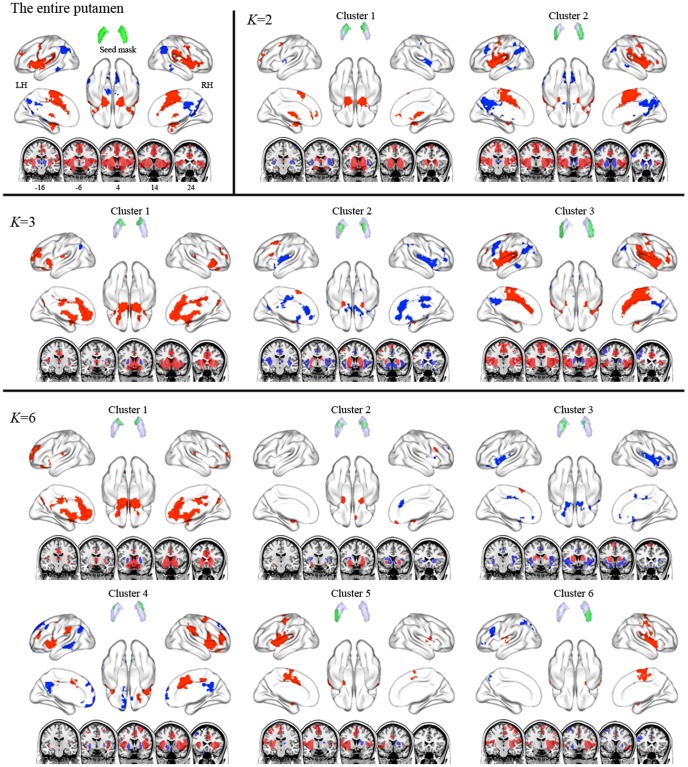
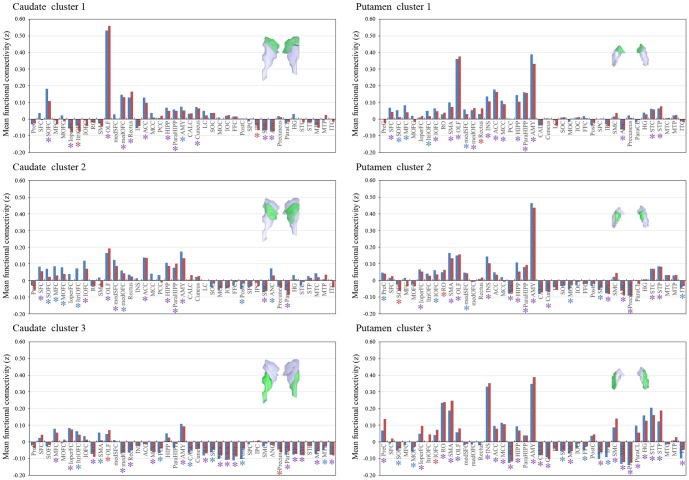
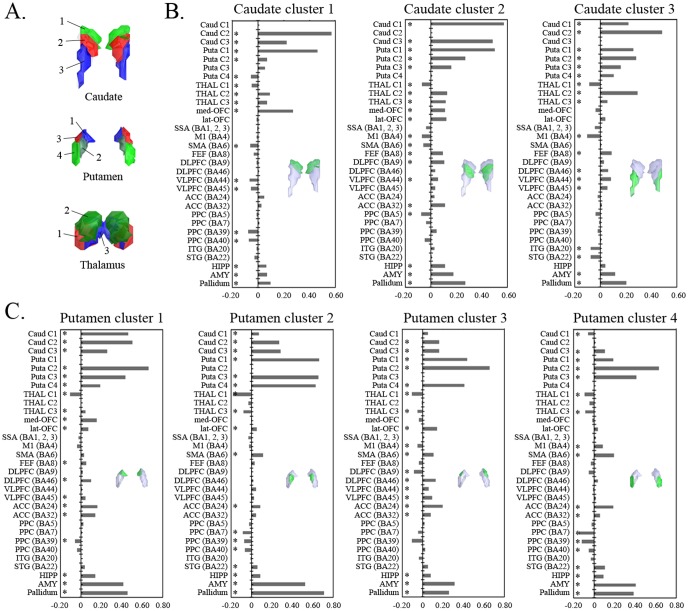
As the main input hub of the basal ganglia, the striatum receives projections from the cerebral cortex. Many studies have provided evidence for multiple parallel corticostriatal loops based on the structural and functional connectivity profiles of the human striatum. A recent resting-state fMRI study revealed the topography of striatum by assigning each voxel in the striatum to its most strongly correlated cortical network among the cognitive, affective, and motor networks. However, it remains unclear what patterns of striatal parcellation would result from performing the clustering without subsequent assignment to cortical networks. Thus, we applied unsupervised clustering algorithms to parcellate the human striatum based on its functional connectivity patterns to other brain regions without any anatomically or functionally defined cortical targets. Functional connectivity maps of striatal subdivisions, identified through clustering analyses, were also computed. Our findings were consistent with recent accounts of the functional distinctions of the striatum as well as with recent studies about its functional and anatomical connectivity. For example, we found functional connections between dorsal and ventral striatal clusters and the areas involved in cognitive and affective processes, respectively, and between rostral and caudal putamen clusters and the areas involved in cognitive and motor processes, respectively. This study confirms prior findings, showing similar striatal parcellation patterns between the present and prior studies. Given such striking similarity, it is suggested that striatal subregions are functionally linked to cortical networks involving specific functions rather than discrete portions of cortical regions. Our findings also demonstrate that the clustering of functional connectivity patterns is a reliable feature in parcellating the striatum into anatomically and functionally meaningful subdivisions. The striatal subdivisions identified here may have important implications for understanding the relationship between corticostriatal dysfunction and various neurodegenerative and psychiatric disorders.
作为基底神经节的主要输入枢纽,纹状体接收来自大脑皮层的投射。许多研究基于人类纹状体的结构和功能连接图谱,为多个平行的皮质-纹状体环路提供了证据。最近一项静息态功能磁共振成像研究通过将纹状体中的每个体素分配到认知、情感和运动网络中与其相关性最强的皮质网络,揭示了纹状体的拓扑结构。然而,在不将聚类结果分配到皮质网络的情况下进行聚类会产生何种纹状体分区模式仍不清楚。因此,我们应用无监督聚类算法,根据纹状体与其他脑区的功能连接模式对人类纹状体进行分区,而不设定任何解剖学或功能上定义的皮质目标。我们还计算了通过聚类分析确定的纹状体亚区的功能连接图谱。我们的研究结果与最近关于纹状体功能差异的描述以及关于其功能和解剖连接的研究一致。例如,我们分别发现背侧和腹侧纹状体簇与参与认知和情感过程的区域之间存在功能连接,以及喙侧和尾侧壳核簇与参与认知和运动过程的区域之间存在功能连接。本研究证实了先前的发现,显示当前研究与先前研究之间存在相似的纹状体分区模式。鉴于这种惊人的相似性,有人提出纹状体亚区在功能上与涉及特定功能的皮质网络相关联,而不是与皮质区域的离散部分相关联。我们的研究结果还表明,功能连接模式的聚类是将纹状体划分为具有解剖学和功能意义的亚区的可靠特征。这里确定的纹状体亚区可能对理解皮质-纹状体功能障碍与各种神经退行性疾病和精神疾病之间的关系具有重要意义。