Institute of Neuroscience and Medicine (INM-7), Heinrich Heine University Düsseldorf, Düsseldorf, Germany; Institute of Systems Neuroscience, Research Centre Jülich, Jülich, Germany.
Institute of Neuroscience and Medicine (INM-1), Research Centre Jülich, Jülich, Germany; Institute for Anatomy I, Medical Faculty, Heinrich Heine University Düsseldorf, Düsseldorf, Germany.
Neuroimage. 2021 Jul 15;235:118006. doi: 10.1016/j.neuroimage.2021.118006. Epub 2021 Apr 2.
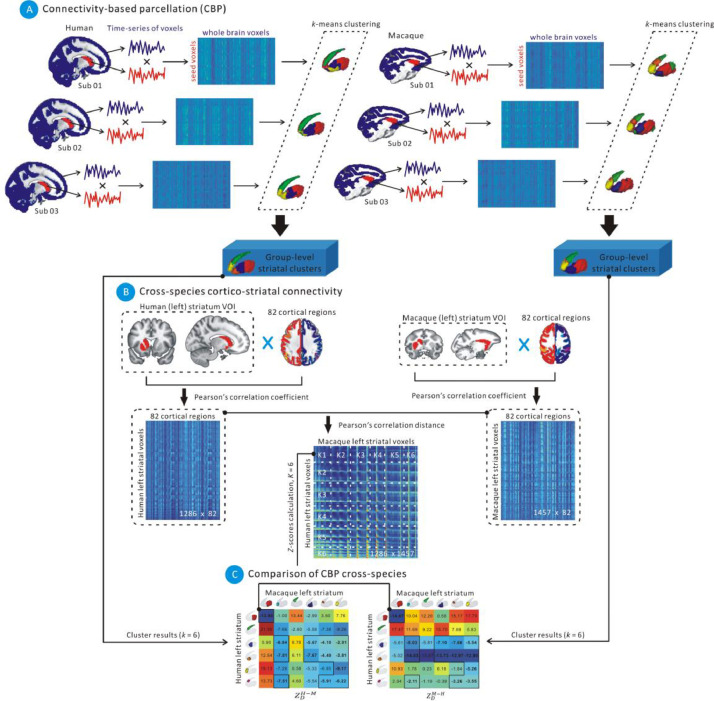
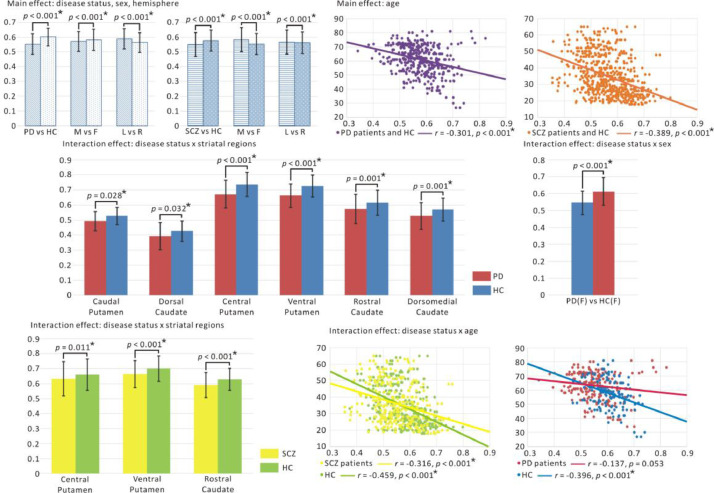
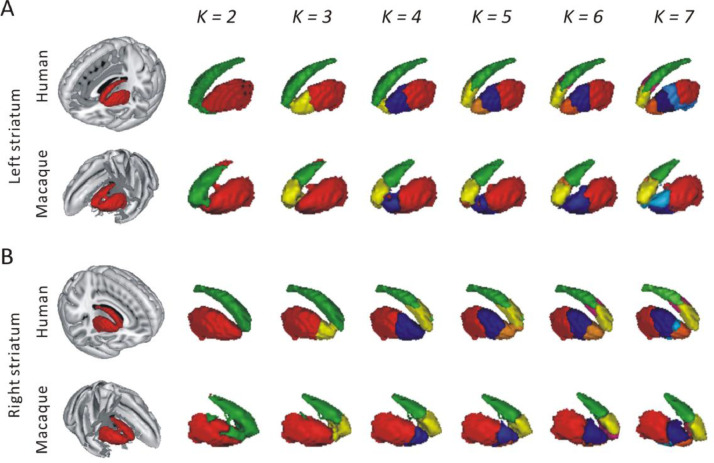
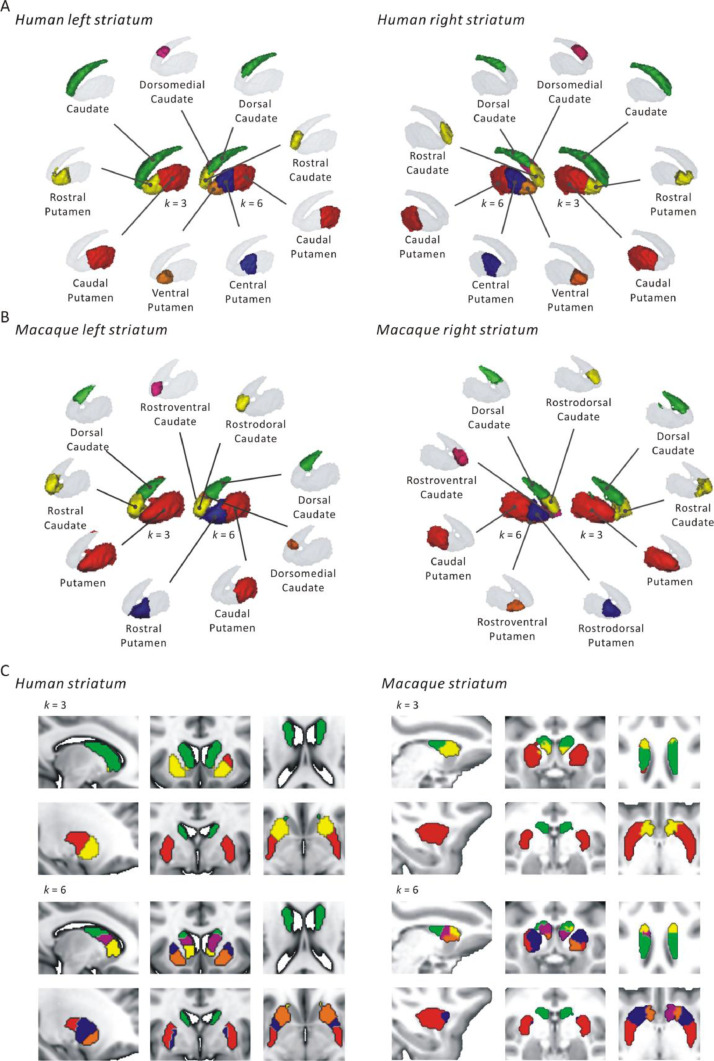
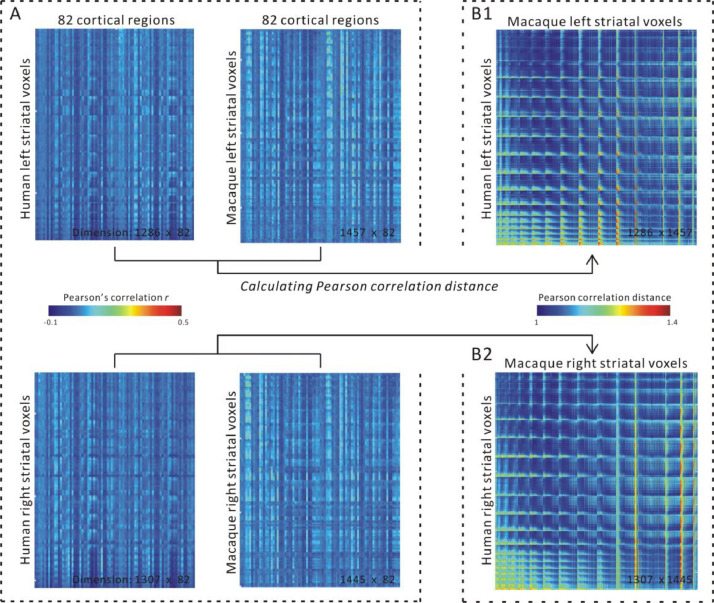
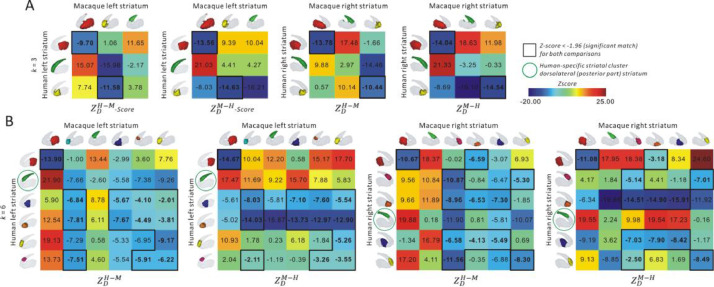
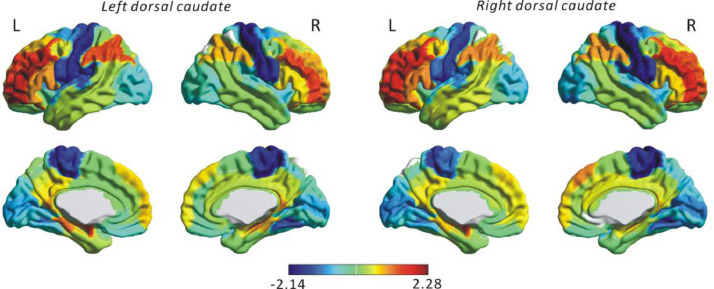
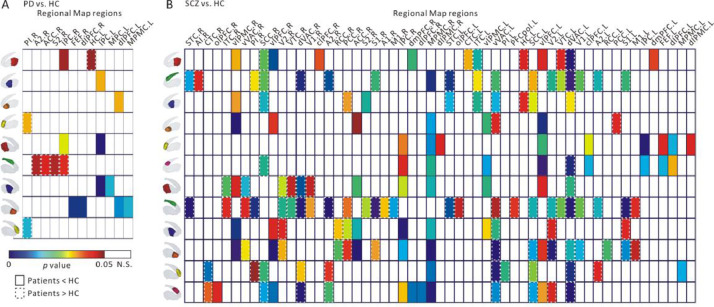
A wide homology between human and macaque striatum is often assumed as in both the striatum is involved in cognition, emotion and executive functions. However, differences in functional and structural organization between human and macaque striatum may reveal evolutionary divergence and shed light on human vulnerability to neuropsychiatric diseases. For instance, dopaminergic dysfunction of the human striatum is considered to be a pathophysiological underpinning of different disorders, such as Parkinson's disease (PD) and schizophrenia (SCZ). Previous investigations have found a wide similarity in structural connectivity of the striatum between human and macaque, leaving the cross-species comparison of its functional organization unknown. In this study, resting-state functional connectivity (RSFC) derived striatal parcels were compared based on their homologous cortico-striatal connectivity. The goal here was to identify striatal parcels whose connectivity is human-specific compared to macaque parcels. Functional parcellation revealed that the human striatum was split into dorsal, dorsomedial, and rostral caudate and ventral, central, and caudal putamen, while the macaque striatum was divided into dorsal, and rostral caudate and rostral, and caudal putamen. Cross-species comparison indicated dissimilar cortico-striatal RSFC of the topographically similar dorsal caudate. We probed clinical relevance of the striatal clusters by examining differences in their cortico-striatal RSFC and gray matter (GM) volume between patients (with PD and SCZ) and healthy controls. We found abnormal RSFC not only between dorsal caudate, but also between rostral caudate, ventral, central and caudal putamen and widespread cortical regions for both PD and SCZ patients. Also, we observed significant structural atrophy in rostral caudate, ventral and central putamen for both PD and SCZ while atrophy in the dorsal caudate was specific to PD. Taken together, our cross-species comparative results revealed shared and human-specific RSFC of different striatal clusters reinforcing the complex organization and function of the striatum. In addition, we provided a testable hypothesis that abnormalities in a region with human-specific connectivity, i.e., dorsal caudate, might be associated with neuropsychiatric disorders.
人类和猕猴的纹状体之间存在广泛的同源性,通常认为两者都参与认知、情绪和执行功能。然而,人类和猕猴纹状体在功能和结构组织上的差异可能揭示了进化上的分歧,并为人类易患神经精神疾病提供了线索。例如,人类纹状体的多巴胺能功能障碍被认为是帕金森病 (PD) 和精神分裂症 (SCZ) 等不同疾病的病理生理学基础。先前的研究发现,人类和猕猴纹状体之间的结构连接具有广泛的相似性,而其功能组织的跨物种比较尚不清楚。在这项研究中,基于纹状体与皮质的同源连接,比较了静息状态功能连接 (RSFC) 衍生的纹状体区。这里的目标是确定与猕猴区相比具有人类特异性连接的纹状体区。功能分割显示,人类纹状体分为背侧、背内侧和额状尾状核以及腹侧、中央和尾状壳核,而猕猴纹状体分为背侧和额状尾状核以及额状和尾状壳核。跨物种比较表明,在形态相似的背侧尾状核中,皮质-纹状体 RSFC 存在差异。我们通过检查患者(PD 和 SCZ)和健康对照之间皮质-纹状体 RSFC 和灰质 (GM) 体积的差异,来探究纹状体簇的临床相关性。我们发现,不仅在 PD 和 SCZ 患者中,而且在背侧尾状核、额状尾状核、腹侧、中央和尾状壳核以及广泛的皮质区域中,都存在异常的 RSFC。此外,我们还观察到 PD 和 SCZ 患者的额状尾状核、腹侧和中央壳核均出现明显的结构萎缩,而背侧尾状核的萎缩则是 PD 特有的。总之,我们的跨物种比较结果揭示了不同纹状体簇的共享和人类特异性 RSFC,强化了纹状体的复杂组织和功能。此外,我们提供了一个可检验的假设,即具有人类特异性连接的区域(即背侧尾状核)的异常可能与神经精神障碍有关。