Department of Physical Education, Gyeongsang National University, Jinju 660-701, Republic of Korea.
Department of Anatomy and Neurobiology, Medical Research Center for Neural Dysfunction, Institute of Health Science, School of Medicine, Gyeongsang National University, Jinju 660-751, Republic of Korea.
Neural Regen Res. 2013 Apr 5;8(10):922-9. doi: 10.3969/j.issn.1673-5374.2013.10.007.
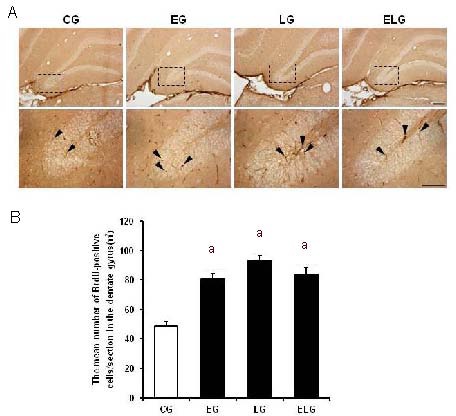
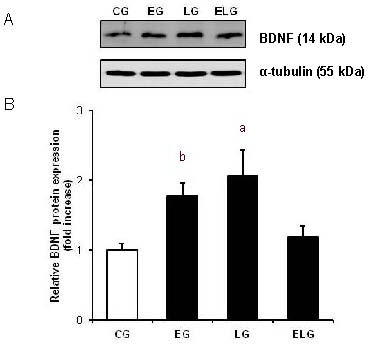
The hippocampus is a brain region responsible for learning and memory functions. The purpose of this study was to investigate the effects of low-intensity exercise and bright light exposure on neurogenesis and brain-derived neurotrophic factor expression in adult rat hippocampus. Male Sprague-Dawley rats were randomly assigned to control, exercise, light, or exercise + light groups (n = 9 per group). The rats in the exercise group were subjected to treadmill exercise (5 days per week, 30 minutes per day, over a 4-week period), the light group rats were irradiated (5 days per week, 30 minutes per day, 10 000 lx, over a 4-week period), the exercise + light group rats were subjected to treadmill exercise in combination with bright light exposure, and the control group rats remained sedentary over a 4-week period. Compared with the control group, there was a significant increase in neurogenesis in the hippocampal dentate gyrus of rats in the exercise, light, and exercise + light groups. Moreover, the expression level of brain-derived neurotrophic factor in the rat hippocampal dentate gyrus was significantly higher in the exercise group and light group than that in the control group. Interestingly, there was no significant difference in brain-derived neurotrophic factor expression between the control group and exercise + light group. These results indicate that low-intensity treadmill exercise (first 5 minutes at a speed of 2 m/min, second 5 minutes at a speed of 5 m/min, and the last 20 minutes at a speed of 8 m/min) or bright-light exposure therapy induces positive biochemical changes in the brain. In view of these findings, we propose that moderate exercise or exposure to sunlight during childhood can be beneficial for neural development.
海马体是负责学习和记忆功能的大脑区域。本研究旨在探讨低强度运动和强光暴露对成年大鼠海马体神经发生和脑源性神经营养因子表达的影响。雄性 Sprague-Dawley 大鼠随机分为对照组、运动组、光照组或运动+光照组(每组 9 只)。运动组大鼠进行跑步机运动(每周 5 天,每天 30 分钟,持续 4 周),光照组大鼠接受光照(每周 5 天,每天 30 分钟,光照强度为 10000 lx,持续 4 周),运动+光照组大鼠同时进行跑步机运动和强光暴露,对照组大鼠在 4 周内保持久坐不动。与对照组相比,运动组、光照组和运动+光照组大鼠海马齿状回的神经发生明显增加。此外,运动组和光照组大鼠海马齿状回脑源性神经营养因子的表达水平明显高于对照组。有趣的是,对照组和运动+光照组之间脑源性神经营养因子的表达没有显著差异。这些结果表明,低强度的跑步机运动(前 5 分钟速度为 2 m/min,第 5-10 分钟速度为 5 m/min,最后 20 分钟速度为 8 m/min)或强光暴露疗法会引起大脑中的积极生化变化。鉴于这些发现,我们提出在儿童时期进行适度运动或暴露在阳光下可能对神经发育有益。