Choi Dong-Hee, Lee Kyoung-Hee, Lee Jongmin
Department of Medical Science, Konkuk University School of Medicine, Seoul 143‑701, Republic of Korea.
Center for Neuroscience Research, Institute of Biomedical Science and Technology, Konkuk University, Seoul 143‑701, Republic of Korea.
Mol Med Rep. 2016 Apr;13(4):2981-90. doi: 10.3892/mmr.2016.4891. Epub 2016 Feb 15.
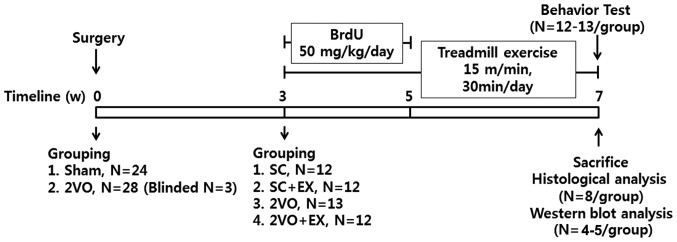
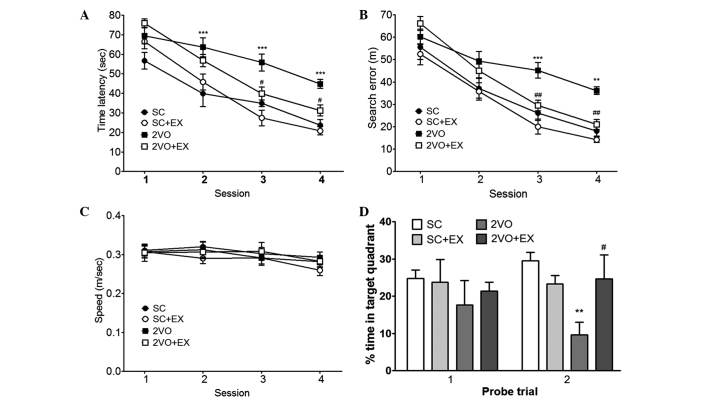
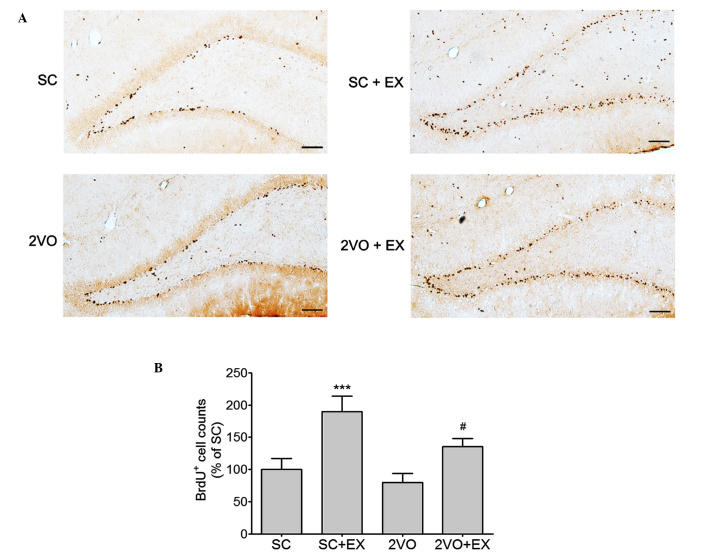
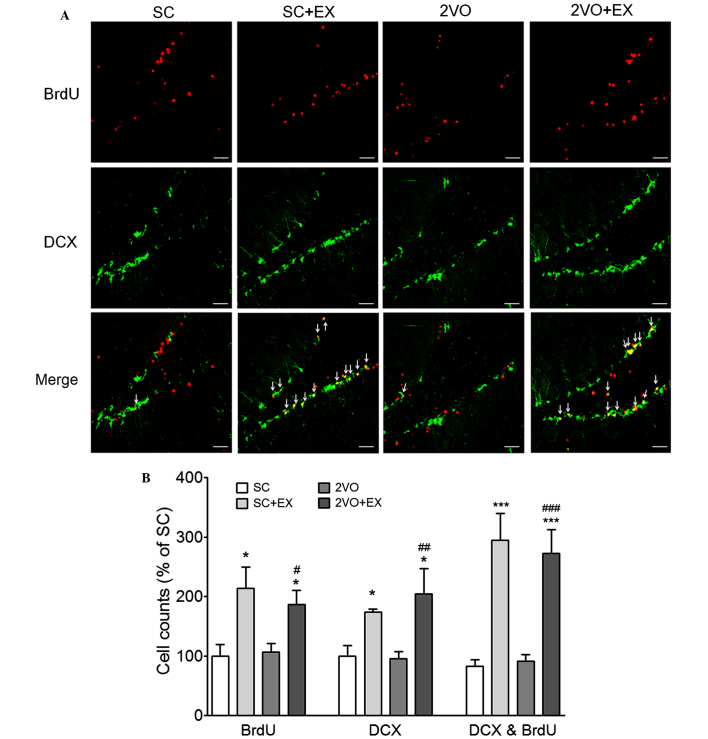
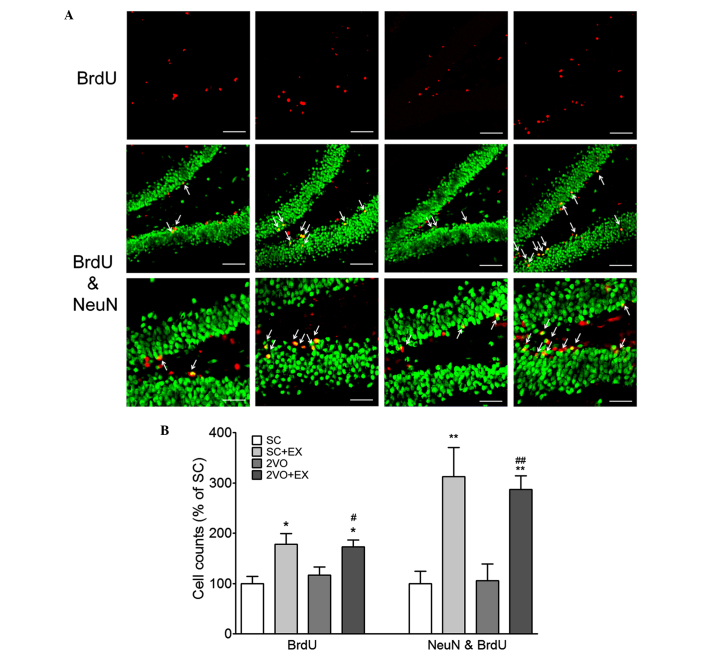
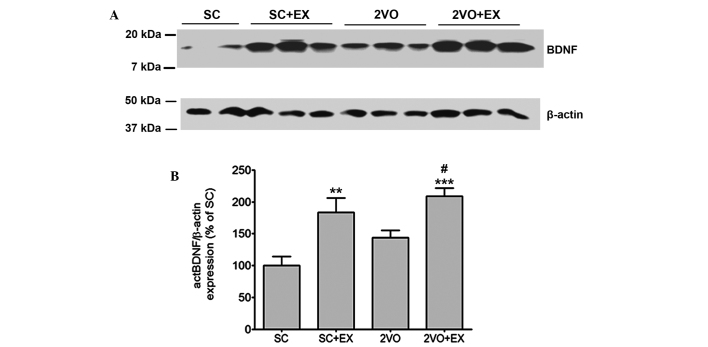
Chronic cerebral hypoperfusion (CCH) is strongly correlated with progressive cognitive decline in neurological diseases, such as vascular dementia (VaD) and Alzheimer's disease. Exercise can enhance learning and memory, and delay age-related cognitive decline. However, exercise-induced hippocampal neurogenesis in experimental animals submitted to CCH has not been investigated. The present study aimed to investigate whether hippocampal neurogenesis induced by exercise can improve cognitive deficit in a rat model of VaD. Male Wistar rats (age, 8 weeks; weight, 292±3.05 g; n=12-13/group) were subjected to bilateral common carotid artery occlusion (2VO) or sham‑surgery and each group was then subdivided randomly into no exercise and treadmill exercise groups. Exercise groups performed treadmill exercise daily at 15 m/min for 30 min for 4 weeks from the third to the seventh week after 2VO. It was demonstrated that the number of neural progenitor cells and mature neurons in the subgranular zone of 2VO rats was increased by exercise, and cognitive impairment in 2VO rats was attenuated by treadmill exercise. In addition, mature brain‑derived neurotrophic factor (BDNF) levels in the hippocampus were increased in the exercise groups. Thus the present study suggests that exercise delays cognitive decline by the enhancing neurogenesis and increasing BDNF expression in the context of VaD.
慢性脑灌注不足(CCH)与神经疾病如血管性痴呆(VaD)和阿尔茨海默病的进行性认知衰退密切相关。运动可以增强学习和记忆,并延缓与年龄相关的认知衰退。然而,在经历CCH的实验动物中,运动诱导的海马神经发生尚未得到研究。本研究旨在探讨运动诱导的海马神经发生是否能改善VaD大鼠模型的认知缺陷。雄性Wistar大鼠(年龄8周;体重292±3.05克;每组12 - 13只)接受双侧颈总动脉闭塞(2VO)或假手术,然后每组随机分为不运动组和跑步机运动组。运动组在进行2VO后第三至第七周,每天以15米/分钟的速度在跑步机上运动30分钟,持续4周。结果表明,运动增加了2VO大鼠颗粒下区神经祖细胞和成熟神经元的数量,跑步机运动减轻了2VO大鼠的认知障碍。此外,运动组海马中成熟脑源性神经营养因子(BDNF)水平升高。因此,本研究表明,在VaD的情况下,运动通过增强神经发生和增加BDNF表达来延缓认知衰退。