Lassi Zohra S, Das Jai K, Salam Rehana A, Bhutta Zulfiqar A
Reprod Health. 2014 Sep 4;11 Suppl 2(Suppl 2):S2. doi: 10.1186/1742-4755-11-S2-S2.
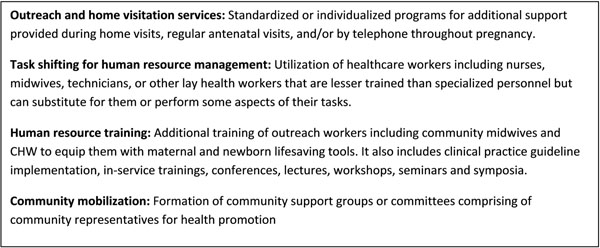
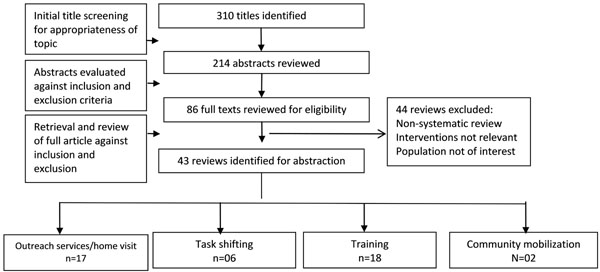
Annually around 40 million mothers give birth at home without any trained health worker. Consequently, most of the maternal and neonatal mortalities occur at the community level due to lack of good quality care during labour and birth. Interventions delivered at the community level have not only been advocated to improve access and coverage of essential interventions but also to reduce the existing disparities and reaching the hard to reach. In this paper, we have reviewed the effectiveness of care delivered through community level inputs for improving maternal and newborn health outcomes. We considered all available systematic reviews published before May 2013 on the pre-defined community level interventions and report findings from 43 systematic reviews. Findings suggest that home visitation significantly improved antenatal care, tetanus immunization coverage, referral and early initiation of breast feeding with reductions in antenatal hospital admission, cesarean-section rates birth, maternal morbidity, neonatal mortality and perinatal mortality. Task shifting to midwives and community health workers has shown to significantly improve immunization uptake and breast feeding initiation with reductions in antenatal hospitalization, episiotomy, instrumental delivery and hospital stay. Training of traditional birth attendants as a part of community based intervention package has significant impact on referrals, early breast feeding, maternal morbidity, neonatal mortality, and perinatal mortality. Formation of community based support groups decreased maternal morbidity, neonatal mortality, perinatal mortality with improved referrals and early breast feeding rates. At community level, home visitation, community mobilization and training of community health workers and traditional birth attendants have the maximum potential to improve a range of maternal and newborn health outcomes. There is lack of data to establish effectiveness of outreach services, mass media campaigns and community education as standalone interventions. Future efforts should be concerted on increasing the availability and training of the community based skilled health workers especially in resource limited settings where the highest burden exists with limited resources to mobilize.
每年约有4000万产妇在家分娩,且没有任何受过培训的卫生工作者在场。因此,由于分娩期间缺乏高质量护理,大多数孕产妇和新生儿死亡发生在社区层面。人们不仅主张在社区层面开展干预措施,以改善基本干预措施的可及性和覆盖范围,还主张减少现有差距,并惠及难以触及的人群。在本文中,我们回顾了通过社区层面投入提供的护理对改善孕产妇和新生儿健康结局的有效性。我们考虑了2013年5月之前发表的所有关于预定义社区层面干预措施的系统评价,并报告了43项系统评价的结果。结果表明,家访显著改善了产前护理、破伤风免疫接种覆盖率、转诊情况以及母乳喂养的早期开始情况,同时减少了产前住院、剖宫产率、孕产妇发病率、新生儿死亡率和围产期死亡率。将任务转移给助产士和社区卫生工作者已显示出能显著提高免疫接种率和母乳喂养开始率,同时减少产前住院、会阴切开术、器械助产和住院时间。将传统接生员培训作为基于社区的一揽子干预措施的一部分,对转诊、早期母乳喂养、孕产妇发病率、新生儿死亡率和围产期死亡率有重大影响。组建基于社区的支持小组可降低孕产妇发病率、新生儿死亡率和围产期死亡率,同时提高转诊率和早期母乳喂养率。在社区层面,家访、社区动员以及对社区卫生工作者和传统接生员的培训最有潜力改善一系列孕产妇和新生儿健康结局。缺乏数据来确定外展服务、大众媒体宣传活动和社区教育作为独立干预措施的有效性。未来的努力应集中在增加基于社区的熟练卫生工作者的数量并加强对他们的培训,尤其是在资源有限且负担最重但资源调动有限的环境中。