Kotil Kadir, Muslumanoglu Murat
Department of Neurosurgery, T.C. Istanbul Arel University, Istanbul, Tepekent/Turkey.
J Craniovertebr Junction Spine. 2014 Apr;5(2):102-5. doi: 10.4103/0974-8237.139213.
The most commonly used techniques for C1-C2 posterior arthrodesis are Goel and Magerl fixation techniques. Due to the anatomical variations of the region, the prior determination of the surgical technique might be hard. Right side Magerl, left side Goel's C1-C2 posterior arthrodesis case is presented as a new surgical combination technique used due to anatomical difficulties.
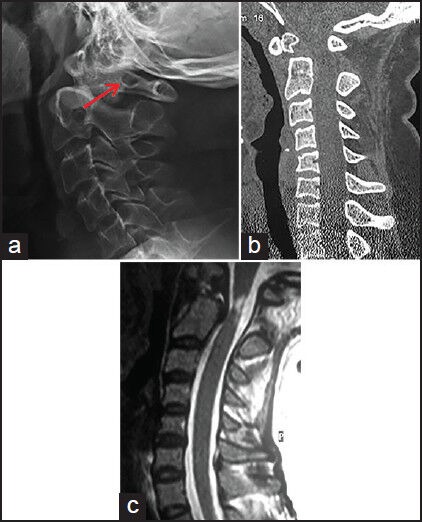
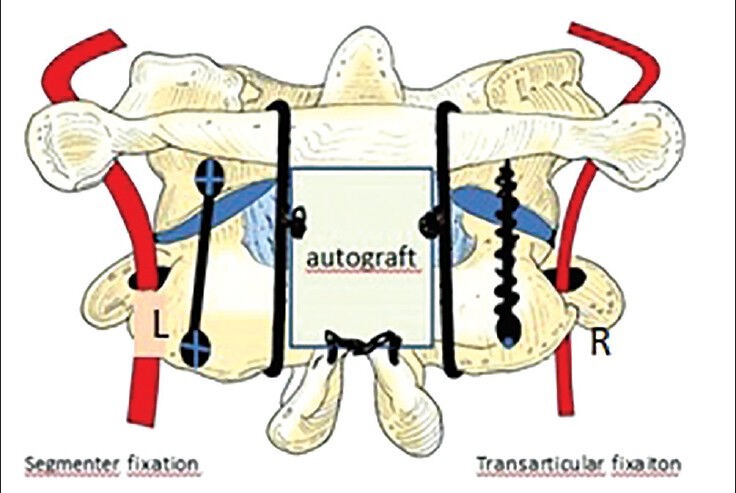
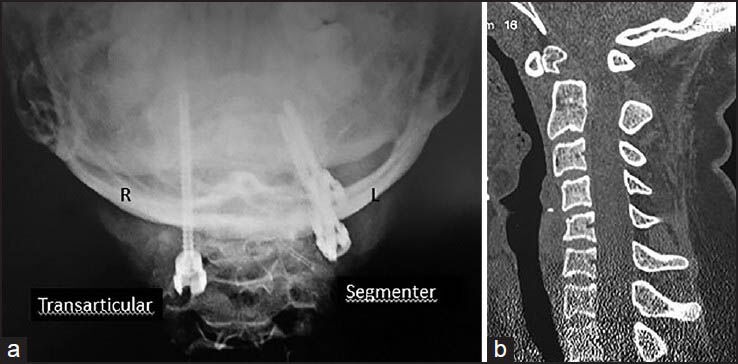
Posterior C1-C2 arthrodesis operation was indicated for a 56-year-old female patient for the treatment of atlanto-axial subluxation caused by os odontoideum. First it was fixed from the nondominant arterial side (right vertebral artery) with Magerl (transarticular) technique. The left side was not suitable for the anatomical transarticular fixation, and the contralateral Goel fixation technique (segmental) was performed. Eventually, right side transarticular left side segmental fixation techniques were combined in one patient for the first time and C1-C2 fusion combination technique was presented.
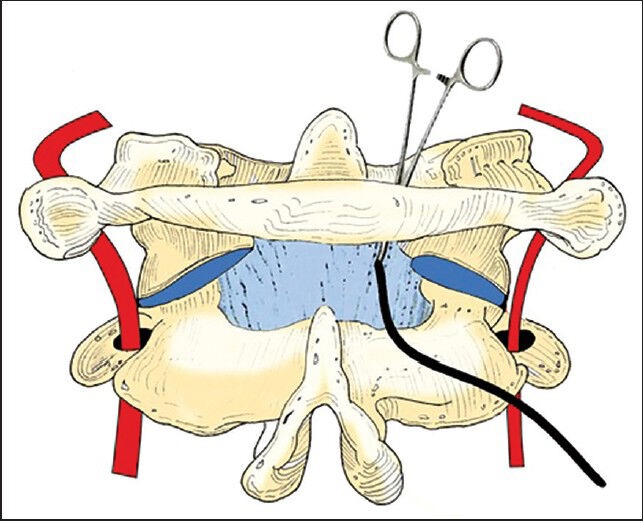
Both Goel and Magerl techniques of C1-C2 posterior fusion techniques were successfully used simultaneously. The operation was initiated with Magerl technique with one screw on the nondominant side. The contralateral side was not suitable for Magerl technique therefore we changed to Goel's technique. Although, fluoroscopy was used 3 times as much during the introduction of the Drill with Magerl technique, twice as much operative time was spent during hemostasis and bleeding, preparation of the C1 entry point, and the reconstruction of polyaxial screws for Goel technique. No neurovascular complications were occurred during both procedures.
Combination of two C1-C2 posterior fusion techniques, Goel and Magerl, in suitable cases caused by anatomical or other reasons appears to be an alternative surgical procedure that protects the patient from complications. For a collection of better data, other studies that include large numbers of patients with high evidential value should be conducted.
C1-C2后路关节融合术最常用的技术是戈尔(Goel)和马格勒(Magerl)固定技术。由于该区域的解剖变异,术前确定手术技术可能会很困难。本文介绍了一例右侧采用马格勒技术、左侧采用戈尔技术的C1-C2后路关节融合术病例,这是一种因解剖困难而采用的新的手术联合技术。
一名56岁女性患者因齿突骨导致寰枢椎半脱位而行C1-C2后路关节融合术。首先,从非优势动脉侧(右侧椎动脉)采用马格勒(经关节)技术进行固定。左侧不适合进行解剖性经关节固定,因此采用对侧的戈尔固定技术(节段性)。最终,首次在一名患者中联合使用右侧经关节左侧节段性固定技术,并提出了C1-C2融合联合技术。
戈尔和马格勒两种C1-C2后路融合技术同时成功应用。手术从非优势侧用一枚螺钉的马格勒技术开始。对侧不适合马格勒技术,因此我们改用戈尔技术。尽管在使用马格勒技术引入钻头时使用的透视次数是其3倍,但在止血、出血、准备C1进针点以及为戈尔技术重建多轴螺钉时花费的手术时间是其2倍。两种手术过程中均未发生神经血管并发症。
在因解剖或其他原因导致的合适病例中,将戈尔和马格勒两种C1-C2后路融合技术联合使用似乎是一种可避免患者出现并发症的替代手术方法。为了收集更好的数据,应该进行其他包含大量具有高证据价值患者的研究。