Rikiishi Kazuhide, Maekawa Masahiko
Institute of Plant Science and Resources, Okayama University, Kurashiki, Okayama, Japan.
PLoS One. 2014 Sep 11;9(9):e107618. doi: 10.1371/journal.pone.0107618. eCollection 2014.
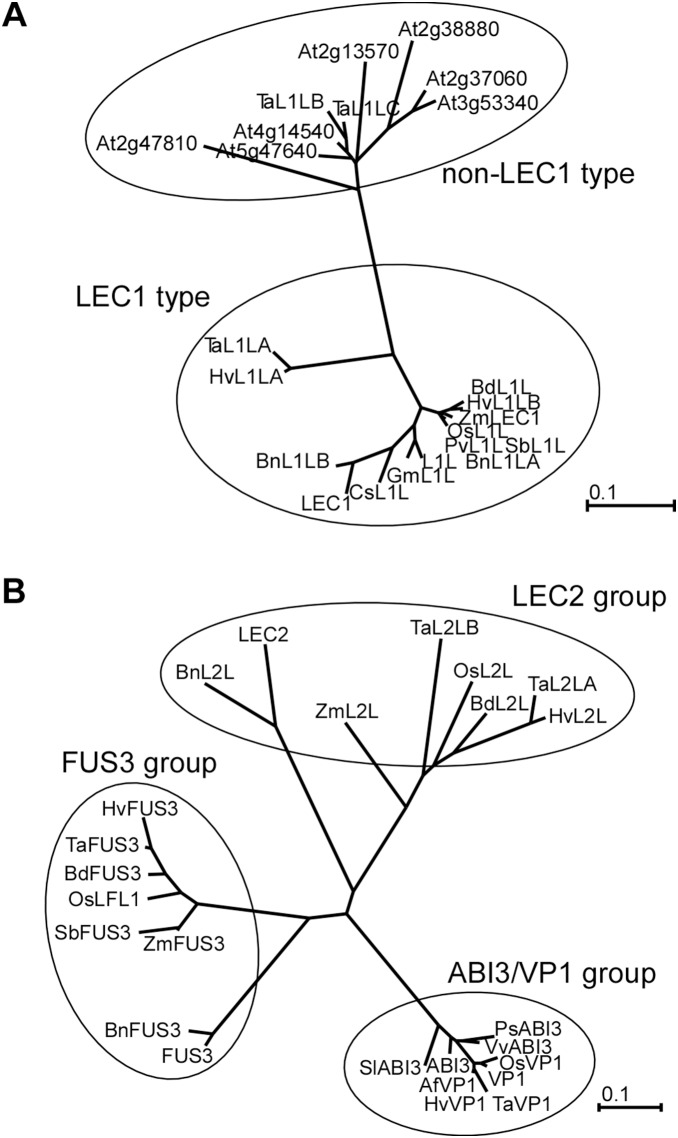
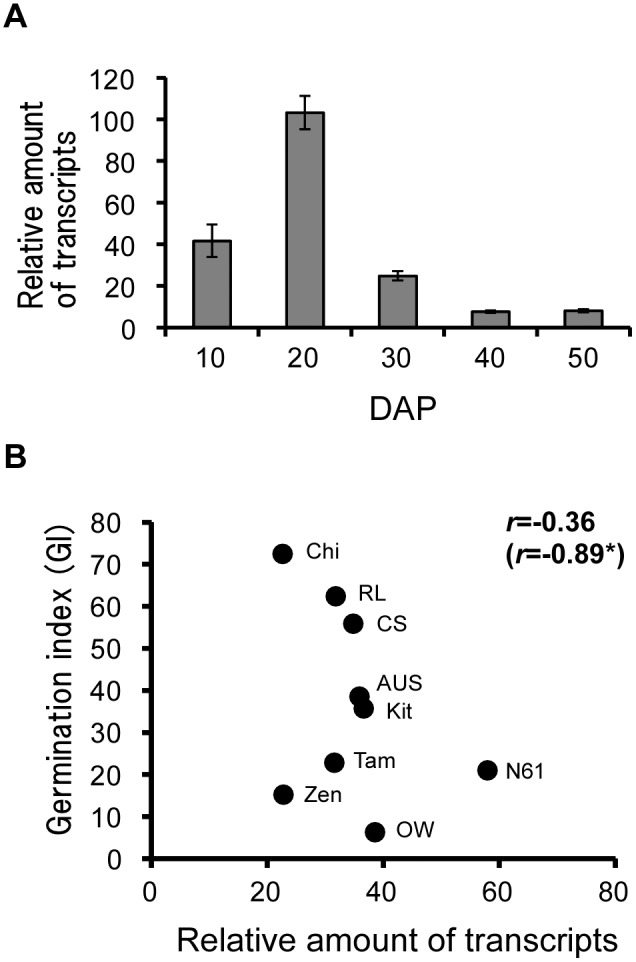
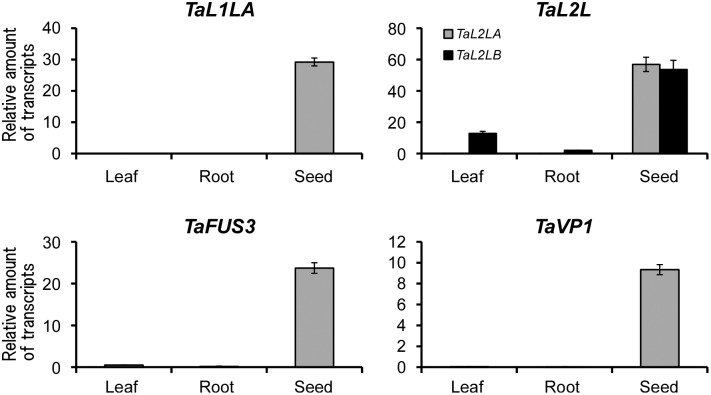
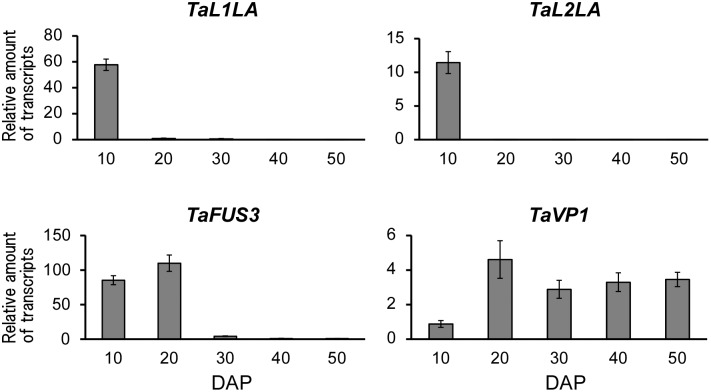
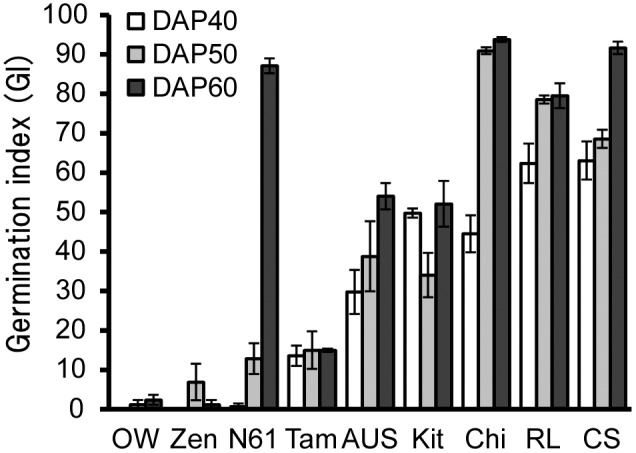
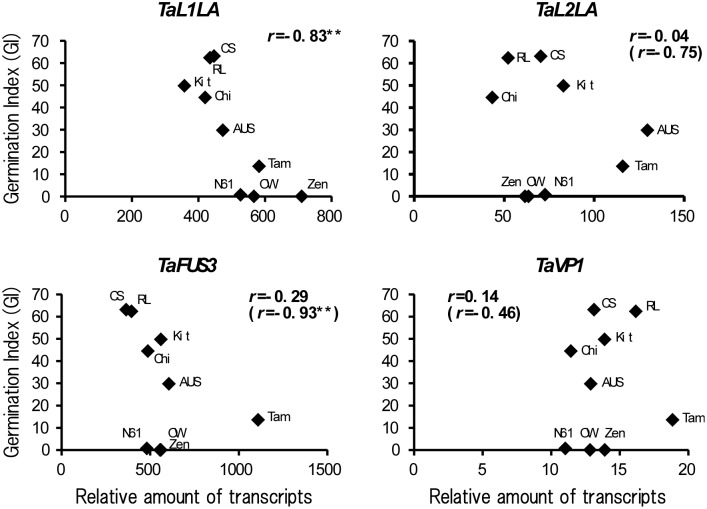
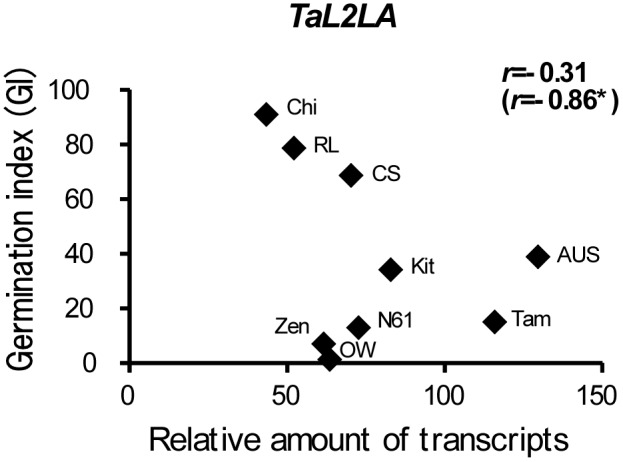
In Arabidopsis, the regulation network of the seed maturation program controls the induction of seed dormancy. Wheat EST sequences showing homology with the master regulators of seed maturation, leafy cotyledon1 (LEC1), LEC2 and FUSCA3 (FUS3), were searched from databases and designated respectively as TaL1L (LEC1-LIKE), TaL2L (LEC2-LIKE), and TaFUS3. TaL1LA, TaL2LA and TaFUS3 mainly expressed in seeds or embryos, with the expression limited to the early stages of seed development. Results show that tissue-specific and developmental-stage-dependent expressions are similar to those of seed maturation regulators in Arabidopsis. In wheat cultivars, the expression level of TaL1LA is correlated significantly with the germination index (GI) of whole seeds at 40 days after pollination (DAP) (r = -0.83**). Expression levels of TaFUS3 and TaL2LA are significantly correlated respectively with GIs at 40 DAP and 50 DAP, except for dormant cultivars. No correlation was found between the expression level of TaVP1, orthologue of ABA insensitive3 (ABI3), and seed dormancy. Delay of germination1 (DOG1) was identified as a quantitative trait locus (QTL) for the regulation of seed dormancy in Arabidopsis. Its promoter has RY motif, which is a target sequence of LEC2. Significant correlation was found between the expression of TaDOG1 and seed dormancy except for dormant cultivars. These results indicate that TaL1LA, TaL2LA, and TaFUS3 are wheat orthologues of seed maturation regulators. The expressions of these genes affect the level of seed dormancy. Furthermore, the pathways, which involve seed maturation regulators and TaDOG1, are important for regulating seed dormancy in wheat.
在拟南芥中,种子成熟程序的调控网络控制着种子休眠的诱导。从小麦EST序列数据库中搜索到与种子成熟主要调控因子叶状子叶1(LEC1)、LEC2和FUSCA3(FUS3)具有同源性的序列,并分别命名为TaL1L(LEC1类似物)、TaL2L(LEC2类似物)和TaFUS3。TaL1LA、TaL2LA和TaFUS3主要在种子或胚中表达,且表达仅限于种子发育的早期阶段。结果表明,组织特异性和发育阶段依赖性表达与拟南芥中种子成熟调控因子的表达相似。在小麦品种中,TaL1LA的表达水平与授粉后40天(DAP)全种子的发芽指数(GI)显著相关(r = -0.83**)。除休眠品种外,TaFUS3和TaL2LA的表达水平分别与40 DAP和50 DAP时的GI显著相关。ABA不敏感3(ABI3)的直系同源基因TaVP1的表达水平与种子休眠之间未发现相关性。延迟发芽1(DOG1)被鉴定为拟南芥种子休眠调控的一个数量性状位点(QTL)。其启动子具有RY基序,这是LEC2的靶序列。除休眠品种外,TaDOG1基因的表达与种子休眠之间存在显著相关性。这些结果表明,TaL1LA、TaL2LA和TaFUS3是种子成熟调控因子的小麦直系同源基因。这些基因的表达影响种子休眠水平。此外,涉及种子成熟调控因子和TaDOG1的途径对小麦种子休眠的调控很重要。