Dyshlovoy Sergey A, Fedorov Sergey N, Shubina Larisa K, Kuzmich Alexandra S, Bokemeyer Carsten, Keller-von Amsberg Gunhild, Honecker Friedemann
Laboratory of Marine Natural Products Chemistry, G.B. Elyakov Pacific Institute of Bioorganic Chemistry, Far-East Branch of the Russian Academy of Sciences, Prospect 100 Let Vladivostoku 159, Vladivostok 690022, Russia ; Department of Oncology, Haematology and Bone Marrow Transplantation with Section Pneumology, Hubertus Wald-Tumorzentrum, University Medical Center Hamburg-Eppendorf, Martinistraße 52, 20246 Hamburg, Germany ; School of Natural Sciences, Far East Federal University, Sukhanova Street 8, Vladivostok 690950, Russia.
Laboratory of Marine Natural Products Chemistry, G.B. Elyakov Pacific Institute of Bioorganic Chemistry, Far-East Branch of the Russian Academy of Sciences, Prospect 100 Let Vladivostoku 159, Vladivostok 690022, Russia.
Biomed Res Int. 2014;2014:469309. doi: 10.1155/2014/469309. Epub 2014 Jul 23.
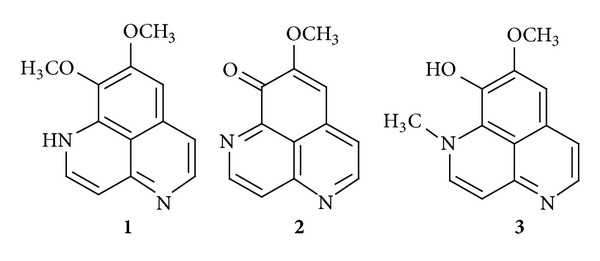
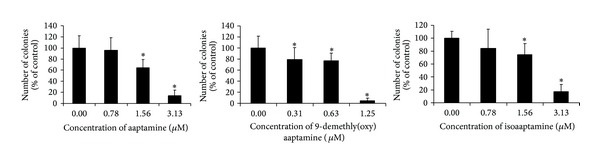
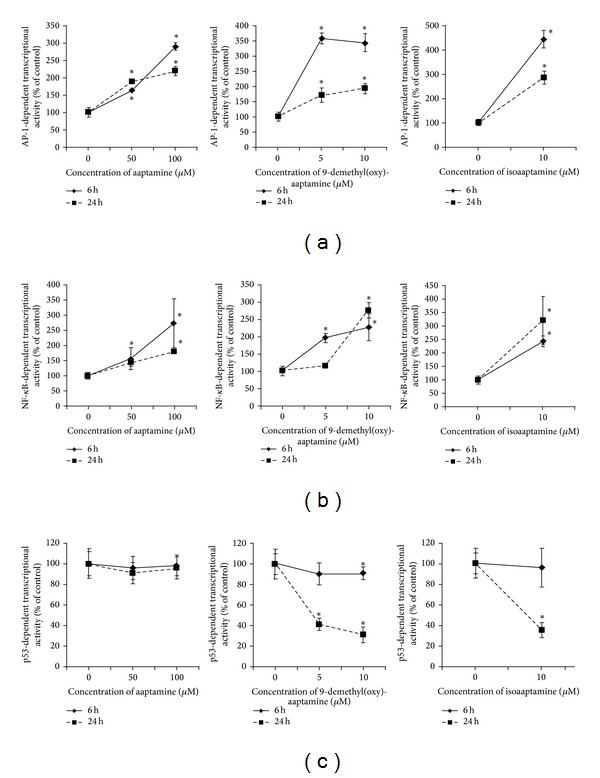
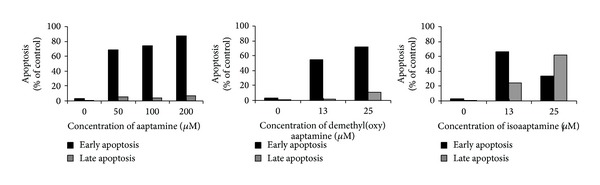
Aaptamine (8,9-dimethoxy-1H-benzo[de][1,6]naphthyridine) is a marine natural compound possessing antioxidative, antimicrobial, antifungal, and antiretroviral activity. Earlier, we have found that aaptamine and its derivatives demonstrate equal anticancer effects against the human germ cell cancer cell lines NT2 and NT2-R and cause some changes in the proteome of these cells. In order to explore further the mechanism of action of aaptamine and its derivatives, we studied the effects of aaptamine (1), demethyl(oxy)aaptamine (2), and isoaaptamine (3) on human cancer cell lines and on AP-1-, NF-κB-, and p53-dependent transcriptional activity in murine JB6 Cl41 cells. We showed that compounds 1-3 demonstrate anticancer activity in THP-1, HeLa, SNU-C4, SK-MEL-28, and MDA-MB-231 human cancer cell lines. Additionally, all compounds were found to prevent EGF-induced neoplastic transformation of murine JB6 Cl41 cells. Nuclear factors AP-1, NF-κB, and p53 are involved in the cellular response to high and nontoxic concentrations of aaptamine alkaloids 1-3. Furthermore, inhibition of EGF-induced JB6 cell transformation, which is exerted by the compounds 1-3 at low nontoxic concentrations of 0.7-2.1 μM, cannot be explained by activation of AP-1 and NF-κB.
阿扑他明(8,9-二甲氧基-1H-苯并[de][1,6]萘啶)是一种具有抗氧化、抗菌、抗真菌和抗逆转录病毒活性的海洋天然化合物。此前,我们发现阿扑他明及其衍生物对人胚细胞癌细胞系NT2和NT2-R具有同等的抗癌作用,并导致这些细胞的蛋白质组发生一些变化。为了进一步探究阿扑他明及其衍生物的作用机制,我们研究了阿扑他明(1)、去甲基(氧基)阿扑他明(2)和异阿扑他明(3)对人癌细胞系以及对小鼠JB6 Cl41细胞中AP-1、NF-κB和p53依赖性转录活性的影响。我们发现化合物1-3在THP-1、HeLa、SNU-C4、SK-MEL-28和MDA-MB-231人癌细胞系中表现出抗癌活性。此外,所有化合物都能阻止表皮生长因子(EGF)诱导的小鼠JB6 Cl41细胞的肿瘤转化。核因子AP-1、NF-κB和p53参与了细胞对高浓度和无毒浓度阿扑他明生物碱1-3 的反应。此外,化合物1-3在0.7-2.1μM的低无毒浓度下对EGF诱导的JB6细胞转化的抑制作用不能用AP-1和NF-κB 的激活来解释。