Eyles Helen, McLean Rebecca, Neal Bruce, Doughty Robert N, Jiang Yannan, Ni Mhurchu Cliona
National Institute for Health Innovation, University of Auckland, Private Bag 92019, Auckland 1142, New Zealand.
BMC Public Health. 2014 Sep 12;14:950. doi: 10.1186/1471-2458-14-950.
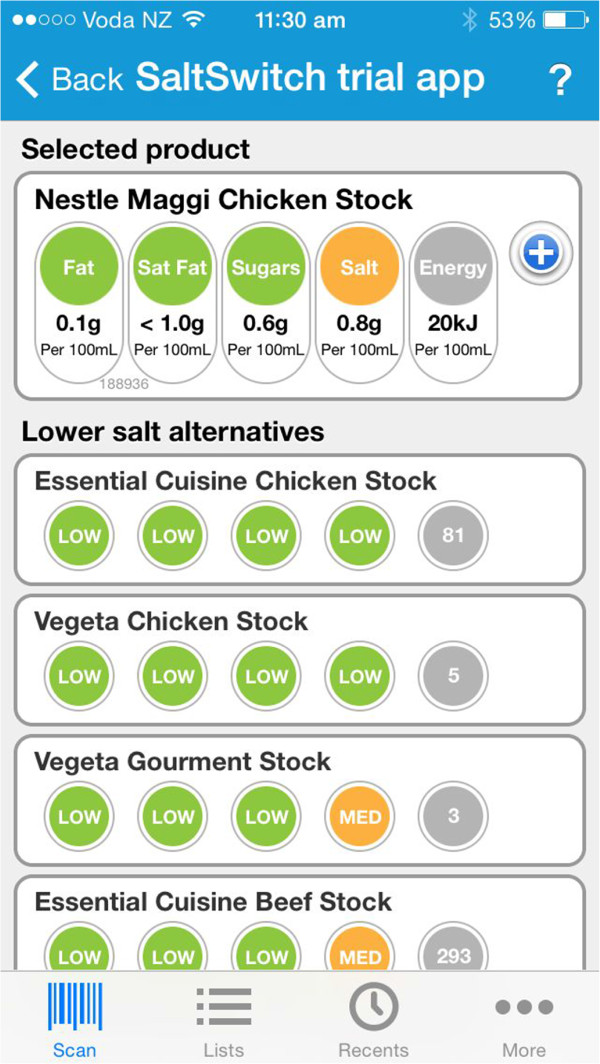
Cardiovascular disease (CVD) is the leading cause of early death worldwide, responsible for an estimated 29% of all global deaths. Reducing salt intake lowers blood pressure and risk of secondary cardiac events. However, identifying low salt foods can be challenging. SaltSwitch is a simple smartphone application (app) that enables shoppers to scan the barcode of packaged foods and receive an immediate, interpretive, traffic light nutrition label on the screen, along with suggestions for healthier lower-salt alternatives. A growing body of evidence suggests mobile technologies can support healthy behaviour change. However, robust evidence for the impact of smartphone interventions is lacking. This manuscript outlines the rationale and methods for a randomized controlled trial designed to determine the effectiveness of SaltSwitch in supporting people with CVD to make lower-salt food choices.
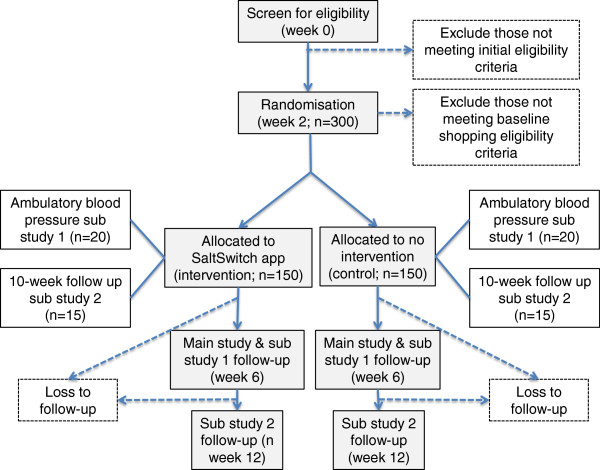
DESIGN/METHODS: A 6-week, two-arm, parallel, randomized controlled trial is being undertaken in New Zealand (2 weeks baseline and 4 weeks intervention). Three hundred adults aged 40 years and older with CVD and their main household shoppers are recruited from research lists, cardiac rehabilitation clinics, and communities in Auckland. Participants are randomized to receive either the SaltSwitch smartphone app or no intervention (control). Randomisation is stratified by ethnicity and age. The primary outcome is the salt content of household food purchases. Secondary outcomes are the saturated fat and energy content of household food purchases, household food expenditure, use and acceptability of the SaltSwitch app by shoppers, and urinary sodium and blood pressure of participants with CVD. Ambulatory blood pressure and potential longer-term impact (12 weeks) of SaltSwitch will be assessed in sub-studies (n ~ 40 and n ~ 20, respectively). Household purchases of salt and other nutrients will be assessed using till receipt data electronically linked with branded food composition data.
The results of the SaltSwitch trial will determine the effectiveness, use and acceptability of a smartphone application to support lower salt food choices and secondary prevention of CVD.
ACTRN12614000206628. Registered 30 March 2014.
心血管疾病(CVD)是全球过早死亡的主要原因,估计占全球所有死亡人数的29%。减少盐摄入量可降低血压和继发性心脏事件的风险。然而,识别低盐食品可能具有挑战性。SaltSwitch是一款简单的智能手机应用程序(应用),使购物者能够扫描包装食品的条形码,并在屏幕上立即获得一个解释性的交通灯营养标签,以及更健康的低盐替代品建议。越来越多的证据表明,移动技术可以支持健康行为的改变。然而,缺乏关于智能手机干预效果的有力证据。本手稿概述了一项随机对照试验的基本原理和方法,该试验旨在确定SaltSwitch在支持心血管疾病患者做出低盐食品选择方面的有效性。
设计/方法:在新西兰正在进行一项为期6周的双臂平行随机对照试验(2周基线期和4周干预期)。从奥克兰的研究名单、心脏康复诊所和社区招募300名40岁及以上患有心血管疾病的成年人及其主要家庭购物者。参与者被随机分为接受SaltSwitch智能手机应用程序或不接受干预(对照组)。随机分组按种族和年龄分层。主要结局是家庭购买食品的盐含量。次要结局包括家庭购买食品的饱和脂肪和能量含量、家庭食品支出、购物者对SaltSwitch应用程序的使用和接受程度,以及心血管疾病参与者的尿钠和血压。将在子研究中分别评估动态血压以及SaltSwitch的潜在长期影响(12周)(分别约40人和约20人)。将使用与品牌食品成分数据电子链接的收银小票数据评估家庭对盐和其他营养素的购买情况。
SaltSwitch试验的结果将确定一款智能手机应用程序在支持低盐食品选择和心血管疾病二级预防方面的有效性、使用情况和可接受性。
ACTRN12614000206628。于2014年3月30日注册。