Panorchan Kwanpeemai, Davenport Andrew
UCL Centre for Nephrology, Royal Free Hospital, University College London Medical School, Rowland Hill Street, NW3 2PF London, UK.
BMC Nephrol. 2014 Sep 12;15:149. doi: 10.1186/1471-2369-15-149.
Cancer antigen 125 (CA125) is made by peritoneal mesothelial cells and can be measured in spent dialysate effluent from peritoneal dialysis (PD) patients. It has been suggested that CA125 is a marker of peritoneal mesothelial cell mass and turnover. As PD CA125 increases during peritoneal inflammation, we wished to determine whether measuring PD CA125 during peritonitis provided additional information in determining outcome of peritonitis.
We prospectively measured peritoneal CA125 in 127 adult PD patients presenting with 187 acute episodes of PD peritonitis, measuring peritoneal CA125 from a sample of dialysate effluent obtained from a 4 hour 2 litre 13.6 g/l dextrose peritoneal dwell.
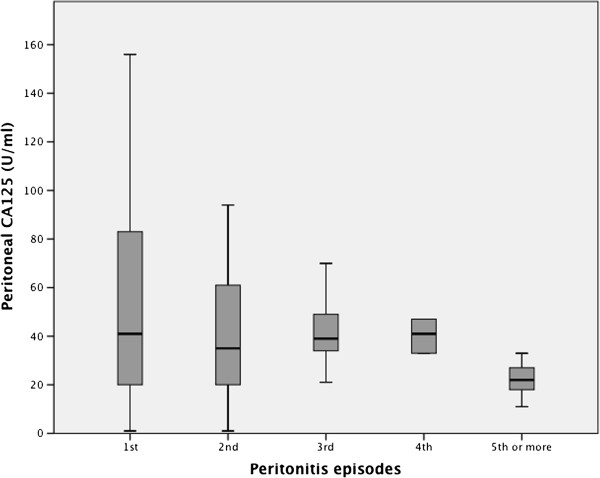
Mean patient age 60.8 ± 17.1 years, 62.6% male, 33.7% diabetic and the median PD vintage was 22 (11-48) months. 127 patients (66.8%) presented with their first episode of peritonitis, 20% their second episode, 13.2% third or greater. Gram positive bacteria accounted for 64.7% of all peritonitis episodes and Gram negative bacteria 21.1%. Treatment was successful for 151 episodes of PD peritonitis (81.1%). The median PD effluent total WBC was 1240 (430-3660)/ml and serum CRP 67 (20-144) mg/l, with a PD CA125 of 38 (20.3-72.3) IU/l on presentation. There were positive correlations between PD effluent CA125 concentrations and total WBC on presentation (r = 0.41, p = <0.001) and dialysis vintage (r = -0.43, p < 0.001) but not with patient age, diabetic status, or serum CRP.There was no difference in PD effluent CA125 concentrations between Gram positive, and Gram negative peritonitis or between those episodes which responded to treatment, median 38 IU/ml (21-69) vs those with treatment failures 38 IU/ml (15-94).
We did not find any additional diagnostic or prognostic benefit for measuring effluent CA125 in PD patients presenting with acute peritonitis compared to standard investigations, including peritoneal WBC and serum CRP. As such our study would not support the routine measurement of peritoneal CA125 during episodes of peritonitis.
癌抗原125(CA125)由腹膜间皮细胞产生,可在腹膜透析(PD)患者的透析废液中检测到。有人提出CA125是腹膜间皮细胞数量和更新的标志物。由于PD患者发生腹膜炎症时CA125会升高,我们希望确定在腹膜炎期间检测PD患者的CA125是否能为判断腹膜炎的预后提供更多信息。
我们前瞻性地检测了127例成年PD患者的腹膜CA125,这些患者共发生187次急性PD腹膜炎发作,从2升13.6克/升葡萄糖腹膜留置4小时后的透析废液样本中检测腹膜CA125。
患者平均年龄60.8±17.1岁,男性占62.6%,糖尿病患者占33.7%,PD中位病程为22(11 - 48)个月。127例患者(66.8%)为首次发生腹膜炎,20%为第二次发作,13.2%为第三次或更多次发作。革兰氏阳性菌占所有腹膜炎发作的64.7%,革兰氏阴性菌占21.1%。151次PD腹膜炎发作(81.1%)治疗成功。PD废液中白细胞总数中位数为1240(430 - 3660)/毫升,血清CRP为67(20 - 144)毫克/升,就诊时PD CA125为38(20.3 - 72.3)国际单位/升。就诊时PD废液CA125浓度与白细胞总数(r = 0.41,p = <0.001)和透析病程(r = -0.43,p < 0.001)呈正相关,但与患者年龄、糖尿病状态或血清CRP无关。革兰氏阳性和革兰氏阴性腹膜炎患者的PD废液CA125浓度无差异,治疗有效患者与治疗失败患者的PD废液CA125浓度也无差异,中位数分别为38国际单位/毫升(21 - 69)和38国际单位/毫升(15 - 94)。
与包括腹膜白细胞和血清CRP在内的标准检查相比,我们未发现对急性腹膜炎的PD患者检测废液CA125有任何额外的诊断或预后益处。因此,我们的研究不支持在腹膜炎发作期间常规检测腹膜CA125。