Gupta Rashmi, Michaud Henri-Alexandre, Zeng Xue, Debbaneh Maya, Arron Sarah T, Jones R Brad, Ormsby Christopher E, Nixon Douglas F, Liao Wilson
Department of Dermatology, University of California, 2340 Sutter Street, San Francisco, 94143-0808, CA, USA.
J Transl Med. 2014 Sep 16;12:256. doi: 10.1186/s12967-014-0256-4.
Psoriasis is a multifactorial, chronic disease of skin affecting 2-3% of the world's population. Genetic studies of psoriasis have identified a number of susceptibility genes that are involved in anti-viral immunity. Furthermore, physiological studies have also found an increase in anti-viral proteins in psoriatic skin. These findings suggest the presence of an anti-viral state in psoriatic skin. However, the triggers for this anti-viral cascade and its consequences for host immunity are not known. Endogenous retroviruses have previously been described in many autoimmune diseases including psoriasis.
In the present study we examined the humoral immune response against human endogenous retrovirus-K (HERV-K) proteins and the cutaneous expression levels of multiple HERV-K genes in psoriasis patients and healthy controls.
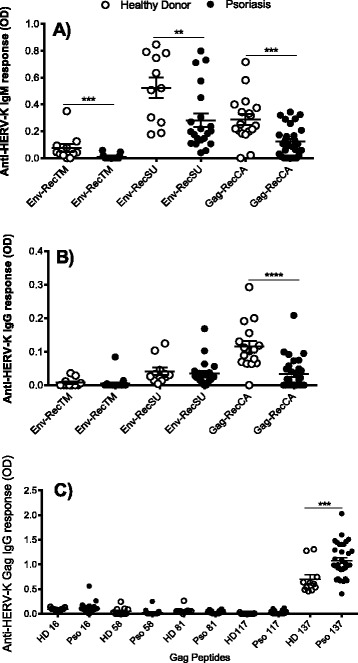
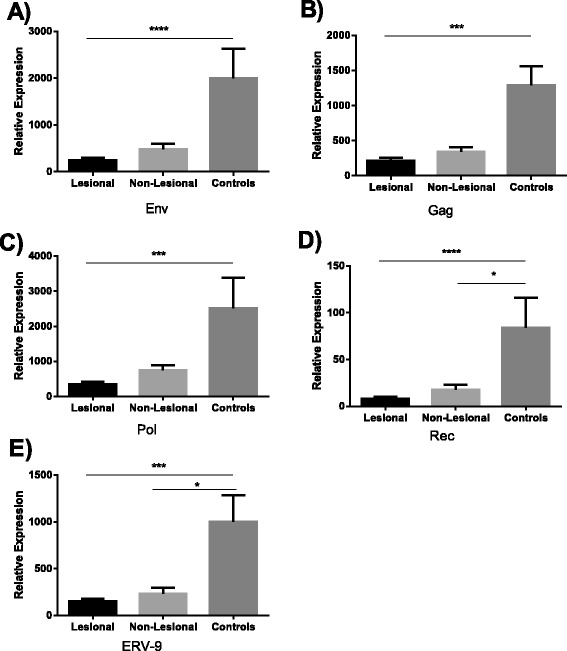
In psoriatic sera we observed a significant decrease in IgM response against three HERV-K proteins: Env surface unit (SU), Env transmembrane protein (TM), and Gag capsid (CA) in comparison to sera obtained from blood bank healthy controls. A decrease in IgG response was also observed against CA. Furthermore, using quantitative RT-PCR we observed a decrease in the expression of HERV-K Env, Gag, Pol and Rec as well as ERV-9 genes in lesional psoriatic skin as compared to healthy skin.
Together, our results suggest that the pro-inflammatory, anti-viral state in psoriasis is associated with diminished expression of HERV-K gene transcripts and a concomitant decrease in humoral responses to HERV-K. Our results indicate that a simple model where continuous, minimally changing HERV-K expression serves as an antigenic trigger in psoriasis might not be correct and further studies are needed to decipher the possible relationship between psoriasis and HERVs.
银屑病是一种多因素的慢性皮肤病,影响着全球2%-3%的人口。银屑病的遗传学研究已经确定了一些参与抗病毒免疫的易感基因。此外,生理学研究还发现银屑病皮肤中的抗病毒蛋白增加。这些发现提示银屑病皮肤中存在抗病毒状态。然而,这种抗病毒级联反应的触发因素及其对宿主免疫的影响尚不清楚。内源性逆转录病毒此前已在包括银屑病在内的许多自身免疫性疾病中被描述。
在本研究中,我们检测了银屑病患者和健康对照者针对人类内源性逆转录病毒-K(HERV-K)蛋白的体液免疫反应以及多个HERV-K基因的皮肤表达水平。
与从血库健康对照者获得的血清相比,我们观察到银屑病患者血清中针对三种HERV-K蛋白(Env表面单位(SU)、Env跨膜蛋白(TM)和Gag衣壳(CA))的IgM反应显著降低。针对CA的IgG反应也有所降低。此外,使用定量逆转录聚合酶链反应(qRT-PCR),我们观察到与健康皮肤相比,银屑病皮损皮肤中HERV-K Env、Gag、Pol和Rec以及ERV-9基因的表达降低。
总之,我们的结果表明,银屑病中的促炎抗病毒状态与HERV-K基因转录本表达减少以及对HERV-K的体液反应随之降低有关。我们的结果表明,一个简单的模型,即持续的、变化极小的HERV-K表达在银屑病中作为抗原触发因素,可能并不正确,需要进一步研究来阐明银屑病与HERV之间的可能关系。