Farrell Michael H, Christopher Stephanie A, La Pean Kirschner Alison, Roedl Sara J, O'Tool Faith O, Ahmad Nadia Y, Farrell Philip M
Center for Patient Care and Outcomes Research, Medical College of Wisconsin, Milwaukee, USA; Aurora University of Wisconsin Medical Group, Center for Urban Population Health, Milwaukee, USA; Program in Genomics and Ethics, Center for Bioethics and Medical Humanities, Medical College of Wisconsin, Milwaukee, USA; Department of Pediatrics, University of Wisconsin-Madison School of Medicine and Public Health, Madison, USA.
Center for Patient Care and Outcomes Research, Medical College of Wisconsin, Milwaukee, USA.
Patient Educ Couns. 2014 Nov;97(2):248-55. doi: 10.1016/j.pec.2014.07.028. Epub 2014 Aug 28.
Problems with clinician-patient communication negatively impact newborn screening, genetics, and all of healthcare. Training programs teach communication, but educational methods are not feasible for entire populations of clinicians. To address this healthcare quality gap, we developed a Communication Quality Assurance intervention.
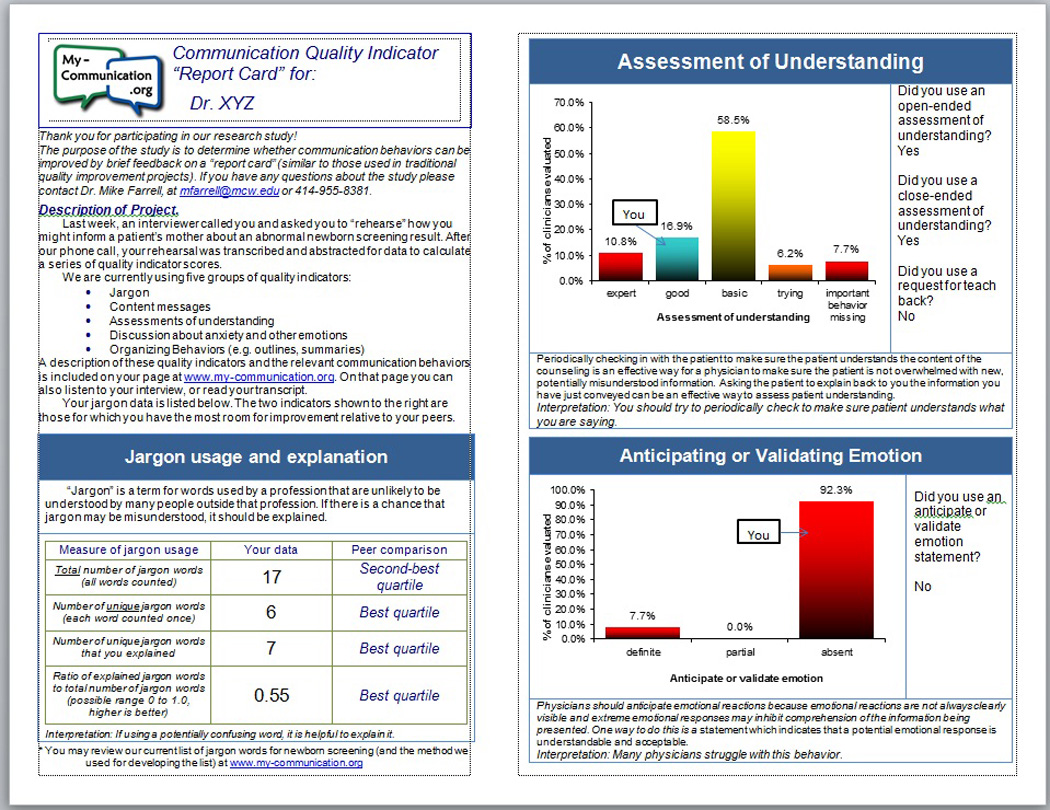
Child health providers volunteered for a randomized controlled trial of assessment and a report card. Participants provided telephone counseling to a standardized parent regarding a newborn screening result showing heterozygous status for cystic fibrosis or sickle cell disease. Our rapid-throughput timeline allows individualized feedback within a week. Two encounters were recorded (baseline and after a random sample received the report card) and abstracted for four groups of communication quality indicators.
92 participants finished both counseling encounters within our rapid-throughput time limits. Participants randomized to receive the report card improved communication behaviors more than controls, including request for teach-back (p<0.01), opening behaviors (p=0.01), anticipate/validate emotion (p<0.001) and the ratio of explained to unexplained jargon words (p<0.03).
The rapid-throughput report card is effective at improving specific communication behaviors.
Communication can be taught, but this project shows how healthcare organizations can assure communication quality everywhere. Further implementation could improve newborn screening, genetics, and healthcare in general.
医患沟通问题对新生儿筛查、遗传学及整个医疗保健领域都产生了负面影响。培训项目会教授沟通技巧,但教育方法对所有临床医生来说并不可行。为了弥补这一医疗质量差距,我们开发了一种沟通质量保证干预措施。
儿童健康服务提供者自愿参加一项关于评估和报告卡的随机对照试验。参与者就新生儿筛查结果(显示囊性纤维化或镰状细胞病的杂合状态)向一位标准化的家长提供电话咨询。我们快速处理的时间安排允许在一周内提供个性化反馈。记录了两次沟通情况(基线情况以及在随机抽取的一部分人收到报告卡之后),并提取了四组沟通质量指标。
92名参与者在我们快速处理的时间限制内完成了两次咨询。被随机分配接受报告卡的参与者在沟通行为方面的改善比对照组更大,包括要求家长反馈(p<0.01)、开场行为(p=0.01)、预测/确认情绪(p<0.001)以及已解释的行话与未解释的行话的比例(p<0.03)。
快速处理的报告卡在改善特定沟通行为方面是有效的。
沟通是可以教授的,但本项目展示了医疗保健机构如何在各个地方确保沟通质量。进一步实施可能会改善新生儿筛查、遗传学及总体医疗保健状况。