Morgan Eric E, Casabianca Andrew B, Khouri Samer J, Kalinoski Andrea L Nestor
Department of Surgery, University of Toledo, College of Medicine and Life Sciences, 3000 Arlington Ave,, Toledo, OH 43614, USA.
Cardiovasc Ultrasound. 2014 Sep 17;12:37. doi: 10.1186/1476-7120-12-37.
Rodent models are increasingly used to study the development and progression of arterial stiffness. Both the non-invasive Doppler derived Pulse Wave Velocity (PWV) and the invasively determined arterial elastance index (EaI) have been used to assess arterial stiffness in rats and mice, but the need for anesthetic agents to make these in vivo estimates may limit their utility. Thus, we sought to determine: 1) if known differences in arterial stiffness in spontaneously hypertensive rats (SHR) are detectable by PWV and EaI measurements when made under isoflurane anesthesia, and 2) if these two uniquely acquired assessments of arterial elasticity correlate.
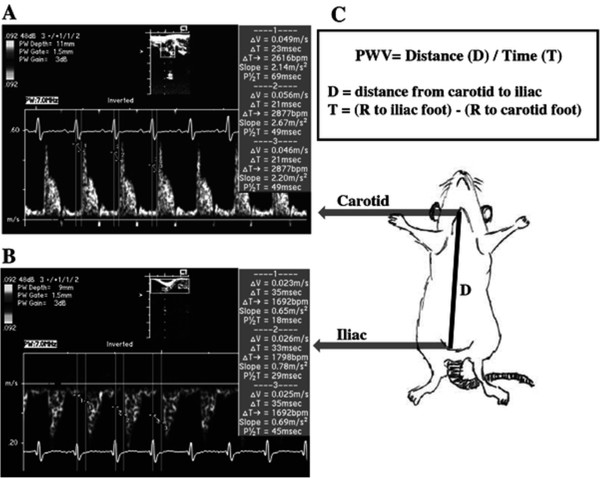
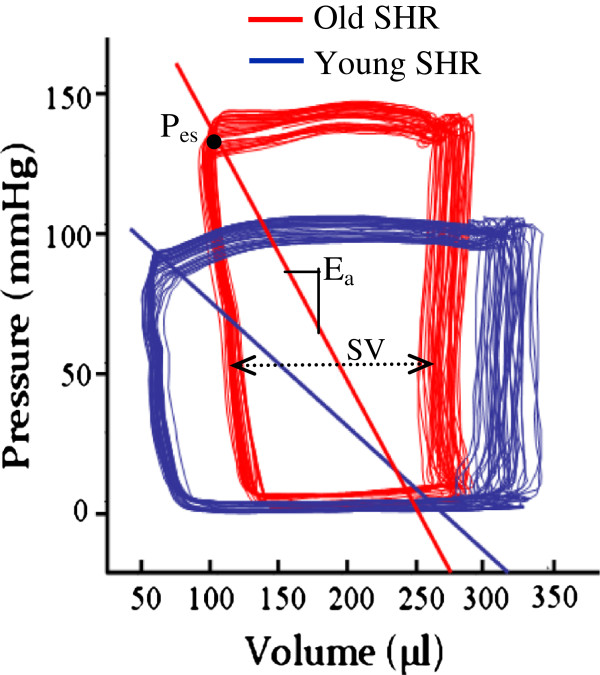
We obtained PWV and EaI measurements in isoflurane anesthetized young and old SHRs, which are known to have significant differences in arterial stiffness. Doppler pulse waves were recorded from carotid and iliac arteries and the distance (D) between probe applantation sites was recorded. Simultaneously, an EKG was obtained, and the time intervals between the R-wave of the EKG to the foot of the Doppler waveforms were measured and averaged over three cardiac cycles. Pulse-transit time (T) of the carotid to iliac artery was determined, and PWV was calculated as Distance (D)/Time (T), where D = the distance from the carotid to the iliac notch and T = (R to iliac foot) - (R to carotid foot). EaI was subsequently determined from pressure volumes loops obtained via left ventricle catheterization.
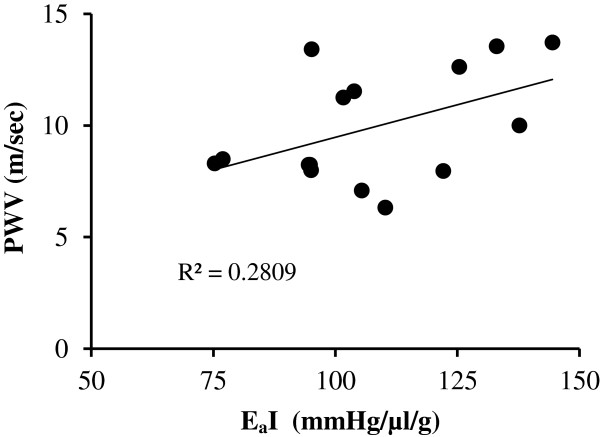
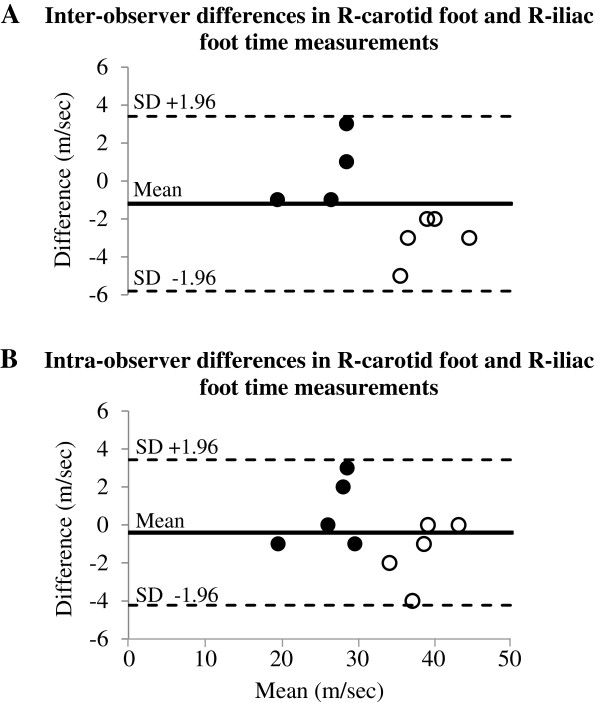
PWV and EaI were found to be significantly faster in the older rats (13.2 ± 2.0 vs. 8.0 ± 0.8 m/sec, p < 0.001; 120 ± 20 vs. 97 ± 16 mmHg/μl/g, p <0.05). Bland-Altman analyses of intra- and inter-observer measures demonstrate a statistically significant relationship between readings (p < 0.0001). PWV and EaI measurements were found to be significantly and positively correlated with a correlation coefficient of 0.53 (p < 0.05).
Our study suggests that isoflurane administration does not limit Doppler PWV or EaI measures in their ability to provide accurate, in vivo assessments of relative arterial stiffness in isoflurane anesthetised SHR rats. Furthermore, PWV data obtained in these rats correlate well with invasively determined EaI.
啮齿动物模型越来越多地用于研究动脉僵硬度的发展和进程。无创多普勒衍生的脉搏波速度(PWV)和有创测定的动脉弹性指数(EaI)都已用于评估大鼠和小鼠的动脉僵硬度,但进行这些体内评估时对麻醉剂的需求可能会限制其效用。因此,我们试图确定:1)在异氟烷麻醉下通过PWV和EaI测量能否检测出自发性高血压大鼠(SHR)已知的动脉僵硬度差异,以及2)这两种独特获得的动脉弹性评估是否相关。
我们在异氟烷麻醉的年轻和老年SHR中获得了PWV和EaI测量值,已知这些大鼠的动脉僵硬度存在显著差异。从颈动脉和髂动脉记录多普勒脉搏波,并记录探头放置部位之间 的距离(D)。同时,获取心电图,并测量心电图R波到多普勒波形波谷之间的时间间隔,并在三个心动周期内求平均值。确定从颈动脉到髂动脉的脉搏传播时间(T),并计算PWV为距离(D)/时间(T),其中D = 从颈动脉到髂骨切迹的距离,T =(R波到髂骨波谷的时间)-(R波到颈动脉波谷的时间)。随后通过左心室导管插入术获得的压力容积环确定EaI。
发现老年大鼠的PWV和EaI明显更快(13.2±2.0 vs. 8.0±0.8米/秒,p<0.001;120±20 vs. 97±16毫米汞柱/微升/克,p<0.05)。观察者内和观察者间测量的布兰德-奥特曼分析表明读数之间存在统计学显著关系(p<0.0001)。发现PWV和EaI测量值显著正相关,相关系数为0.53(p<0.05)。
我们的研究表明,异氟烷给药并不限制多普勒PWV或EaI测量在异氟烷麻醉的SHR大鼠中提供准确的体内相对动脉僵硬度评估的能力。此外,在这些大鼠中获得的PWV数据与有创测定的EaI相关性良好。