Antonio Liliane de Fátima, Fagundes Aline, Oliveira Raquel Vasconcellos Carvalhaes, Pinto Priscila Garcia, Bedoya-Pacheco Sandro Javier, Vasconcellos Erica de Camargo Ferreira e, Valete-Rosalino Maria Cláudia, Lyra Marcelo Rosandiski, Passos Sônia Regina Lambert, Pimentel Maria Inês Fernandes, Schubach Armando de Oliveira
Laboratório de Vigilância em Leishmanioses (Lab VigiLeish), Instituto de Pesquisa Clínica Evandro Chagas (IPEC)/Fiocruz, Brazil.
Laboratório de Epidemiologia Clínica (Lab. EpiClin), Instituto de Pesquisa Clínica Evandro Chagas (IPEC)/Fiocruz, Brazil.
Rev Inst Med Trop Sao Paulo. 2014 Sep-Oct;56(5):375-80. doi: 10.1590/s0036-46652014000500002.
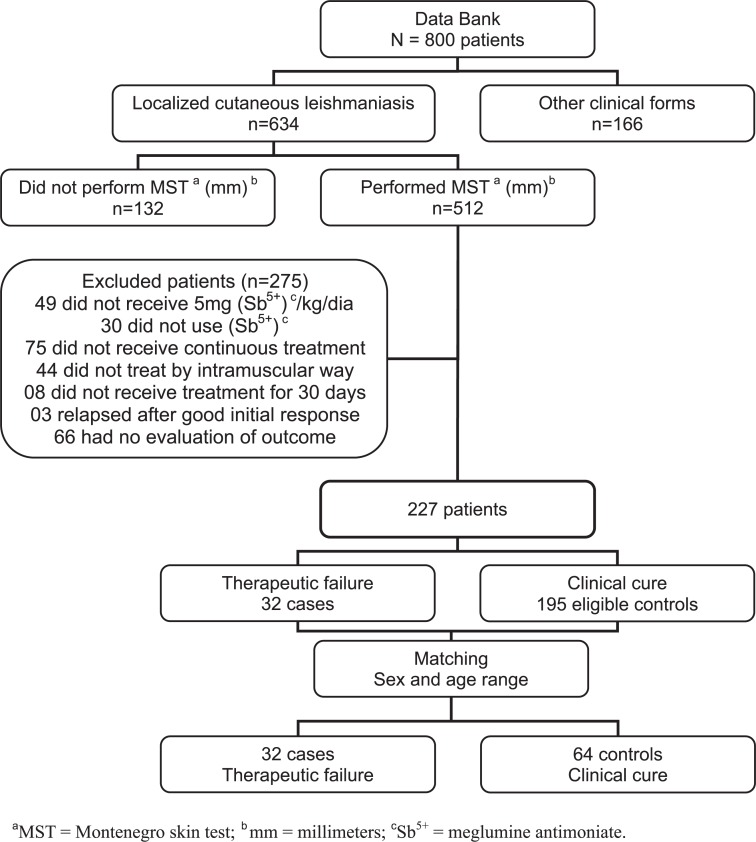
A case-control study was conducted to examine the association among the Montenegro skin test (MST), age of skin lesion and therapeutic response in patients with cutaneous leishmaniasis (CL) treated at Evandro Chagas National Institute of Infectious Diseases (INI), Oswaldo Cruz Foundation (FIOCRUZ), Rio de Janeiro, Brazil. For each treatment failure (case), two controls showing skin lesion healing following treatment, paired by sex and age, were randomly selected. All patients were treated with 5 mg Sb(5+)/kg/day of intramuscular meglumine antimoniate (Sb(5+)) for 30 successive days. Patients with CL were approximately five times more likely to fail when lesions were less than two months old at the first appointment. Patients with treatment failure showed less intense MST reactions than patients progressing to clinical cure. For each 10 mm of increase in MST response, there was a 26% reduction in the chance of treatment failure. An early treatment - defined as a treatment applied for skin lesions, which starts when they are less than two months old at the first appointment -, as well as a poor cellular immune response, reflected by lower reactivity in MST, were associated with treatment failure in cutaneous leishmaniasis.
在巴西里约热内卢奥斯瓦尔多·克鲁兹基金会(FIOCRUZ)的埃万德罗·查加斯国家传染病研究所(INI),开展了一项病例对照研究,以探讨皮肤利什曼病(CL)患者的黑山皮肤试验(MST)、皮损年龄与治疗反应之间的关联。对于每例治疗失败的患者(病例),随机选取两名在治疗后皮损愈合的对照,按性别和年龄进行配对。所有患者均连续30天接受每日5 mg Sb(5+)/kg的肌肉注射葡甲胺锑酸盐(Sb(5+))治疗。首次就诊时皮损小于两个月的CL患者治疗失败的可能性约为其他患者的五倍。治疗失败的患者比临床治愈的患者MST反应强度更低。MST反应每增加10 mm,治疗失败的几率就降低26%。早期治疗(定义为在首次就诊时皮损小于两个月时开始针对皮肤病变进行的治疗)以及MST反应性较低所反映的细胞免疫反应不佳,均与皮肤利什曼病的治疗失败有关。