Yu Rongqin, Branje Susan, Keijsers Loes, Meeus Wim H J
Research Centre Adolescent Development, Utrecht University, Utrecht, the Netherlands.
Research Centre Adolescent Development, Utrecht University, Utrecht, the Netherlands; Department of Developmental Psychology, Tilburg University, Tilburg, the Netherlands.
PLoS One. 2014 Sep 18;9(9):e102078. doi: 10.1371/journal.pone.0102078. eCollection 2014.
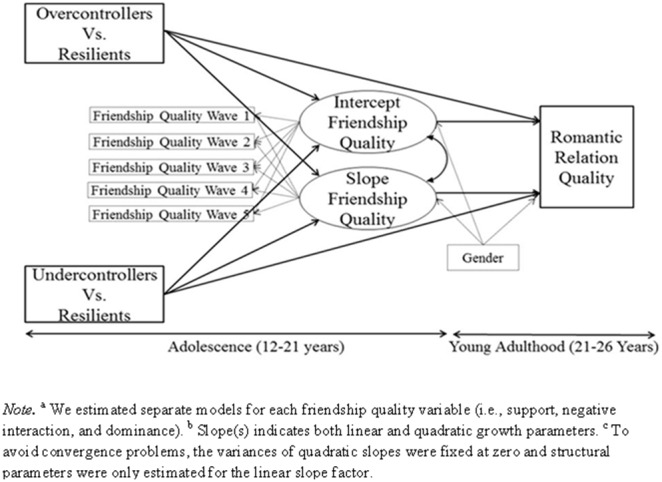
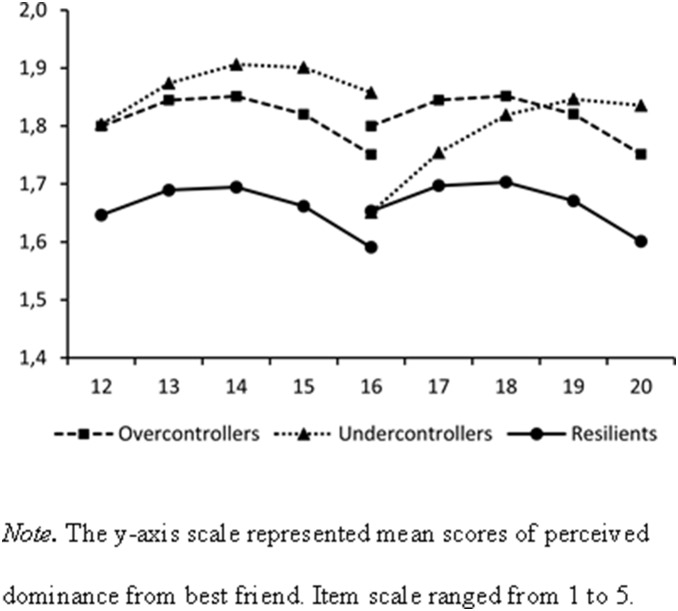
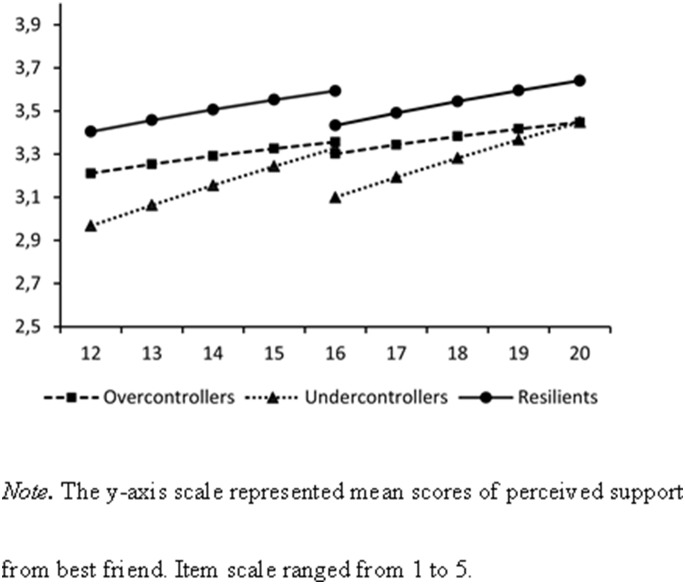
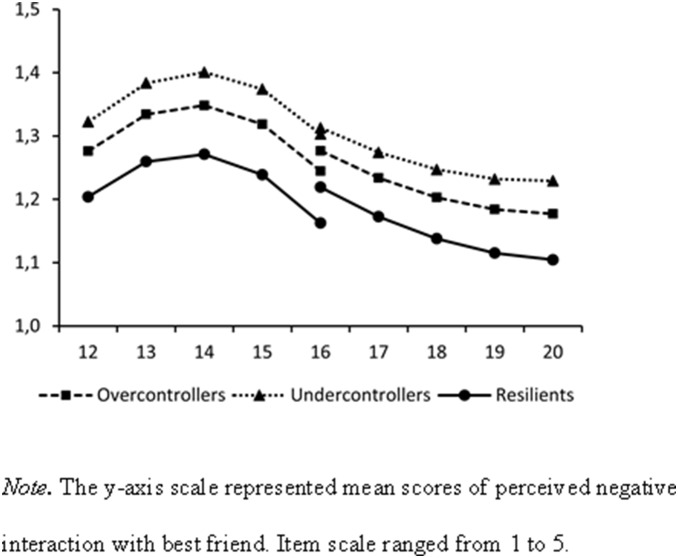
This study examined whether individuals with different personality types (i.e., overcontrollers, undercontrollers, resilients) had different friendship quality development throughout adolescence. It also investigated whether personality types were indirectly related to romantic relationship quality in young adulthood, via friendship quality development in adolescence. The study employed six waves of longitudinal questionnaire data from Dutch youths who had a romantic relationship when they were young adults. Two age cohorts were followed, from 12 to 21 years and from 16 to 25 years, respectively. Findings showed that resilients reported higher mean levels of friendship quality during adolescence (i.e., more support from, less negative interaction with and less dominance from their best friend) than both overcontrollers and undercontrollers. Through the mean levels of friendship quality throughout adolescence, resilients indirectly experienced higher romantic relationship quality during young adulthood than both overcontrollers and undercontrollers. Thus, results provide support for a developmental model in which adolescent friendship quality is a mechanism linking personality types with young adulthood romantic relationship quality.
本研究考察了不同性格类型(即过度控制型、控制不足型、适应良好型)的个体在整个青春期的友谊质量发展是否存在差异。研究还调查了性格类型是否通过青春期的友谊质量发展与青年期的恋爱关系质量存在间接关联。该研究采用了来自荷兰青年的六波纵向问卷调查数据,这些青年在成年早期处于恋爱关系中。分别跟踪了两个年龄组,从12岁到21岁以及从16岁到25岁。研究结果表明,适应良好型个体在青春期报告的友谊质量平均水平高于过度控制型和控制不足型个体(即从最好的朋友那里得到更多支持、与最好的朋友有更少的负面互动以及更少受其支配)。通过整个青春期的友谊质量平均水平,适应良好型个体在成年早期间接体验到比过度控制型和控制不足型个体更高的恋爱关系质量。因此,研究结果为一个发展模型提供了支持,在该模型中,青少年友谊质量是将性格类型与成年早期恋爱关系质量联系起来的一种机制。