Li Qi, Saiki Jun
Graduate School of Human and Environmental Studies, Kyoto University Kyoto, Japan.
Front Psychol. 2014 Sep 4;5:965. doi: 10.3389/fpsyg.2014.00965. eCollection 2014.
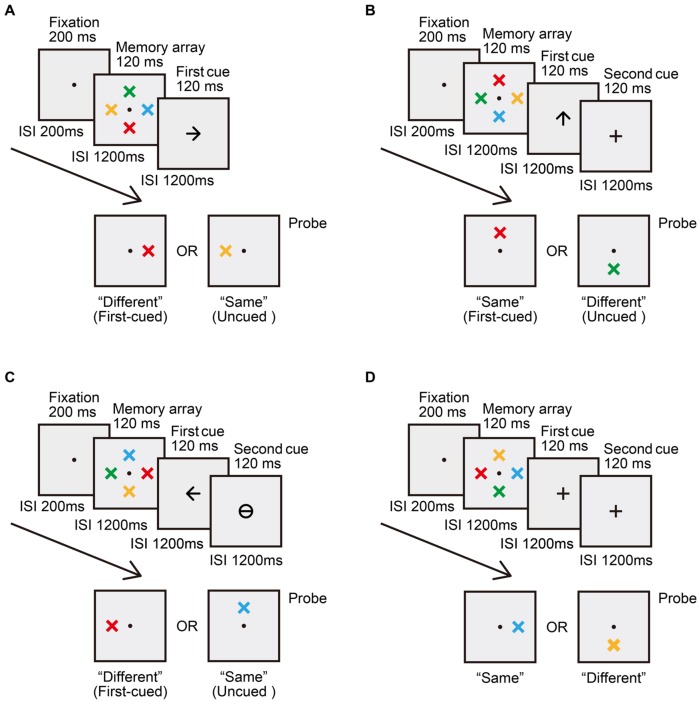
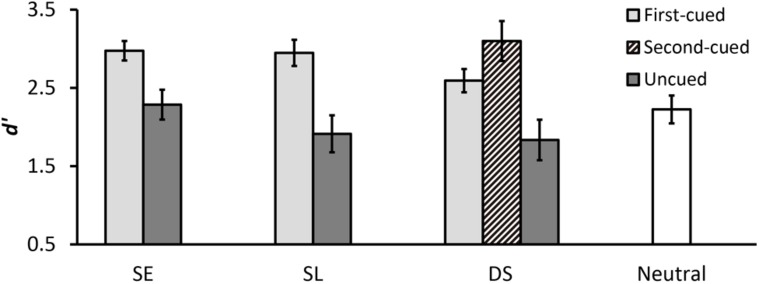
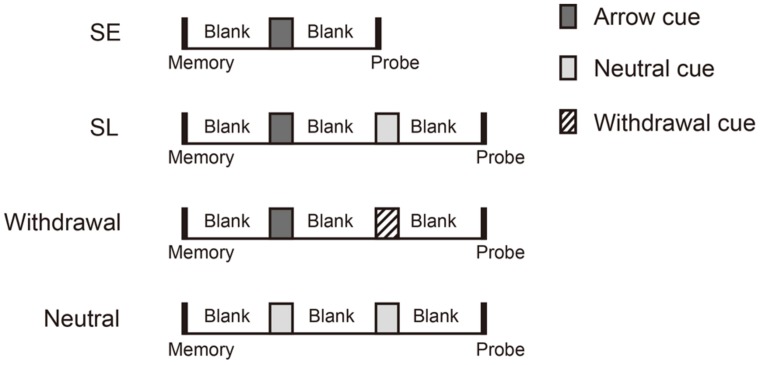
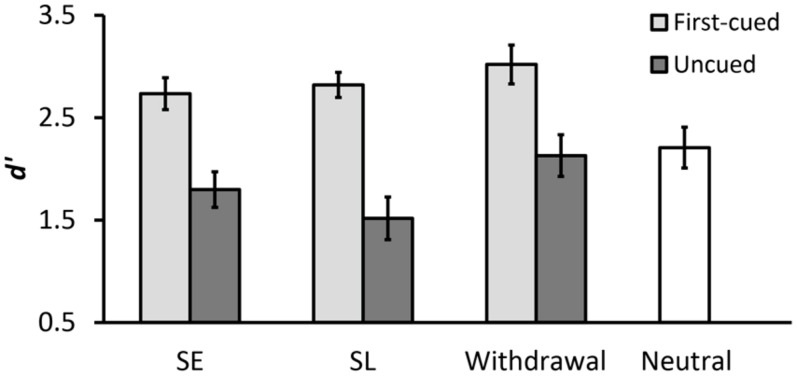
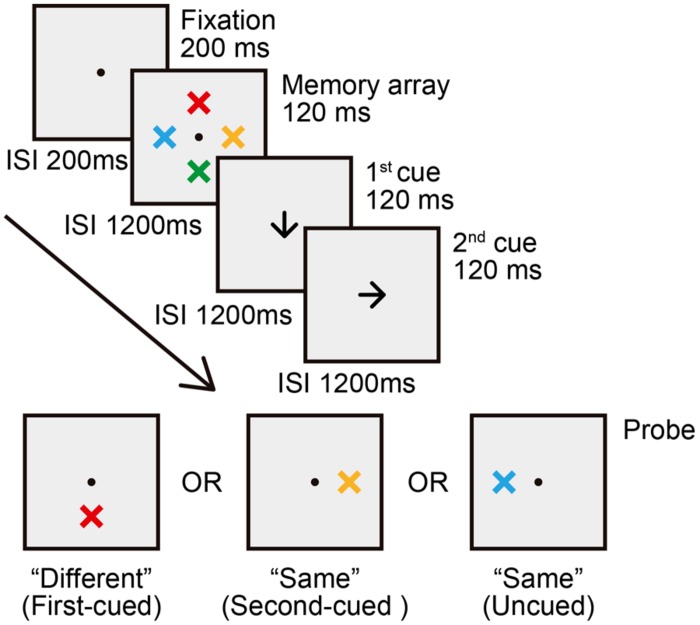
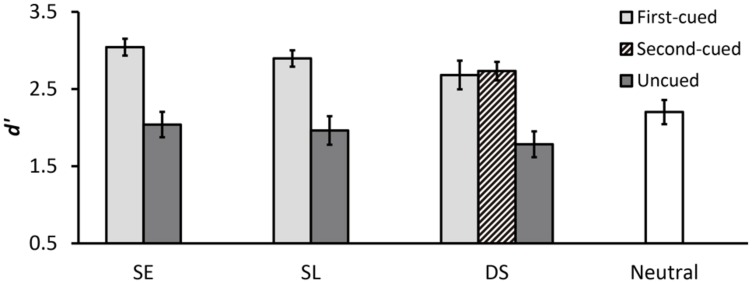
Previous studies have shown conflicting data as to whether it is possible to sequentially shift spatial attention among visual working memory (VWM) representations. The present study investigated this issue by asynchronously presenting attentional cues during the retention interval of a change detection task. In particular, we focused on two types of sequential attention shifts: (1) orienting attention to one location, and then withdrawing attention from it, and (2) switching the focus of attention from one location to another. In Experiment 1, a withdrawal cue was presented after a spatial retro-cue to measure the effect of withdrawing attention. The withdrawal cue significantly reduced the cost of invalid spatial cues, but surprisingly, did not attenuate the benefit of valid spatial cues. This indicates that the withdrawal cue only triggered the activation of facilitative components but not inhibitory components of attention. In Experiment 2, two spatial retro-cues were presented successively to examine the effect of switching the focus of attention. We observed equivalent benefits of the first and second spatial cues, suggesting that participants were able to reorient attention from one location to another within VWM, and the reallocation of attention did not attenuate memory at the first-cued location. In Experiment 3, we found that reducing the validity of the preceding spatial cue did lead to a significant reduction in its benefit. However, performance was still better at first-cued locations than at uncued and neutral locations, indicating that the first cue benefit might have been preserved both partially under automatic control and partially under voluntary control. Our findings revealed new properties of dynamic attentional control in VWM maintenance.
以往的研究对于是否能够在视觉工作记忆(VWM)表征之间顺序性地转移空间注意力给出了相互矛盾的数据。本研究通过在变化检测任务的保持间隔期间异步呈现注意力提示来调查这个问题。具体而言,我们关注两种类型的顺序性注意力转移:(1)将注意力导向一个位置,然后从该位置撤回注意力,以及(2)将注意力焦点从一个位置切换到另一个位置。在实验1中,在空间回溯提示之后呈现一个撤回提示,以测量撤回注意力的效果。撤回提示显著降低了无效空间提示的代价,但令人惊讶的是,并没有减弱有效空间提示的益处。这表明撤回提示仅触发了注意力促进成分的激活,而未触发抑制成分的激活。在实验2中,相继呈现两个空间回溯提示,以检查注意力焦点切换的效果。我们观察到第一个和第二个空间提示具有同等的益处,这表明参与者能够在VWM中将注意力从一个位置重新定向到另一个位置,并且注意力的重新分配并未减弱第一个提示位置处的记忆。在实验3中,我们发现降低前一个空间提示的有效性确实导致其益处显著降低。然而,在第一个提示位置的表现仍然优于未提示和中性位置,这表明第一个提示的益处可能部分在自动控制下得以保留,部分在自主控制下得以保留。我们的研究结果揭示了VWM维持中动态注意力控制的新特性。