Gressmann Marcel, Janczyk Markus
Department of Psychology III, Julius Maximilians University of Würzburg Würzburg, Germany.
Department of Psychology, Eberhard Karls University of Tübingen Tübingen, Germany.
Front Psychol. 2016 Mar 31;7:244. doi: 10.3389/fpsyg.2016.00244. eCollection 2016.
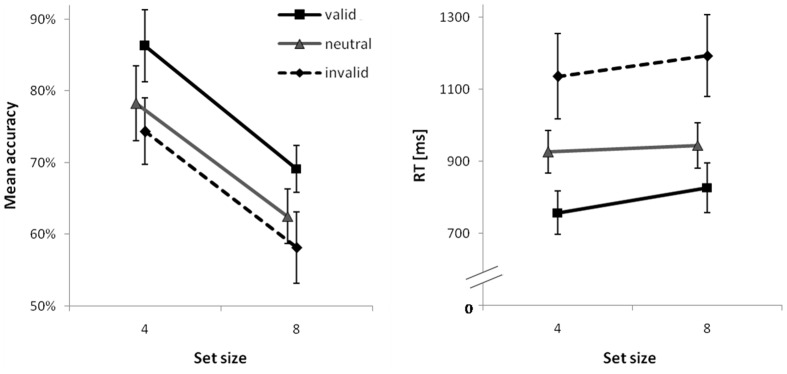
Studies with the retro-cue paradigm have shown that validly cueing objects in visual working memory long after encoding can still benefit performance on subsequent change detection tasks. With regard to the effects of invalid cues, the literature is less clear. Some studies reported costs, others did not. We here revisit two recent studies that made interesting suggestions concerning invalid retro-cues: One study suggested that costs only occur for larger set sizes, and another study suggested that inclusion of invalid retro-cues diminishes the retro-cue benefit. New data from one experiment and a reanalysis of published data are provided to address these conclusions. The new data clearly show costs (and benefits) that were independent of set size, and the reanalysis suggests no influence of the inclusion of invalid retro-cues on the retro-cue benefit. Thus, previous interpretations may be taken with some caution at present.
采用后线索范式的研究表明,在编码后很长时间对视觉工作记忆中的物体进行有效线索提示,仍能提高后续变化检测任务的表现。关于无效线索的影响,相关文献的结论不太明确。一些研究报告了成本,另一些则没有。我们在此重新审视两项近期的研究,它们对无效后线索提出了有趣的观点:一项研究表明,成本仅在较大集合规模时出现,另一项研究表明,包含无效后线索会减少后线索带来的益处。本文提供了一个实验的新数据以及对已发表数据的重新分析,以探讨这些结论。新数据清楚地显示了与集合规模无关的成本(和益处),重新分析表明,包含无效后线索对后线索益处没有影响。因此,目前对先前的解释可能需要谨慎对待。