Kim Seo Hwa, Baek Moon Seong, Yoon Dong Sik, Park Jong Seol, Yoon Byoung Wook, Oh Byoung Su, Park Jinkyeong, Kim Hui Jung
Department of Internal Medicine, Wonkwang University Sanbon Hospital, Wonkwang University College of Medicine, Gunpo, Korea.
Tuberc Respir Dis (Seoul). 2014 Aug;77(2):73-80. doi: 10.4046/trd.2014.77.2.73. Epub 2014 Aug 29.
Low levels of serum vitamin D is associated with several lung diseases. The production and activation of matrix metalloproteinases (MMPs) may play an important role in the pathogenesis of emphysema. The aim of the current study therefore is to investigate if vitamin D modulates the expression and activation of MMP-2 and MMP-9 in human lung fibroblasts (HFL-1) cells.
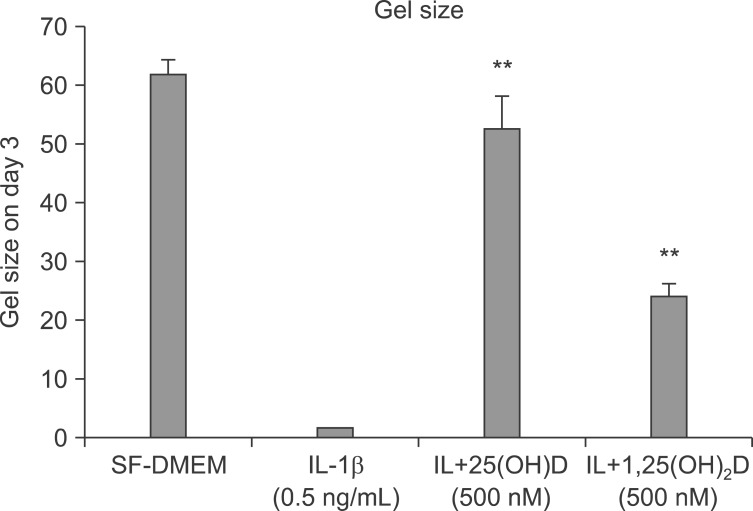
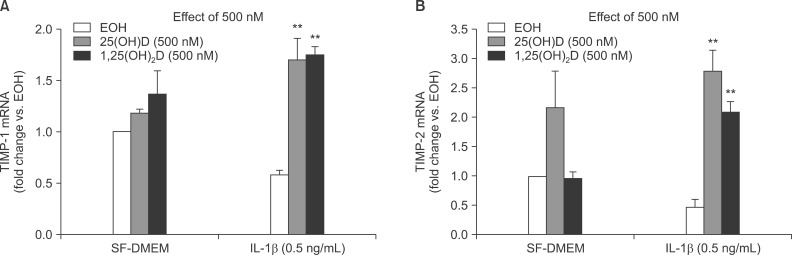
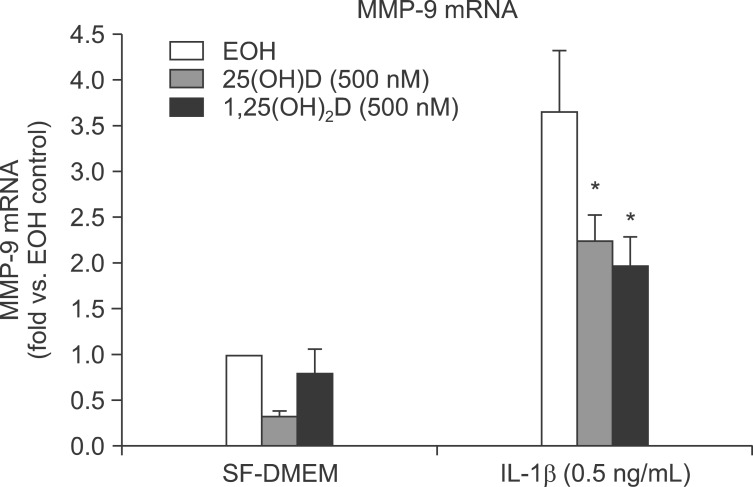
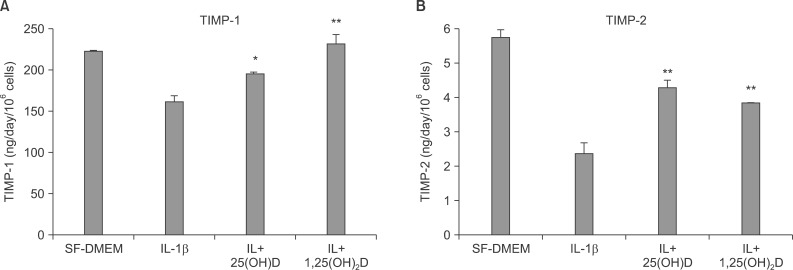
HFL-1 cells were cast into three-dimensional collagen gels and stimulated with or without interleukin-1β (IL-1β) in the presence or absence of 100 nM 25-hydroxyvitamin D (25(OH)D) or 1,25-dihydroxyvitamin D (1,25(OH)2D) for 48 hours. Trypsin was then added into the culture medium in order to activate MMPs. To investigate the activity of MMP-2 and MMP-9, gelatin zymography was performed. The expression of the tissue inhibitor of metalloproteinase (TIMP-1, TIMP-2) was measured by enzyme-linked immunosorbent assay. Expression of MMP-9 mRNA and TIMP-1, TIMP-2 mRNA was quantified by real time reverse transcription polymerase chain reaction.
IL-1β significantly stimulated MMP-9 production and mRNA expression. Trypsin converted latent MMP-2 and MMP-9 into their active forms of MMP-2 (66 kDa) and MMP-9 (82 kDa) within 24 hours. This conversion was significantly inhibited by 25(OH)D (100 nM) and 1,25(OH)2D (100 nM). The expression of MMP-9 mRNA was also significantly inhibited by 25(OH)D and 1,25(OH)2D.
Vitamin D, 25(OH)D, and 1,25(OH)2D play a role in regulating human lung fibroblast functions in wound repair and tissue remodeling through not only inhibiting IL-1β stimulated MMP-9 production and conversion to its active form but also inhibiting IL-1β inhibition on TIMP-1 and TIMP-2 production.
血清维生素D水平低与多种肺部疾病相关。基质金属蛋白酶(MMPs)的产生和激活可能在肺气肿的发病机制中起重要作用。因此,本研究的目的是调查维生素D是否调节人肺成纤维细胞(HFL-1)中MMP-2和MMP-9的表达及激活。
将HFL-1细胞接种到三维胶原凝胶中,在有或无100 nM 25-羟基维生素D(25(OH)D)或1,25-二羟基维生素D(1,25(OH)2D)存在的情况下,用或不用白细胞介素-1β(IL-1β)刺激48小时。然后向培养基中加入胰蛋白酶以激活MMPs。为研究MMP-2和MMP-9的活性,进行了明胶酶谱分析。通过酶联免疫吸附测定法检测金属蛋白酶组织抑制剂(TIMP-1、TIMP-2)的表达。通过实时逆转录聚合酶链反应定量MMP-9 mRNA以及TIMP-1、TIMP-2 mRNA的表达。
IL-1β显著刺激MMP-9的产生和mRNA表达。胰蛋白酶在24小时内将无活性的MMP-2和MMP-9转化为其活性形式的MMP-2(66 kDa)和MMP-9(82 kDa)。这种转化受到25(OH)D(100 nM)和1,25(OH)2D(100 nM)的显著抑制。25(OH)D和1,25(OH)2D也显著抑制MMP-9 mRNA的表达。
维生素D、25(OH)D和1,25(OH)2D在调节人肺成纤维细胞在伤口修复和组织重塑中的功能方面发挥作用,不仅通过抑制IL-1β刺激的MMP-9产生及其向活性形式的转化,还通过抑制IL-1β对TIMP-1和TIMP-2产生的抑制作用。