Aryana Parastou, Rajaei Samira, Bagheri Abdolhamid, Karimi Forouzan, Dabbagh Ali
Anesthesiology Research Center, Shahid Beheshti University of Medical Sciences, Tehran, Iran.
Immunology Department, School of Medicine, Tehran University of Medical Sciences, Tehran, Iran.
Anesth Pain Med. 2014 Jun 17;4(3):e16316. doi: 10.5812/aapm.16316. eCollection 2014 Aug.
Cardiovascular problems are among the most common health issues. A considerable number of cardiac patients undergo cardiac surgery, and coronary artery disease patients constitute about two-thirds of all these surgeries. The application of cardiopulmonary bypass (CBP) usually results in some untoward effects.
Studies have suggested magnesium sulfate (MgSO4) as an anti-inflammatory agent in a coronary artery bypass graft (CABG). This study aimed to assess the effect of an IV MgSO4 infusion during elective CABG (with CBP) on the blood levels of interleukin-6 (IL-6) and tumor necrosis factor alpha (TNF-α).
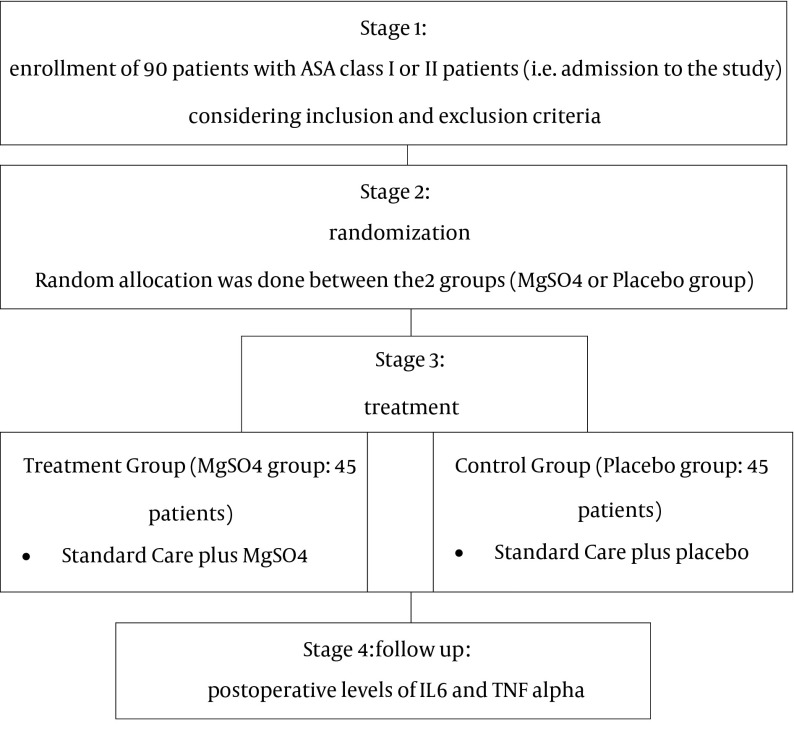
During a 12 month period, after review board approval and based on inclusion and exclusion criteria, 90 patients were selected and entered randomly into one of the two study groups (MgSO4 or placebo). Anesthesia, surgery and CBP were performed in exactly the same way, except for the use of MgSO4 or a placebo. Both preoperative and postoperative plasma levels of IL-6 and TNF-α were checked and compared between the two groups using an ELISA.
There was no difference found between the two groups with regard to; gender, basic variables, Ejection Fraction (EF), CBP time and aortic cross-clamp time. The preoperative levels of IL-6 and TNF-α were not different; however, their postoperative levels were significantly higher in the placebo group (P value = 0.01 for IL-6 and 0.005 for TNF-α).
This study showed that MgSO4 infusion could suppress part of the inflammatory response after CABG with CBP. This was demonstrated by decreased levels of interleukin-6 and TNF-α in postoperative serum levels in elective CABG with CBP.
心血管问题是最常见的健康问题之一。相当数量的心脏病患者接受心脏手术,其中冠状动脉疾病患者约占所有这些手术的三分之二。体外循环(CBP)的应用通常会产生一些不良影响。
研究表明硫酸镁(MgSO4)可作为冠状动脉旁路移植术(CABG)中的抗炎剂。本研究旨在评估择期CABG(使用CBP)期间静脉输注MgSO4对白细胞介素-6(IL-6)和肿瘤坏死因子α(TNF-α)血液水平的影响。
在12个月期间,经审查委员会批准并根据纳入和排除标准,选择90例患者并随机分为两个研究组之一(MgSO4组或安慰剂组)。除了使用MgSO4或安慰剂外,麻醉、手术和CBP的操作方式完全相同。使用酶联免疫吸附测定法(ELISA)检查并比较两组术前和术后血浆中IL-6和TNF-α的水平。
两组在性别、基本变量、射血分数(EF)、CBP时间和主动脉阻断时间方面没有差异。术前IL-6和TNF-α的水平没有差异;然而,安慰剂组术后这些指标的水平显著更高(IL-6的P值=0.01,TNF-α的P值=0.005)。
本研究表明,在使用CBP的CABG术后,输注MgSO4可抑制部分炎症反应。这在使用CBP的择期CABG术后血清中白细胞介素-6和肿瘤坏死因子-α水平降低得到了证实。