van Blitterswijk Marka, Mullen Bianca, Wojtas Aleksandra, Heckman Michael G, Diehl Nancy N, Baker Matthew C, DeJesus-Hernandez Mariely, Brown Patricia H, Murray Melissa E, Hsiung Ging-Yuek R, Stewart Heather, Karydas Anna M, Finger Elizabeth, Kertesz Andrew, Bigio Eileen H, Weintraub Sandra, Mesulam Marsel, Hatanpaa Kimmo J, White Charles L, Neumann Manuela, Strong Michael J, Beach Thomas G, Wszolek Zbigniew K, Lippa Carol, Caselli Richard, Petrucelli Leonard, Josephs Keith A, Parisi Joseph E, Knopman David S, Petersen Ronald C, Mackenzie Ian R, Seeley William W, Grinberg Lea T, Miller Bruce L, Boylan Kevin B, Graff-Radford Neill R, Boeve Bradley F, Dickson Dennis W, Rademakers Rosa
Department of Neuroscience, Mayo Clinic, 4500 San Pablo Road, Jacksonville, FL 32224, USA.
Mol Neurodegener. 2014 Sep 20;9:38. doi: 10.1186/1750-1326-9-38.
Hexanucleotide repeat expansions in chromosome 9 open reading frame 72 (C9ORF72) are causative for frontotemporal dementia (FTD) and motor neuron disease (MND). Substantial phenotypic heterogeneity has been described in patients with these expansions. We set out to identify genetic modifiers of disease risk, age at onset, and survival after onset that may contribute to this clinical variability.
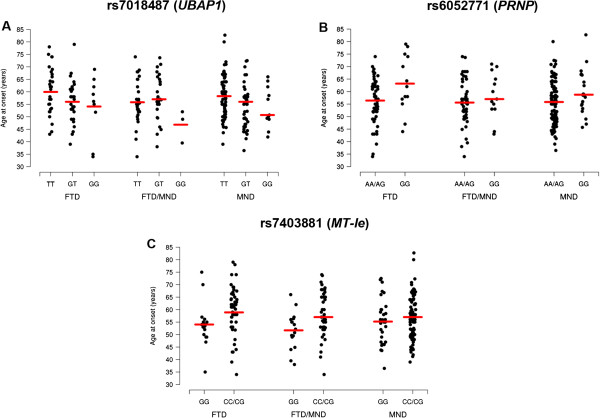
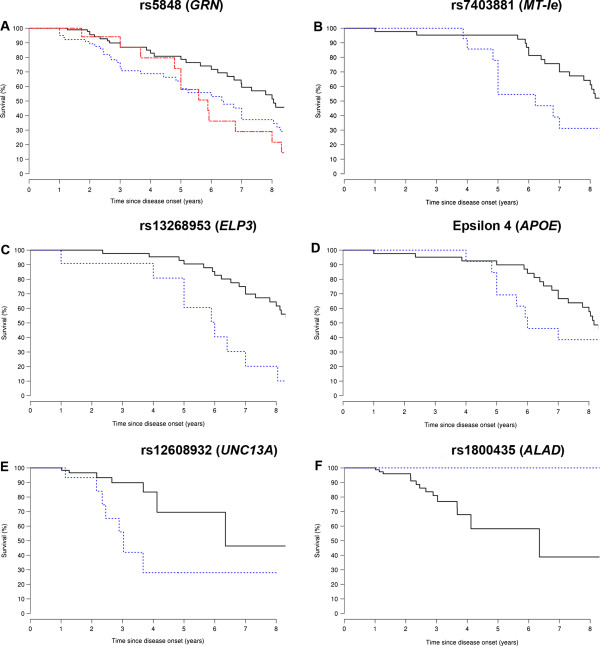
We examined a cohort of 330 C9ORF72 expansion carriers and 374 controls. In these individuals, we assessed variants previously implicated in FTD and/or MND; 36 variants were included in our analysis. After adjustment for multiple testing, our analysis revealed three variants significantly associated with age at onset (rs7018487 [UBAP1; p-value = 0.003], rs6052771 [PRNP; p-value = 0.003], and rs7403881 [MT-Ie; p-value = 0.003]), and six variants significantly associated with survival after onset (rs5848 [GRN; p-value = 0.001], rs7403881 [MT-Ie; p-value = 0.001], rs13268953 [ELP3; p-value = 0.003], the epsilon 4 allele [APOE; p-value = 0.004], rs12608932 [UNC13A; p-value = 0.003], and rs1800435 [ALAD; p-value = 0.003]).
Variants identified through this study were previously reported to be involved in FTD and/or MND, but we are the first to describe their effects as potential disease modifiers in the presence of a clear pathogenic mutation (i.e. C9ORF72 repeat expansion). Although validation of our findings is necessary, these variants highlight the importance of protein degradation, antioxidant defense and RNA-processing pathways, and additionally, they are promising targets for the development of therapeutic strategies and prognostic tests.
9号染色体开放阅读框72(C9ORF72)中的六核苷酸重复扩增是额颞叶痴呆(FTD)和运动神经元病(MND)的病因。这些扩增患者中已描述了显著的表型异质性。我们着手确定可能导致这种临床变异性的疾病风险、发病年龄和发病后存活的遗传修饰因子。
我们检查了330名C9ORF72扩增携带者和374名对照的队列。在这些个体中,我们评估了先前与FTD和/或MND相关的变异;我们的分析纳入了36个变异。在对多重检验进行校正后,我们的分析揭示了三个与发病年龄显著相关的变异(rs7018487 [UBAP1;p值 = 0.003]、rs6052771 [PRNP;p值 = 0.003]和rs7403881 [MT-Ie;p值 = 0.003]),以及六个与发病后存活显著相关的变异(rs5848 [GRN;p值 = 0.001]、rs7403881 [MT-Ie;p值 = 0.001]、rs13268953 [ELP3;p值 = 0.003]、ε4等位基因 [APOE;p值 = 0.004]、rs12608932 [UNC13A;p值 = 0.003]和rs1800435 [ALAD;p值 = 0.003])。
通过本研究鉴定的变异先前报道与FTD和/或MND有关,但我们是首个将其在存在明确致病突变(即C9ORF72重复扩增)的情况下作为潜在疾病修饰因子的作用进行描述的。尽管有必要对我们的发现进行验证,但这些变异突出了蛋白质降解、抗氧化防御和RNA加工途径的重要性,此外,它们是治疗策略和预后测试开发的有前景的靶点。