Department of Neuroscience, Mayo Clinic, Jacksonville, FL, USA.
Lancet Neurol. 2013 Oct;12(10):978-88. doi: 10.1016/S1474-4422(13)70210-2. Epub 2013 Sep 5.
Hexanucleotide repeat expansions in chromosome 9 open reading frame 72 (C9ORF72) are the most common known genetic cause of frontotemporal dementia (FTD) and motor neuron disease (MND). We assessed whether expansion size is associated with disease severity or phenotype.
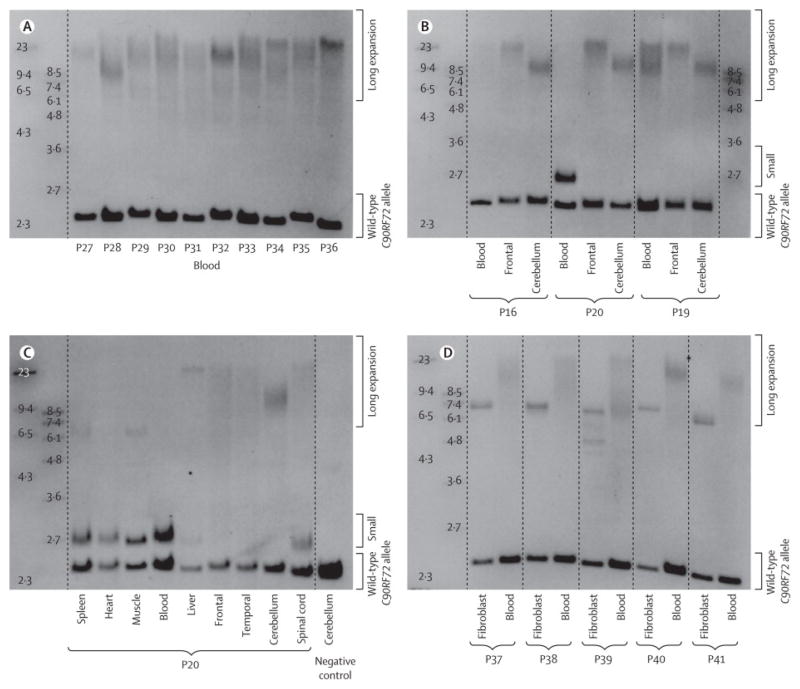
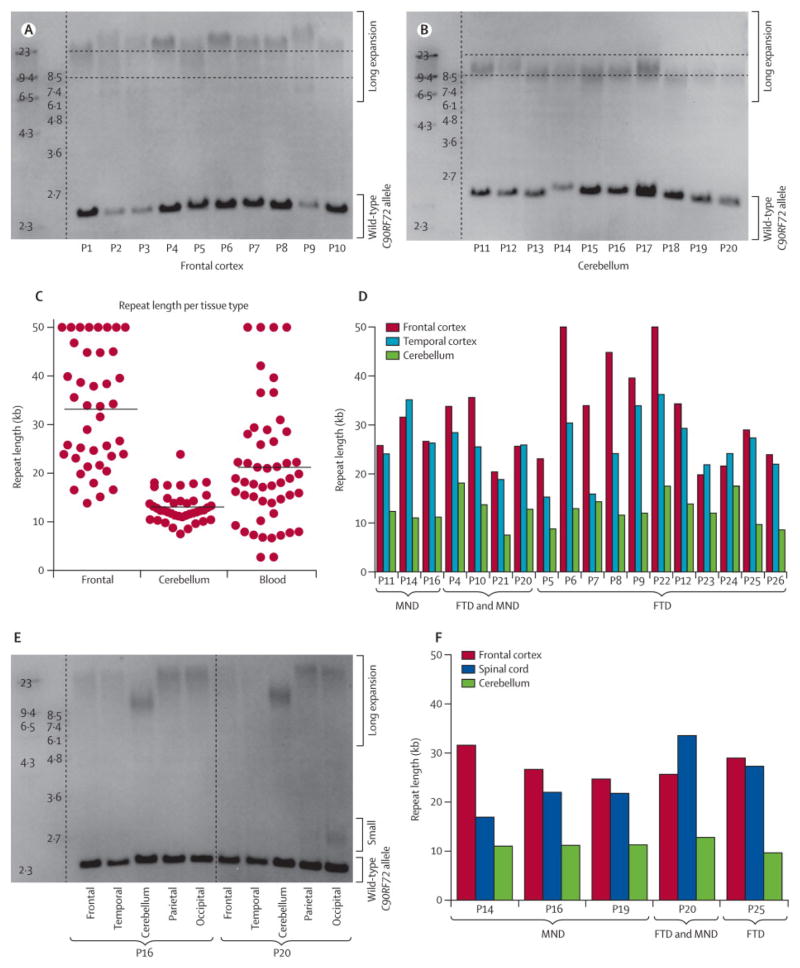
We did a cross-sectional Southern blot characterisation study (Xpansize-72) in a cohort of individuals with FTD, MND, both these diseases, or no clinical phenotype. All participants had GGGGCC repeat expansions in C9ORF72, and high quality DNA was available from one or more of the frontal cortex, cerebellum, or blood. We used Southern blotting techniques and densitometry to estimate the repeat size of the most abundant expansion species. We compared repeat sizes between different tissues using Wilcoxon rank sum and Wilcoxon signed rank tests, and between disease subgroups using Kruskal-Wallis rank sum tests. We assessed the association of repeat size with age at onset and age at collection using a Spearman's test of correlation, and assessed the association between repeat size and survival after disease onset using Cox proportional hazards regression models.
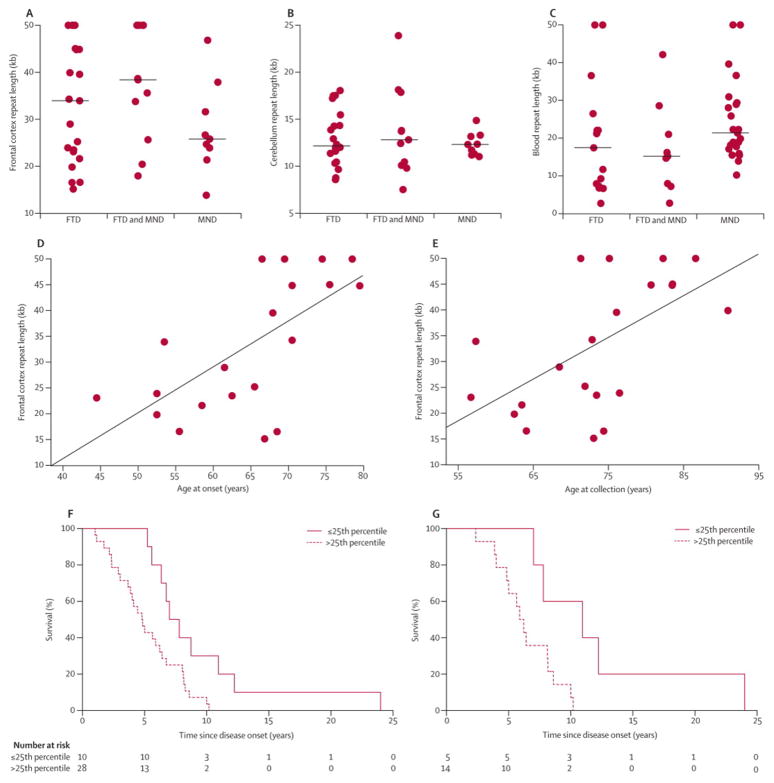
We included 84 individuals with C9ORF72 expansions: 35 had FTD, 16 had FTD and MND, 30 had MND, and three had no clinical phenotype. We focused our analysis on three major tissue subgroups: frontal cortex (available from 41 patients [21 with FTD, 11 with FTD and MND, and nine with MND]), cerebellum (40 patients [20 with FTD, 12 with FTD and MND, and eight with MND]), and blood (47 patients [15 with FTD, nine with FTD and MND, and 23 with MND] and three carriers who had no clinical phenotype). Repeat lengths in the cerebellum were smaller (median 12·3 kb [about 1667 repeat units], IQR 11·1-14·3) than those in the frontal cortex (33·8 kb [about 5250 repeat units], 23·5-44·9; p<0·0001) and those in blood (18·6 kb [about 2717 repeat units], 13·9-28·1; p=0·0002). Within these tissues, we detected no difference in repeat length between disease subgroups (cerebellum p=0·96, frontal cortex p=0·27, blood p=0·10). In the frontal cortex of patients with FTD, repeat length correlated with age at onset (r=0·63; p=0·003) and age at sample collection (r=0·58; p=0·006); we did not detect such a correlation in samples from the cerebellum or blood. When assessing cerebellum samples from the overall cohort, survival after disease onset was 4·8 years (IQR 3·0-7·4) in the group with expansions greater than 1467 repeat units (the 25th percentile of repeat lengths) versus 7·4 years (6·3-10·9) in the group with smaller expansions (HR 3·27, 95% CI 1·34-7·95; p=0·009).
We detected substantial variation in repeat sizes between samples from the cerebellum, frontal cortex, and blood, and longer repeat sizes in the cerebellum seem to be associated with a survival disadvantage. Our findings indicate that expansion size does affect disease severity, which--if replicated in other cohorts--could be relevant for genetic counselling.
The ALS Therapy Alliance, the National Institute of Neurological Disorders and Stroke, the National Institute on Aging, the Arizona Department of Health Services, the Arizona Biomedical Research Commission, and the Michael J Fox Foundation for Parkinson's Research.
9 号染色体开放阅读框 72(C9ORF72)中的六核苷酸重复扩增是额颞叶痴呆(FTD)和运动神经元病(MND)最常见的已知遗传原因。我们评估了扩增大小是否与疾病严重程度或表型相关。
我们在一个 FTD、MND、这两种疾病或无临床表型的患者队列中进行了横断面 Southern 印迹特征研究(Xpansize-72)。所有参与者的 C9ORF72 中均存在 GGGGCC 重复扩增,并且前额皮质、小脑或血液中的一个或多个部位可获得高质量的 DNA。我们使用 Southern 印迹技术和密度计来估计最丰富的扩增物种的重复大小。我们使用 Wilcoxon 秩和检验和 Wilcoxon 符号秩检验比较不同组织之间的重复大小,使用 Kruskal-Wallis 秩和检验比较疾病亚组之间的重复大小。我们使用 Spearman 相关检验评估重复大小与发病年龄和采集年龄之间的相关性,并使用 Cox 比例风险回归模型评估重复大小与疾病发病后生存之间的相关性。
我们纳入了 84 名 C9ORF72 扩增患者:35 名患有 FTD,16 名患有 FTD 和 MND,30 名患有 MND,3 名无临床表型。我们将分析重点放在三个主要组织亚组上:前额皮质(41 名患者中有[21 名患有 FTD,11 名患有 FTD 和 MND,9 名患有 MND])、小脑(40 名患者中有[20 名患有 FTD,12 名患有 FTD 和 MND,8 名患有 MND])和血液(47 名患者中有[15 名患有 FTD,9 名患有 FTD 和 MND,23 名患有 MND]和 3 名无临床表型的携带者)。小脑中的重复长度较小(中位数 12.3kb[约 1667 个重复单位],IQR 11.1-14.3),而前额皮质中的重复长度为 33.8kb[约 5250 个重复单位],23.5-44.9(p<0.0001),血液中的重复长度为 18.6kb[约 2717 个重复单位],13.9-28.1(p=0.0002)。在这些组织中,我们没有检测到疾病亚组之间重复长度的差异(小脑 p=0.96,前额皮质 p=0.27,血液 p=0.10)。在 FTD 患者的前额皮质中,重复长度与发病年龄(r=0.63,p=0.003)和样本采集年龄(r=0.58,p=0.006)相关;我们没有在小脑或血液样本中检测到这种相关性。在评估整个队列的小脑样本时,发病后生存时间在重复长度大于 1467 个重复单位(重复长度第 25 百分位数)的组中为 4.8 年(IQR 3.0-7.4),而在重复长度较小的组中为 7.4 年(6.3-10.9)(HR 3.27,95%CI 1.34-7.95;p=0.009)。
我们在小脑、前额皮质和血液样本之间检测到重复大小的显著差异,并且小脑中的较长重复大小似乎与生存劣势相关。我们的发现表明,扩增大小确实会影响疾病严重程度,如果在其他队列中得到复制,这可能与遗传咨询相关。
ALS 治疗联盟、美国国立卫生研究院神经疾病和中风研究所、美国国立老龄化研究所、亚利桑那州卫生服务部、亚利桑那州生物医学研究委员会和迈克尔 J 福克斯基金会帕金森病研究。