Hamusse Shallo D, Demissie Meaza, Teshome Dejene, Lindtjørn Bernt
Oromia Regional Health Bureau, Addis Ababa, Ethiopia; Centre for International Health, University of Bergen, Norway;
Addis Continental Institute of Public Health, Addis Ababa, Ethiopia.
Glob Health Action. 2014 Sep 19;7:25382. doi: 10.3402/gha.v7.25382. eCollection 2014.
Directly Observed Treatment Short course (DOTS) strategy is aimed at diagnosing 70% of infectious tuberculosis (TB) and curing 85% of it. Arsi Zone of Ethiopia piloted DOTS strategy in 1992. Since then, the trend in treatment outcomes in general and at district-level in particular has not been assessed. The aim of this study was to analyse the trend in TB treatment outcomes and audit district-level treatment outcomes in the 25 districts of Arsi Zone.
A retrospective cohort study design was employed to audit pulmonary smear-positive (PTB + ) patients registered between 1997 and 2011. Demographic and related data were collected from the TB unit registers between January and March 2013. The 15-year trend in treatment outcomes among PTB+ patients and district-level treatment outcomes was computed.
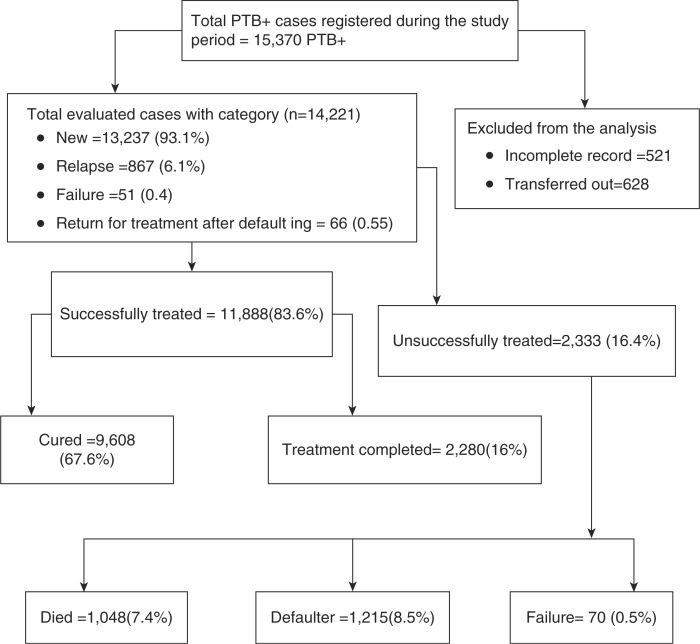
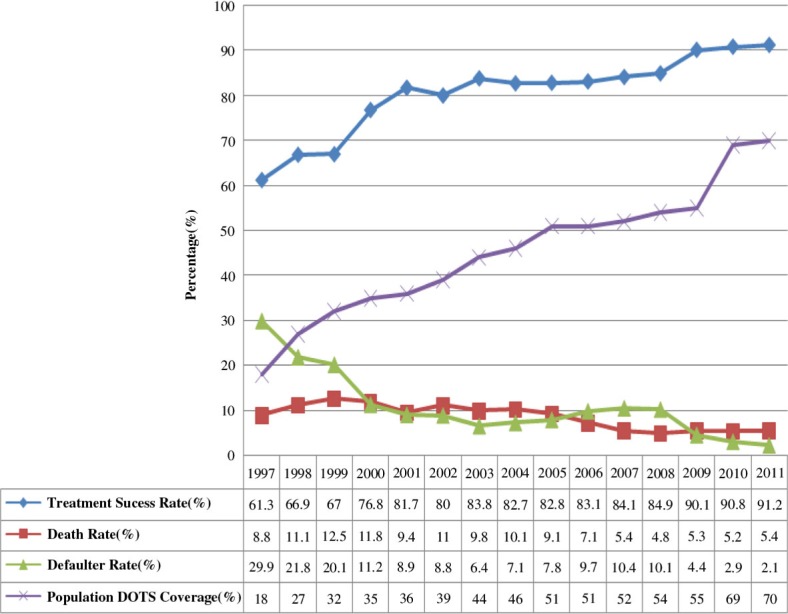
From 14,221 evaluated PTB+ cases, 11,888 (83.6%) were successfully treated. The treatment success rate (TSR) varied from 69.3 to 92.5%, defaulter rate from 2.5 to 21.6%, death rate from 1.6 to 11.1%, and failure rate from 0 to 3.6% across the 25 districts of the zone. The trend in TSR increased from 61 to 91% with the increase of population DOTS coverage from 18 to 70%. There was a declining trend in defaulter rate from 29.9 to 2.1% and death rate from 8.8 to 5.4% over 15 years. Patients aged 25-49 years (Adjusted Odd Ratio (AOR), 0.23; 95% CI: 0.21-0.26) and ≥50 years (AOR, 0.43; 95% CI: 0.32-0.59), re-treatment cases (AOR, 0.61; 0.41, 0.67), and TB/HIV co-infection cases (AOR, 0.45; 95% CI: 0.31-0.53) were associated with unsuccessful treatment outcomes.
DOTS expansion and improving population DOTS coverage in Arsi has led to a significant increase in treatment success and decrease in death and defaulter rates. However, there is a major variation in treatment outcomes across the 25 districts of the zone, so district-specific intervention strategy needs to be considered. The low TSR among re-treatment cases might be due to the high rate of MDR-TB among this group, and the issue needs to be further investigated to identify the extent of the problem.
直接观察短程治疗(DOTS)策略旨在诊断出70%的传染性结核病(TB)并治愈其中的85%。埃塞俄比亚的阿尔西地区于1992年试点了DOTS策略。自那时以来,总体治疗结果的趋势,特别是地区层面的趋势尚未得到评估。本研究的目的是分析阿尔西地区25个区结核病治疗结果的趋势,并审核地区层面的治疗结果。
采用回顾性队列研究设计,对1997年至2011年期间登记的痰涂片阳性肺结核(PTB+)患者进行审核。2013年1月至3月期间从结核病科室登记册收集人口统计学及相关数据。计算PTB+患者治疗结果的15年趋势以及地区层面的治疗结果。
在14221例评估的PTB+病例中,11888例(83.6%)得到成功治疗。该地区25个区的治疗成功率(TSR)在69.3%至92.5%之间,失访率在2.5%至21.6%之间,死亡率在1.6%至11.1%之间,失败率在0至3.6%之间。随着人群DOTS覆盖率从18%提高到70%,TSR从61%上升至91%。15年间失访率从29.9%下降至2.1%,死亡率从8.8%下降至5.4%。年龄在25 - 49岁(调整比值比(AOR),0.23;95%置信区间:0.21 - 0.26)和≥50岁(AOR,0.43;95%置信区间:0.32 - 0.59)的患者、复治病例(AOR,0.61;0.41,0.67)以及结核/艾滋病毒合并感染病例(AOR,0.45;95%置信区间:0.31 - 0.53)与治疗结果不佳相关。
在阿尔西地区扩大DOTS并提高人群DOTS覆盖率已使治疗成功率显著提高,死亡率和失访率降低。然而,该地区25个区的治疗结果存在较大差异,因此需要考虑针对各地区的干预策略。复治病例中较低的TSR可能是由于该组中耐多药结核病的高发生率,这一问题需要进一步调查以确定问题的严重程度。