Miyazaki Shinsuke, Taniguchi Hiroshi, Kusa Shigeki, Komatsu Yuki, Ichihara Noboru, Takagi Takamitsu, Iwasawa Jin, Kuroi Akio, Nakamura Hiroaki, Hachiya Hitoshi, Hirao Kenzo, Iesaka Yoshito
Cardiovascular Center, Tsuchiura Kyodo Hospital, Tsuchiura, Ibaraki, Japan (S.M., H.T., S.K., Y.K., N.I., T.T., J.I., A.K., H.N., H.H., Y.I.).
Heart Rhythm Center, Tokyo Medical and Dental University, Tokyo, Japan (K.H.).
J Am Heart Assoc. 2014 Sep 23;3(5):e001209. doi: 10.1161/JAHA.114.001209.
Periesophageal vagal nerve injury is recognized as a rare complication in atrial fibrillation ablation procedures. We investigated the factors associated with the occurrence of symptomatic periesophageal vagal nerve injury after pulmonary vein antrum isolation.
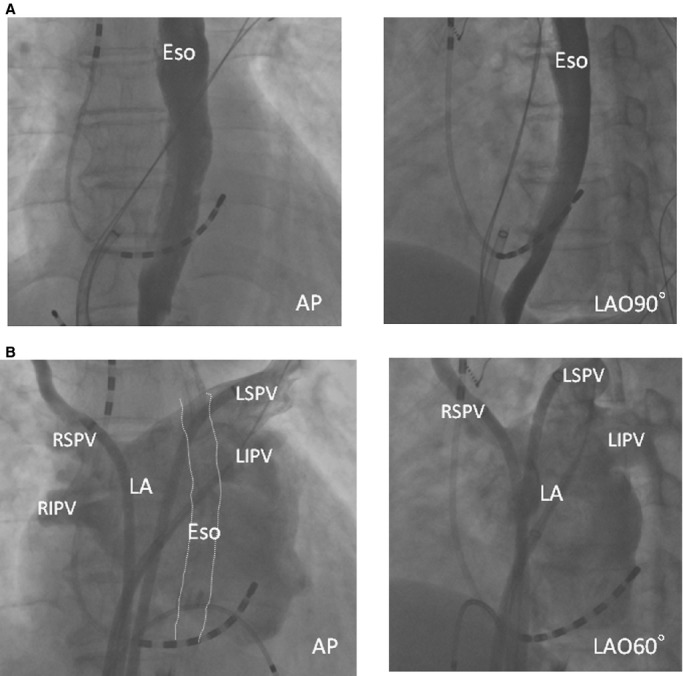
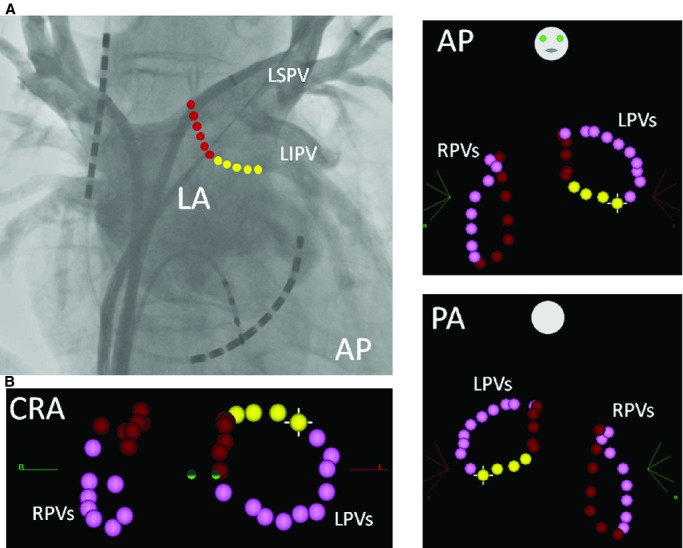
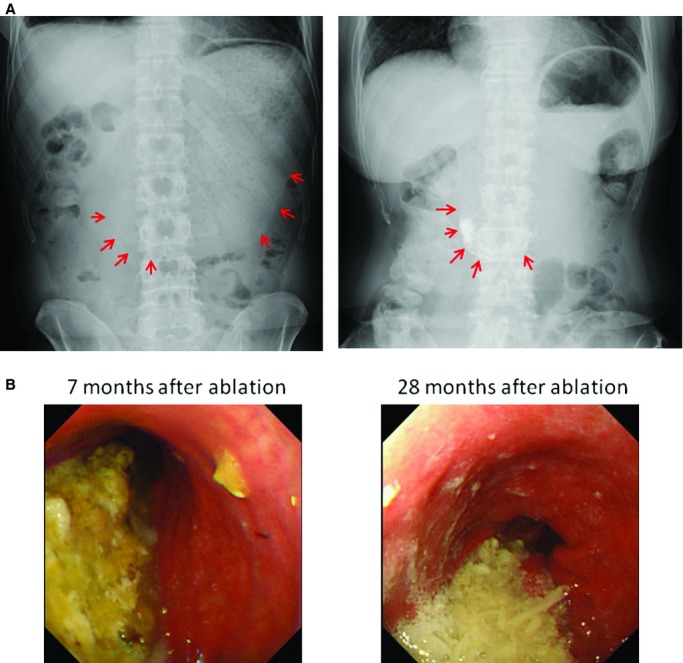
Overall, 535 consecutive patients who underwent sole pulmonary vein antrum isolation were included. Point-by-point radiofrequency applications were applied using irrigated-tip catheters under minimal sedation without esophageal temperature monitoring. In the initial 165 patients, the ablation settings for the posterior left atrium were a maximum energy of 25 to 30 W and a duration of 30 seconds. In the subsequent 370 patients, the power was additionally limited to 20 to 25 W at specific parts of the posterior left atrium where the ablation line transversed the esophagus. Symptomatic gastric hypomotility was found in 13 patients, and all were observed during the initial period (7.9%). No other collateral damage was observed. Logistic regression analysis revealed that the body mass index was the only independent predictor for identifying patients with gastric hypomotility (odds ratio 0.770; 95% confidence interval 0.643 to 0.922; P=0.0045) during the initial period. The prevalence of gastric hypomotility was significantly higher in the initial study period than subsequently (0 of 370, 0%; P<0.0001). All except for 1 patient recovered completely with conservative treatment within 4 months after the procedure.
Periesophageal vagal nerve injury is more common collateral damage than direct esophageal injury in pulmonary vein antrum isolation procedures. Titrating the radiofrequency energy at specific areas where the ablation line transverses the esophagus and taking account of the body mass index might reduce occurrences not only of direct esophageal damage but also of periesophageal vagal nerve injury in pulmonary vein antrum isolation procedures.
食管周围迷走神经损伤被认为是心房颤动消融手术中一种罕见的并发症。我们研究了肺静脉前庭隔离术后出现有症状的食管周围迷走神经损伤的相关因素。
总共纳入了535例连续接受单纯肺静脉前庭隔离术的患者。在最小镇静状态下,使用灌注射频消融导管进行逐点射频消融,未进行食管温度监测。在最初的165例患者中,左心房后壁的消融设置为最大能量25至30瓦,持续时间30秒。在随后的370例患者中,在左心房后壁消融线穿过食管的特定部位,功率额外限制为20至25瓦。13例患者出现有症状的胃动力减退,均在初期观察到(7.9%)。未观察到其他附带损伤。逻辑回归分析显示,体重指数是识别初期出现胃动力减退患者的唯一独立预测因素(比值比0.770;95%置信区间0.643至0.922;P=0.0045)。初期研究阶段胃动力减退的发生率显著高于随后阶段(370例中的0例,0%;P<0.0001)。除1例患者外,所有患者在术后4个月内通过保守治疗完全康复。
在肺静脉前庭隔离手术中,食管周围迷走神经损伤是比直接食管损伤更常见的附带损伤。在消融线穿过食管的特定区域调整射频能量并考虑体重指数,可能不仅会减少肺静脉前庭隔离手术中直接食管损伤的发生,还会减少食管周围迷走神经损伤的发生。