Michael Smith Laboratories, University of British Columbia , Vancouver, BC , Canada.
Child and Family Research Institute, University of British Columbia , Vancouver, BC , Canada.
Front Immunol. 2014 Sep 5;5:427. doi: 10.3389/fimmu.2014.00427. eCollection 2014.
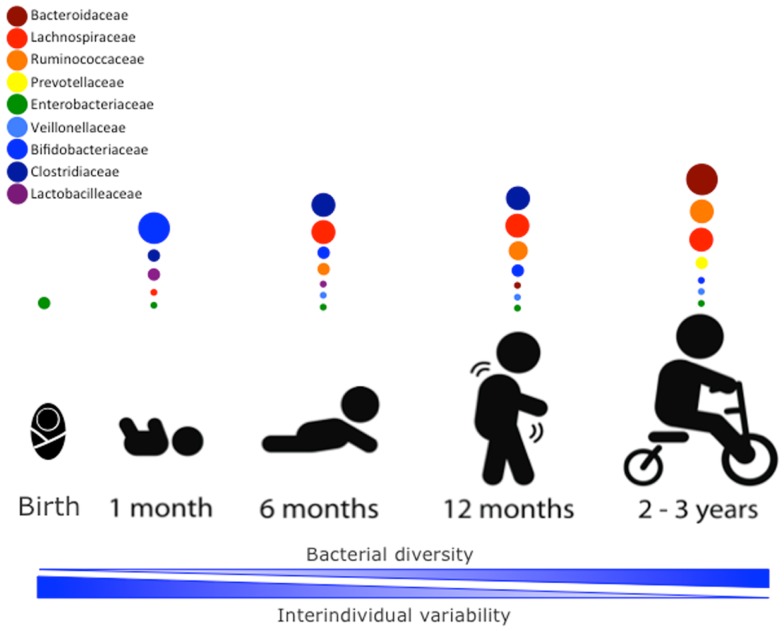
Human microbial colonization begins at birth and continues to develop and modulate in species abundance for about 3 years, until the microbiota becomes adult-like. During the same time period, children experience significant developmental changes that influence their health status as well as their immune system. An ever-expanding number of articles associate several diseases with early-life imbalances of the gut microbiota, also referred to as gut microbial dysbiosis. Whether early-life dysbiosis precedes and plays a role in disease pathogenesis, or simply originates from the disease process itself is a question that is beginning to be answered in a few diseases, including IBD, obesity, and asthma. This review describes the gut microbiome structure and function during the formative first years of life, as well as the environmental factors that determine its composition. It also aims to discuss the recent advances in understanding the role of the early-life gut microbiota in the development of immune-mediated, metabolic, and neurological diseases. A greater understanding of how the early-life gut microbiota impacts our immune development could potentially lead to novel microbial-derived therapies that target disease prevention at an early age.
人类微生物定植始于出生,并在大约 3 年内继续发展和调节物种丰度,直到微生物组变得与成人相似。在此期间,儿童经历了重大的发育变化,这些变化会影响他们的健康状况和免疫系统。越来越多的文章将几种疾病与肠道微生物组的早期失衡相关联,也称为肠道微生物失调。早期失调是先于疾病发生并在疾病发病机制中发挥作用,还是仅仅源自疾病本身,这个问题在一些疾病中开始得到解答,包括 IBD、肥胖症和哮喘。这篇综述描述了生命最初几年的肠道微生物组结构和功能,以及决定其组成的环境因素。它还旨在讨论在理解早期肠道微生物组在免疫介导、代谢和神经疾病发展中的作用方面的最新进展。更好地了解早期肠道微生物组如何影响我们的免疫发育,可能会导致新的基于微生物的疗法,以在早期预防疾病。