Firoozi Manijeh, Besharat Mohammad Ali, Rahimian Boogar Eshagh
Cancer Research Center,Shahid Beheshti University of Medical Sciences, Tehran, Iran ; Dept. of Psychology, University of Tehran, Tehran, Iran.
Dept. of Psychology, University of Tehran, Tehran, Iran.
Iran J Cancer Prev. 2013 Spring;6(2):65-72.
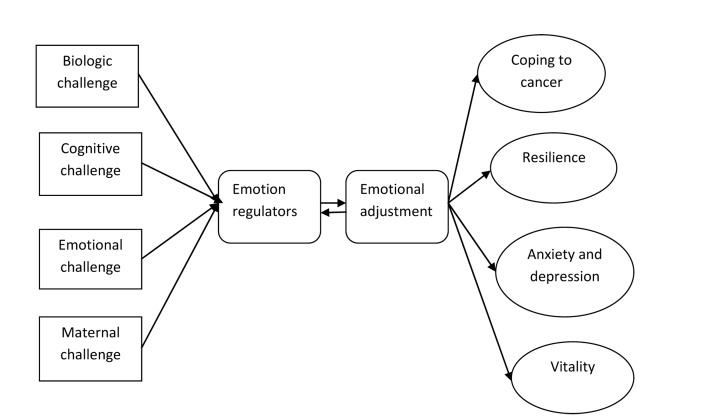
Children with cancer should deal with difficult situations such asundergoing multimodal treatment. Emotion Regulation Mechanisms (ERM) could be more effective for childhood cancer adaptation. The main purpose of this study was examination a number of the biological, psychological and social emotion regulators on adjustment to pediatric oncology.
In this study, 98 children (39 girls and 59 boys) have participated that diagnosed as Acute Lymphoblastic Leukemia (ALL) cases along with their mothers. The participants were between 8 to 12 years old. Salivary cortisol, cognitive emotion regulation, children's level of inhibition, maternal positivity and Beck Depression Inventory have been applied for evaluation of Emotion Regulation (ER) while Cancer-Specific Stress and Coping, Connor-Davidson Resilience Scale, anxiety-depression scales and vitality test have all used for assessing the Emotional Adjustment (EA).
Using the canonical correlation has been showing significant relation between predictors of ER and EA. Cortisol level and mother's depression have played the most important role in above correlation.
Variation of cortisol level has identified by its various effects on the mother's behavioral system depression, cognitive strategies and emotional inhibition; would determine the rate of coping with cancer, resiliency and vitality.
患癌儿童需要应对诸如接受多模式治疗等困难情况。情绪调节机制(ERM)可能对儿童癌症适应更为有效。本研究的主要目的是考察一些生物、心理和社会情绪调节因素对儿科肿瘤适应的影响。
在本研究中,98名被诊断为急性淋巴细胞白血病(ALL)的儿童(39名女孩和59名男孩)及其母亲参与其中。参与者年龄在8至12岁之间。唾液皮质醇、认知情绪调节、儿童抑制水平、母亲的积极性和贝克抑郁量表用于评估情绪调节(ER),而癌症特异性应激与应对、康纳 - 戴维森韧性量表、焦虑 - 抑郁量表和活力测试均用于评估情绪调整(EA)。
使用典型相关分析表明,情绪调节和情绪调整的预测因素之间存在显著关系。皮质醇水平和母亲的抑郁在上述相关性中起最重要作用。
皮质醇水平的变化通过其对母亲行为系统抑郁、认知策略和情绪抑制的各种影响得以体现;这将决定应对癌症的能力、恢复力和活力水平。