Smith Jason M, Chavez Francisco P, Francis Christopher A
Research Division, Monterey Bay Aquarium Research Institute, Moss Landing, California, United States of America; Department of Environmental Earth System Science, Stanford University, Stanford, California, United States of America.
Research Division, Monterey Bay Aquarium Research Institute, Moss Landing, California, United States of America.
PLoS One. 2014 Sep 24;9(9):e108173. doi: 10.1371/journal.pone.0108173. eCollection 2014.
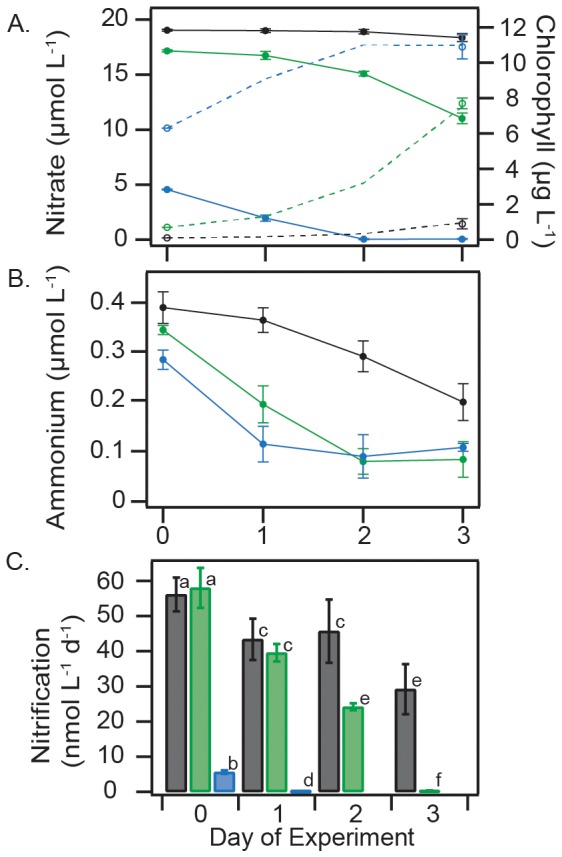
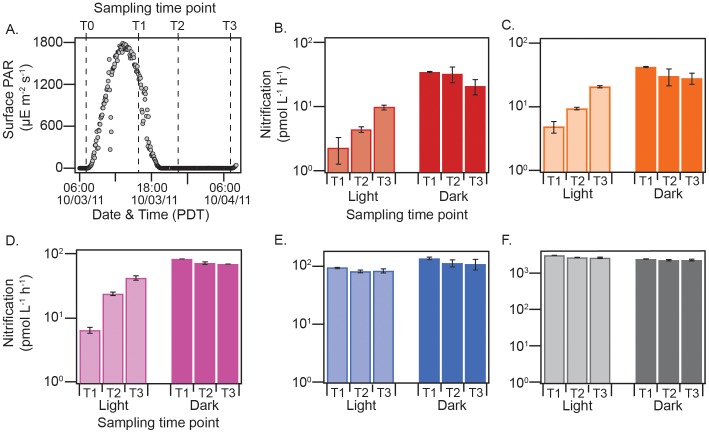
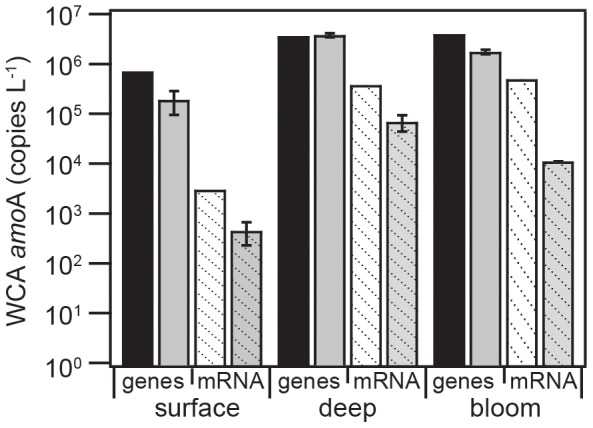
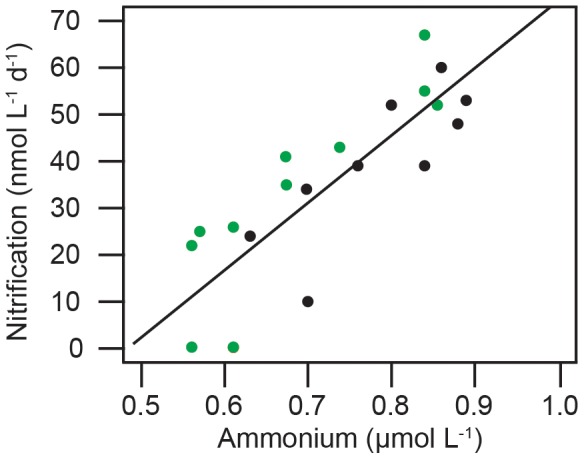
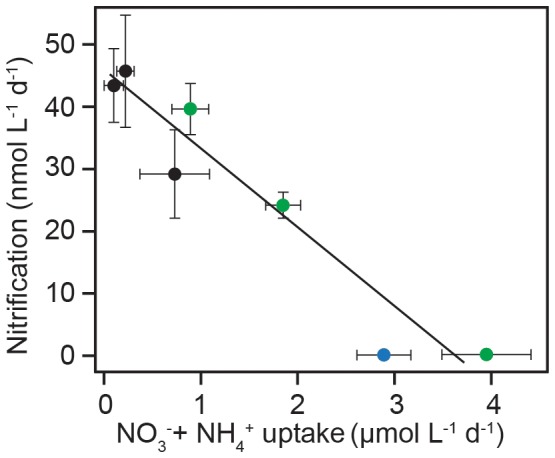
Nitrification, the microbial oxidation of ammonium to nitrate, is a central part of the nitrogen cycle. In the ocean's surface layer, the process alters the distribution of inorganic nitrogen species available to phytoplankton and produces nitrous oxide. A widely held idea among oceanographers is that nitrification is inhibited by light in the ocean. However, recent evidence that the primary organisms involved in nitrification, the ammonia-oxidizing archaea (AOA), are present and active throughout the surface ocean has challenged this idea. Here we show, through field experiments coupling molecular genetic and biogeochemical approaches, that competition for ammonium with phytoplankton is the strongest regulator of nitrification in the photic zone. During multiday experiments at high irradiance a single ecotype of AOA remained active in the presence of rapidly growing phytoplankton. Over the course of this three day experiment, variability in the intensity of competition with phytoplankton caused nitrification rates to decline from those typical of the lower photic zone (60 nmol L-1 d-1) to those in well-lit layers (<1 nmol L-1 d-1). During another set of experiments, nitrification rates exhibited a diel periodicity throughout much of the photic zone, with the highest rates occurring at night when competition with phytoplankton is lowest. Together, the results of our experiments indicate that nitrification rates in the photic zone are more strongly regulated by competition with phytoplankton for ammonium than they are by light itself. This finding advances our ability to model the impact of nitrification on estimates of new primary production, and emphasizes the need to more strongly consider the effects of organismal interactions on nutrient standing stocks and biogeochemical cycling in the surface of the ocean.
硝化作用,即将铵微生物氧化为硝酸盐的过程,是氮循环的核心部分。在海洋表层,这一过程改变了浮游植物可利用的无机氮物种的分布,并产生一氧化二氮。海洋学家中一个普遍的观点是,硝化作用在海洋中受到光的抑制。然而,最近有证据表明,参与硝化作用的主要生物体——氨氧化古菌(AOA),在整个海洋表层都存在且活跃,这对这一观点提出了挑战。在这里,我们通过将分子遗传学和生物地球化学方法相结合的野外实验表明,与浮游植物争夺铵是光合层中硝化作用最强的调节因子。在高光照强度下进行的多日实验中,单一生态型的AOA在快速生长的浮游植物存在的情况下仍保持活跃。在这个为期三天的实验过程中,与浮游植物竞争强度的变化导致硝化速率从光合层下部典型的速率(60 nmol L-1 d-1)下降到光照良好层的速率(<1 nmol L-1 d-1)。在另一组实验中,硝化速率在大部分光合层中呈现出昼夜周期性,最高速率出现在夜间,此时与浮游植物的竞争最低。总之,我们的实验结果表明,光合层中的硝化速率受与浮游植物争夺铵的竞争调节比受光本身的调节更强。这一发现提高了我们模拟硝化作用对新初级生产力估计影响的能力,并强调需要更加强烈地考虑生物相互作用对海洋表层营养存量和生物地球化学循环的影响。