Wuhan Hospital for Psychotherapy, Wuhan Mental Health Center, Tongji Medical College Huazhong University of Science and Technology, Kaiming Road 44#, Wuhan 430019, China.
Department of Psychiatry, University of California, San Francisco, California, USA.
Confl Health. 2014 Sep 4;8:14. doi: 10.1186/1752-1505-8-14. eCollection 2014.
Without effective treatment, PTSD and depression can cause persistent disability in disaster-affected populations.
Our objective was to test the efficacy of Interpersonal Psychotherapy (IPT) delivered by trained local personnel compared with treatment as usual (TAU) for Posttraumatic Stress Disorder (PTSD) and Major Depressive Disorder (MDD) among adults affected by the Sichuan 2008 earthquake. A small randomized controlled trial of IPT + TAU versus TAU alone was delivered by local mental health personnel in Shifang, China. Between July 2011 and January 2012, 49 adults ≥ 18 years with PTSD, MDD or both were enrolled and randomized to 12 weekly sessions of IPT + TAU (27) or TAU (22) alone x 12 weeks. IPT was then offered to the TAU group. Unblinded follow up assessments were conducted at three and six months. IPT was a 12 session, weekly one hour treatment delivered by local personnel who were trained and supervised in IPT. TAU was continuation of prescribed psychotropic medication (if applicable) and crisis counseling, as needed. MAIN OUTCOME(S) AND MEASURES (S): Clinician Administered PTSD Scale (CAPS) PTSD diagnosis; Structured Clinical Interview for DSM-IV (SCID) for MDD diagnosis. Secondary measures included PTSD/depression symptoms, interpersonal conflict/anger, social support, self-efficacy and functioning.
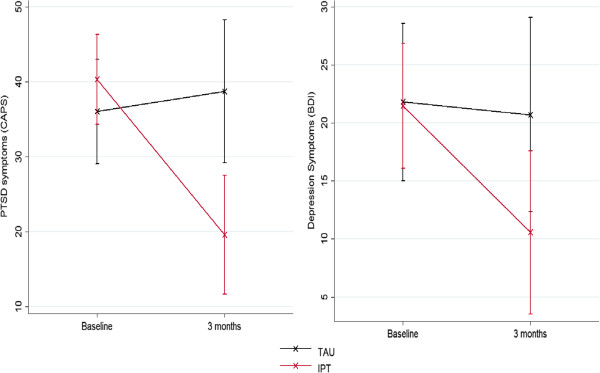
Using an intent-to-treat analysis, 22 IPT + TAU and 19 TAU participants were compared at three months post-baseline. A significantly greater reduction of PTSD and MDD diagnoses was found in the IPT group (51.9%, 30.1%, respectively) versus the TAU group (3.4%, 3.4%, respectively). Despite the small sample, the estimates for time-by-condition analyses of target outcomes (2.37 for PTSD (p = .018) and 1.91 for MDD (p = .056)) indicate the improvement was better in the IPT + TAU condition versus the TAU group. Treatment gains were maintained at 6 months for the IPT group. A similar treatment response was observed in the TAU group upon receipt of IPT.
This initial study shows that IPT is a promising treatment for reducing PTSD and depression, the two major mental health disorders affecting populations surviving natural disaster, using a design that builds local mental health care capacity.
ClinicalTrials.Gov number, NCT01624935.
如果没有有效的治疗,创伤后应激障碍和抑郁症会导致受灾人群持续残疾。
我们的目的是测试由经过培训的当地人员提供的人际心理治疗(IPT)与常规治疗(TAU)相比,对 2008 年四川地震受灾成年人的创伤后应激障碍(PTSD)和重度抑郁症(MDD)的疗效。在中国什邡市,由当地心理健康人员进行了一项小规模的随机对照试验,比较 IPT+TAU 与单独 TAU 治疗。2011 年 7 月至 2012 年 1 月期间,纳入了 49 名年龄≥18 岁的 PTSD、MDD 或两者兼有成年人,并随机分为 12 周 IPT+TAU(27 人)或单独 TAU(22 人)×12 周。IPT 随后提供给 TAU 组。在三个月和六个月时进行了非盲随访评估。IPT 是一种 12 节、每周一小时的治疗,由接受 IPT 培训和监督的当地人员提供。TAU 是继续服用规定的精神药物(如适用)和按需进行危机咨询。主要结局指标和测量方法:临床医生管理的 PTSD 量表(CAPS) PTSD 诊断;DSM-IV 的结构化临床访谈(SCID)用于 MDD 诊断。次要指标包括 PTSD/抑郁症状、人际冲突/愤怒、社会支持、自我效能和功能。
采用意向治疗分析,在基线后三个月比较了 22 名 IPT+TAU 和 19 名 TAU 参与者。IPT 组 PTSD 和 MDD 诊断的显著减少(分别为 51.9%和 30.1%)明显优于 TAU 组(分别为 3.4%和 3.4%)。尽管样本量较小,但目标结局的时间-条件分析的估计值(PTSD 为 2.37(p=0.018),MDD 为 1.91(p=0.056))表明,IPT+TAU 条件下的改善优于 TAU 组。IPT 组在 6 个月时治疗效果保持。在接受 IPT 后,TAU 组也观察到类似的治疗反应。
这项初步研究表明,IPT 是一种有前途的治疗方法,可使用一种建立当地心理健康护理能力的设计,减少影响自然灾害幸存者的两种主要心理健康障碍:创伤后应激障碍和抑郁症。
ClinicalTrials.gov 编号,NCT01624935。