Telenti Amalio, Ayday Erman, Hubaux Jean Pierre
Department of Laboratories, University Hospital of Lausanne, Lausanne, Switzerland.
Laboratory for Communications and Applications Laboratory, École Polytechnique Fédérale de Lausanne, Lausanne, Switzerland.
F1000Res. 2014 Mar 31;3:80. doi: 10.12688/f1000research.3817.1. eCollection 2014.
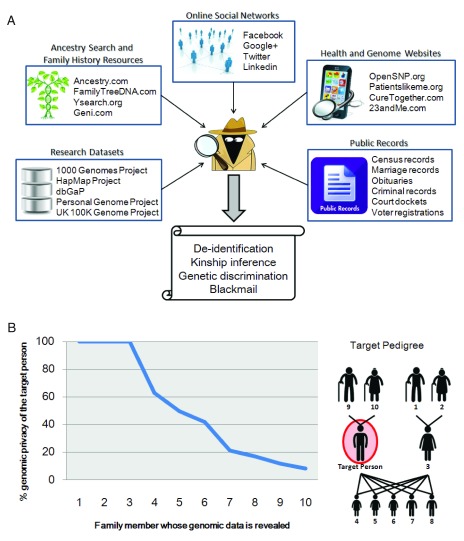
The storage of greater numbers of exomes or genomes raises the question of loss of privacy for the individual and for families if genomic data are not properly protected. Access to genome data may result from a personal decision to disclose, or from gaps in protection. In either case, revealing genome data has consequences beyond the individual, as it compromises the privacy of family members. Increasing availability of genome data linked or linkable to metadata through online social networks and services adds one additional layer of complexity to the protection of genome privacy. The field of computer science and information technology offers solutions to secure genomic data so that individuals, medical personnel or researchers can access only the subset of genomic information required for healthcare or dedicated studies.
如果基因组数据得不到妥善保护,存储大量外显子组或基因组就会引发个人及家庭隐私泄露的问题。获取基因组数据可能源于个人主动披露的决定,也可能是保护措施存在漏洞。无论哪种情况,披露基因组数据的影响都不止于个人,因为这会危及家庭成员的隐私。通过在线社交网络和服务,可与元数据关联或能够关联的基因组数据越来越多,这给基因组隐私保护增添了一层复杂性。计算机科学和信息技术领域提供了保护基因组数据安全的解决方案,以便个人、医护人员或研究人员只能访问医疗保健或专门研究所需的那部分基因组信息。