Mazumder Rajarshi, Murchison Charles, Bourdette Dennis, Cameron Michelle
Oregon Health & Science University, Portland, Oregon, United States of America.
Department of Neurology, Oregon Health & Science University, Portland, Oregon, United States of America.
PLoS One. 2014 Sep 25;9(9):e107620. doi: 10.1371/journal.pone.0107620. eCollection 2014.
To compare the risk, circumstances, consequences and causes of prospectively recorded falls between people with multiple sclerosis (PwMS) and healthy controls of similar age and gender.
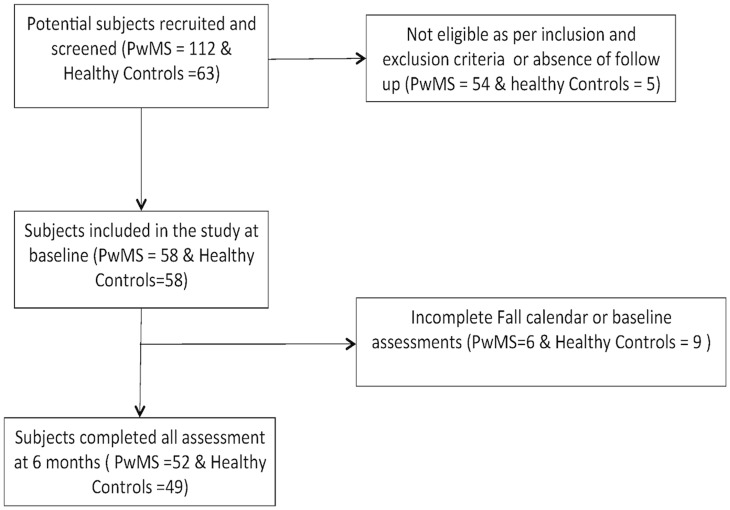
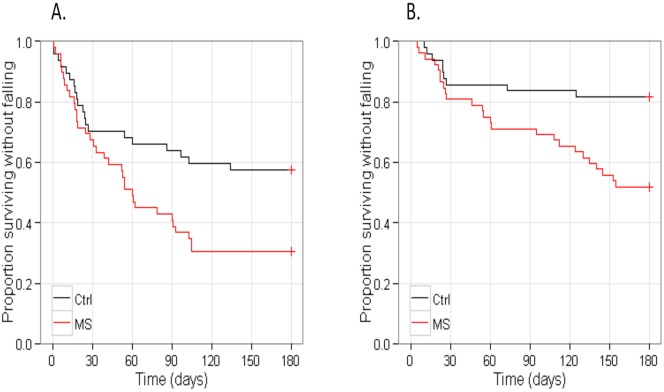
58 PwMS and 58 healthy controls, who are community-dwelling, were recruited in this 6-month prospective cohort study. 90% of PwMS and 84% of healthy controls completed the study. Participants counted falls prospectively using fall calendars and noted fall location, fall-related injuries, and the cause of the falls. Kaplan Meier survival analysis and log-rank tests were performed to compare the distributions of survival without falling between PwMS and healthy controls.
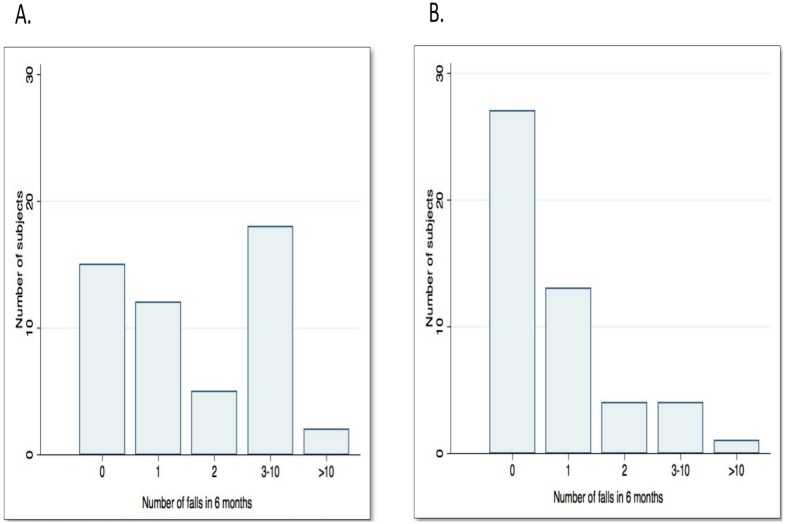
40.8% of controls and 71.2% of PwMS fell at least once. 48.1% of PwMS and 18.4% of healthy controls fell at least twice. 42.3% of PwMS and 20.4% of health controls sustained a fall-related injury. After adjusting for age and gender, the time to first fall (HR: 1.87, p = 0.033) and the time to recurrent falls (HR: 2.87, p = 0.0082) were significantly different between PwMS and healthy controls. PwMS reported an almost equal number of falls inside and outside, 86% of the falls in healthy controls were outside. Healthy controls were more likely to fall due to slipping on a slippery surface (39.5% vs 10.4%). PwMS more often attributed falls to distraction (31% vs 7%) and uniquely attributed falls to fatigue or heat.
Fall risk, circumstances, consequences, and causes are different for PwMS than for healthy people of the same age and gender. PwMS fall more, are more likely to be injured by a fall, and often fall indoors. PwMS, but not healthy controls, frequently fall because they are distracted, fatigued or hot.
比较多发性硬化症患者(PwMS)与年龄和性别相似的健康对照者前瞻性记录的跌倒风险、情况、后果及原因。
在这项为期6个月的前瞻性队列研究中,招募了58名社区居住的PwMS患者和58名健康对照者。90%的PwMS患者和84%的健康对照者完成了研究。参与者使用跌倒日历前瞻性地记录跌倒情况,并注明跌倒地点、与跌倒相关的损伤以及跌倒原因。进行Kaplan Meier生存分析和对数秩检验,以比较PwMS患者和健康对照者无跌倒生存分布情况。
40.8%的对照者和71.2%的PwMS患者至少跌倒过一次。48.1%的PwMS患者和18.4%的健康对照者至少跌倒过两次。42.3%的PwMS患者和20.4%的健康对照者遭受了与跌倒相关的损伤。在调整年龄和性别后,PwMS患者和健康对照者首次跌倒时间(风险比:1.87,p = 0.033)和再次跌倒时间(风险比:2.87,p = 0.0082)存在显著差异。PwMS患者报告的室内外跌倒次数几乎相等,健康对照者86%的跌倒发生在室外。健康对照者更有可能因在湿滑表面滑倒而跌倒(39.5%对10.4%)。PwMS患者更多地将跌倒归因于注意力分散(31%对7%),且独特地将跌倒归因于疲劳或炎热。
PwMS患者与同龄及同性别的健康人相比,跌倒风险、情况、后果及原因有所不同。PwMS患者跌倒更频繁,更有可能因跌倒受伤,且经常在室内跌倒。PwMS患者经常因注意力分散、疲劳或炎热而跌倒,而健康对照者并非如此。