Lee Dong Soo, Kim Seung Joon, Kang Jin Hyoung, Hong Sook Hee, Jeon Eun Kyoung, Kim Young Kyoon, Yoo Ie Ryoung, Park Jae Gil, Jang Hong Seok, Lee Hyo Chun, Kim Yeon Sil
1. Department of Radiation Oncology, Uijeongbu St. Mary's Hospital, College of Medicine, The Catholic University of Korea, Uijeongbu-si, Gyeonggi-do, South Korea; ; 6. Department of Radiation Oncology, Seoul St. Mary's Hospital, College of Medicine, The Catholic University of Korea, Seoul, South Korea.
2. Department of Internal Medicine, Seoul St. Mary's Hospital, College of Medicine, The Catholic University of Korea, Seoul, South Korea;
J Cancer. 2014 Sep 5;5(8):663-9. doi: 10.7150/jca.9871. eCollection 2014.
This study aimed to clarify the clinical associations between serum carcinoembryonic antigen (CEA) levels and whole-body metastatic distribution in stage IV NSCLC patients.
This study analyzed 377 eligible patients between June 2007 and December 2012. All patients enrolled in the study were newly diagnosed with stage IV NSCLC and had records of pre-treatment serum CEA levels. The serum CEA levels were categorized as normal (< 5 ng/ml) or abnormal (≥ 5 ng/ml) to reveal clinically correlated factors with abnormal serum CEA levels.
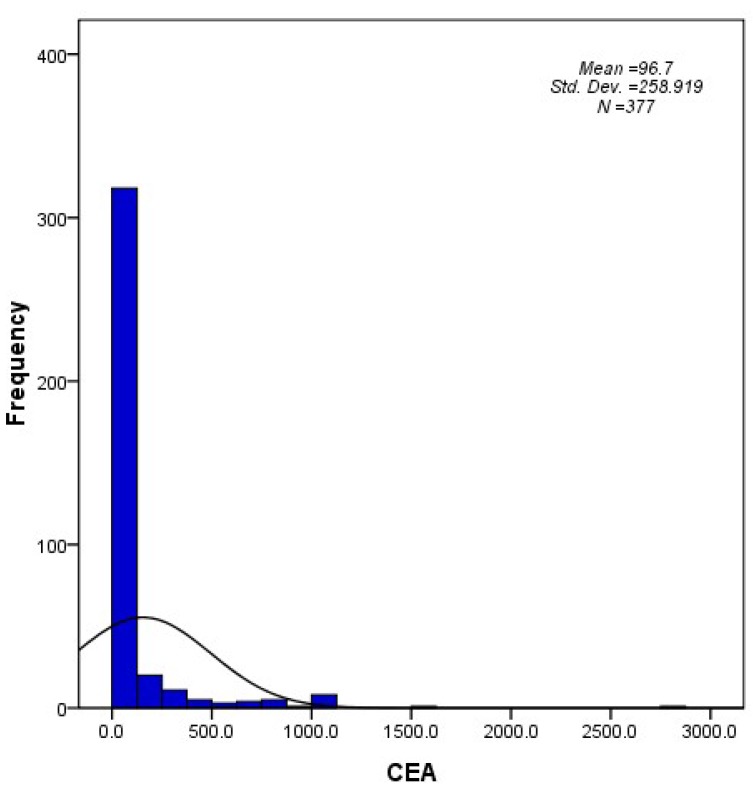
The median age of the study cohort was 65 years old (range, 30-94), and 236 (62.6%) patients were male. Two hundred seventy-seven (73.5%) patients had tumors with a histology that is consistent with adenocarcinoma. The median serum CEA value was 8.2 ng/ml (range, 0.1-2872.7), and 218 (57.8%) patients had abnormal serum CEA levels. In multivariate analysis, abnormal serum CEA levels had statistically strong associations with non-squamous cell histology (P=0.002), bone (P=0.001), and brain metastases (P=0.005); and were also closely correlated with positive metastatic LN status (P=0.083) and pulmonary metastasis (P=0.065). Very high serum CEA levels (≥ 100 ng/ml) were additionally correlated with abdominal/pelvic metastasis (P < 0.001).
Our findings suggested that abnormal serum CEA levels were strongly correlated with increased whole-body metastatic potential in advanced NSCLC. The results provided evidence for future exploratory anti-CEA targeting and intensive systemic assessment in advanced NSCLC patients with abnormal serum CEA levels.
本研究旨在阐明血清癌胚抗原(CEA)水平与IV期非小细胞肺癌(NSCLC)患者全身转移分布之间的临床关联。
本研究分析了2007年6月至2012年12月期间的377例符合条件的患者。所有纳入研究的患者均为新诊断的IV期NSCLC,并有治疗前血清CEA水平记录。血清CEA水平分为正常(<5 ng/ml)或异常(≥5 ng/ml),以揭示与异常血清CEA水平相关的临床因素。
研究队列的中位年龄为65岁(范围30 - 94岁),236例(62.6%)患者为男性。277例(73.5%)患者的肿瘤组织学类型与腺癌一致。血清CEA的中位值为8.2 ng/ml(范围0.1 - 2872.7),218例(57.8%)患者血清CEA水平异常。多因素分析显示,血清CEA水平异常与非鳞状细胞组织学(P = 0.002)、骨转移(P = 0.001)和脑转移(P = 0.005)有统计学上的强关联;也与阳性转移淋巴结状态(P = 0.083)和肺转移(P = 0.065)密切相关。血清CEA水平非常高(≥100 ng/ml)还与腹部/盆腔转移相关(P < 0.001)。
我们的研究结果表明,血清CEA水平异常与晚期NSCLC全身转移潜能增加密切相关。这些结果为未来对血清CEA水平异常的晚期NSCLC患者进行探索性抗CEA靶向治疗和强化全身评估提供了证据。