Lung Cancer Unit, IRCCS-Ospedale Policlinico San Martino, Genova, Italy.
Clinical Epidemiology Unit, IRCCS-Ospedale Policlinico San Martino, Genova, Italy.
J Transl Med. 2019 Mar 8;17(1):74. doi: 10.1186/s12967-019-1828-0.
CEA, CYFRA21-1 and NSE are tumor markers used for monitoring the response to chemotherapy in advanced adenocarcinoma, squamous cell carcinoma and small-cell lung cancer, respectively. Their role in cancer immunotherapy needs to be elucidated.
Patients with advanced non-small cell lung cancer (NSCLC) were treated with nivolumab 3 mg/kg every 2 weeks within the Italian Nivolumab Expanded Access Program. Blood samples were collected at baseline, at each cycle up to cycle 5 and then every two cycles until patient's withdrawn from the study. All patients underwent a CT-scan after every 4 cycles of treatment and responses were classified according to RECIST 1.1. The biomarkers serum levels were measured with a chemiluminescent microparticle immunoassay for CEA and with an immuno radiometric assay for CYFRA21-1 and NSE. The markers values at baseline and after 4 cycles were used to analyze the relationship between their variation over baseline and the tumor response, evaluated as disease control rate (DCR: CR + PR + SD), and survival (PFS and OS).
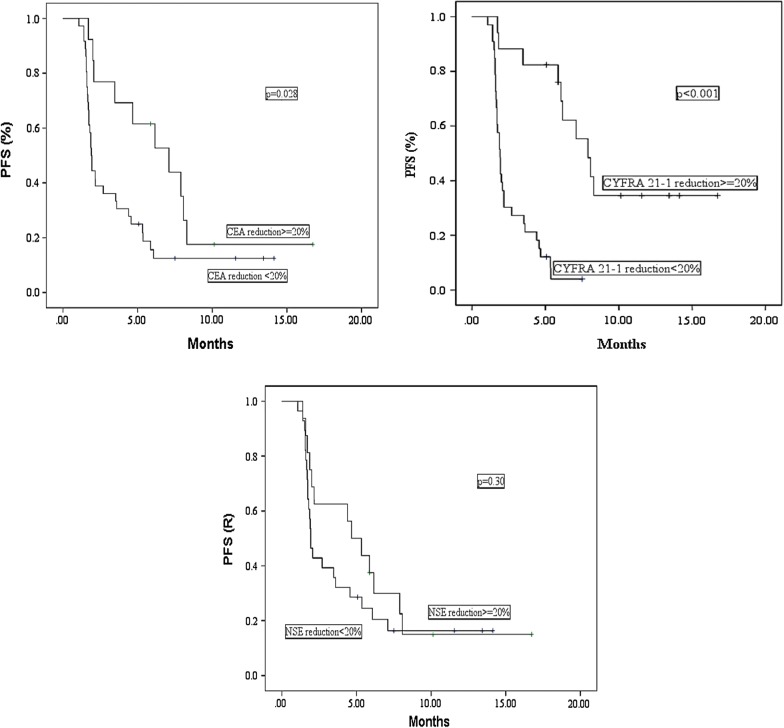
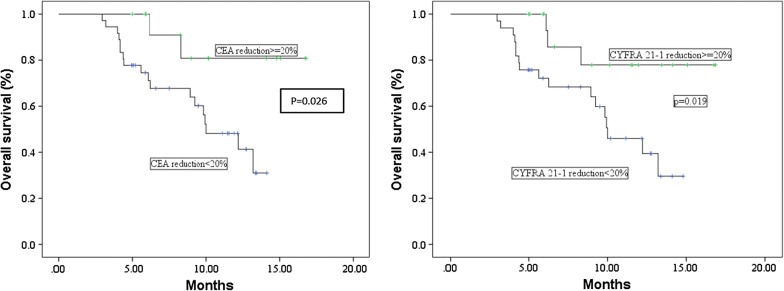
A total of 70 patients were evaluable for the analysis. Overall, a disease control was obtained in 24 patients (35.8%, 4 PR + 20 SD). After 4 cycles of nivolumab a CEA or CYFRA21-1 reduction ≥ 20% over the baseline was significantly associated with DCR (CEA, p = 0.021; CYFRA21-1, p < 0.001), PFS (CEA, p = 0.028; CYFRA21-1, p < 0.001) and OS (CEA, p = 0.026; CYFRA21-1, p = 0.019). Multivariate analysis confirmed the ability of CYFRA21-1 reduction ≥ 20% to predict DCR (p = 0.002) and PFS (p < 0.001).
The reduction in serum level of CYFRA21-1 or CEA might be a reliable biomarker to predict immunotherapy efficacy in NSCLC patients. NSE was not significant for monitoring the efficacy of nivolumab.
CEA、CYFRA21-1 和 NSE 分别是用于监测晚期腺癌、鳞状细胞癌和小细胞肺癌化疗反应的肿瘤标志物。它们在癌症免疫治疗中的作用需要阐明。
意大利的纳武利尤单抗扩大准入计划中,晚期非小细胞肺癌(NSCLC)患者每 2 周接受 3mg/kg 的纳武利尤单抗治疗。在基线时、每个周期(最多 5 个周期)以及每个两个周期(直到患者退出研究)采集血液样本。所有患者在每 4 个周期的治疗后进行 CT 扫描,根据 RECIST 1.1 对反应进行分类。采用化学发光微粒子免疫分析法测定 CEA,免疫放射分析法测定 CYFRA21-1 和 NSE 的血清水平。使用基线和 4 个周期后的标志物值来分析其相对于基线的变化与肿瘤反应(疾病控制率(DCR:CR+PR+SD))和生存(PFS 和 OS)之间的关系。
共 70 例患者可用于分析。总体而言,24 例患者(35.8%,4 例 CR+20 例 SD)获得了疾病控制。纳武利尤单抗治疗 4 个周期后,CEA 或 CYFRA21-1 相对于基线的下降≥20%与 DCR(CEA,p=0.021;CYFRA21-1,p<0.001)、PFS(CEA,p=0.028;CYFRA21-1,p<0.001)和 OS(CEA,p=0.026;CYFRA21-1,p=0.019)显著相关。多变量分析证实了 CYFRA21-1 下降≥20%预测 DCR(p=0.002)和 PFS(p<0.001)的能力。
血清 CYFRA21-1 或 CEA 水平降低可能是预测 NSCLC 患者免疫治疗疗效的可靠生物标志物。NSE 对监测纳武利尤单抗的疗效不显著。