Bruton Joseph, Jeffries Gavin D M, Westerblad Håkan
Department of Physiology and Pharmacology, Karolinska Institute, Stockholm, Sweden.
Department of Chemical and Biological Engineering, Chalmers University of Technology, Gothenburg, Sweden.
PLoS One. 2014 Sep 26;9(9):e108601. doi: 10.1371/journal.pone.0108601. eCollection 2014.
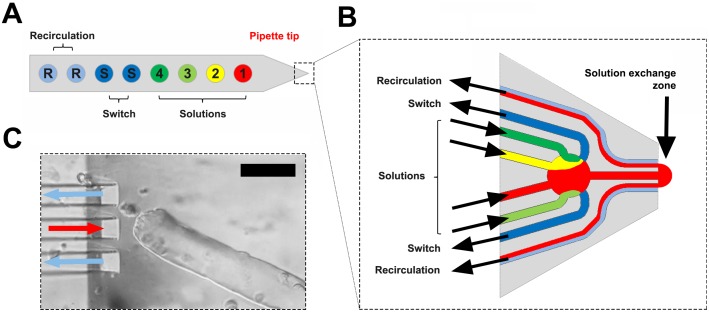
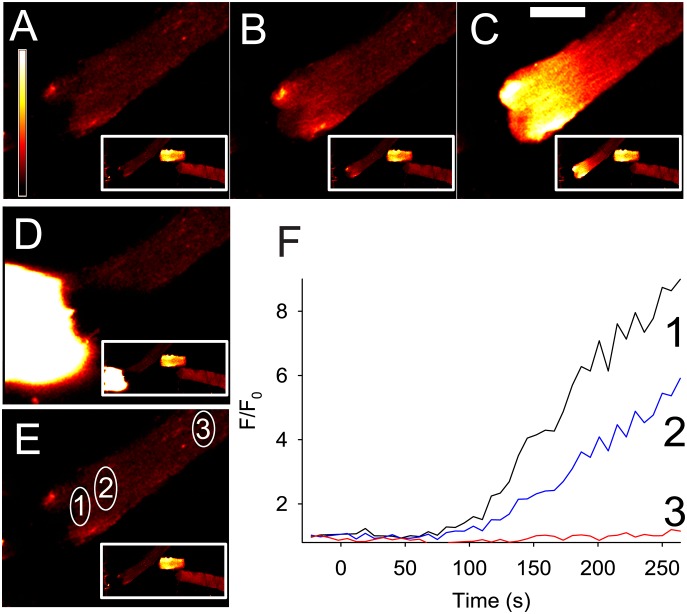
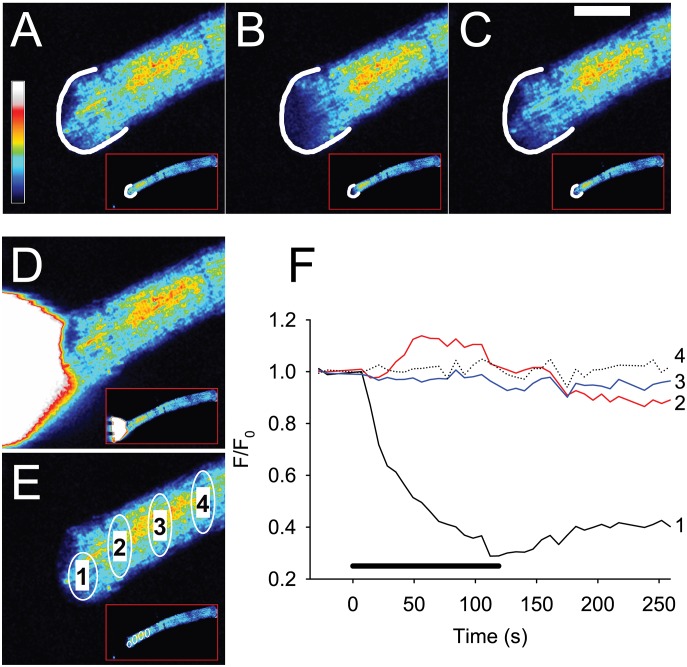
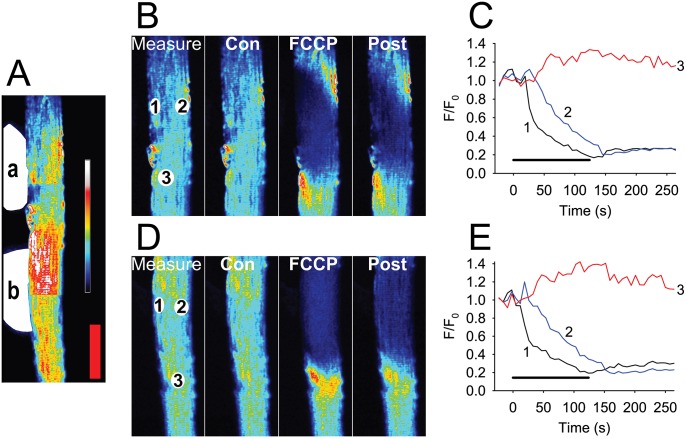
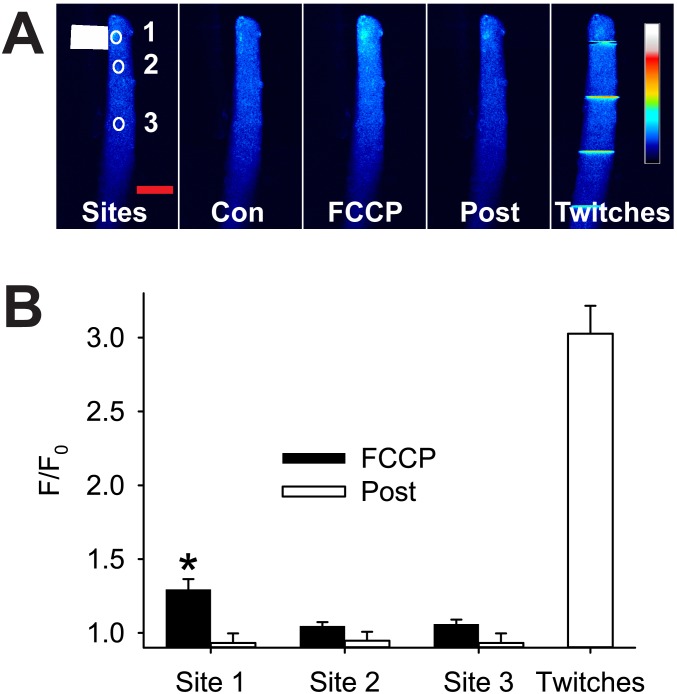
In cells, such as neurones and immune cells, mitochondria can form dynamic and extensive networks that change over the minute timescale. In contrast, mitochondria in adult mammalian skeletal muscle fibres show little motility over several hours. Here, we use a novel three channelled microflow device, the multifunctional pipette, to test whether mitochondria in mouse skeletal muscle connect to each other. The central channel in the pipette delivers compounds to a restricted region of the sarcolemma, typically 30 µm in diameter. Two channels on either side of the central channel use suction to create a hydrodynamically confined flow zone and remove compounds completely from the bulk solution to internal waste compartments. Compounds were delivered locally to the end or side of single adult mouse skeletal muscle fibres to test whether changes in mitochondrial membrane potential were transmitted to more distant located mitochondria. Mitochondrial membrane potential was monitored with tetramethylrhodamine ethyl ester (TMRE). Cytosolic free [Ca2+] was monitored with fluo-3. A pulse of carbonyl cyanide 4-(trifluoromethoxy) phenylhydrazone (FCCP, 100 µM) applied to a small area of the muscle fibre (30 µm in diameter) produced a rapid decrease in the mitochondrial TMRE signal (indicative of depolarization) to 38% of its initial value. After washout of FCCP, the TMRE signal partially recovered. At distances greater than 50 µm away from the site of FCCP application, the mitochondrial TMRE signal was unchanged. Similar results were observed when two sites along the fibre were pulsed sequentially with FCCP. After a pulse of FCCP, cytosolic [Ca2+] was unchanged and fibres contracted in response to electrical stimulation. In conclusion, our results indicate that extensive networks of interconnected mitochondria do not exist in skeletal muscle. Furthermore, the limited and reversible effects of targeted FCCP application with the multifunctional pipette highlight its advantages over bulk application of compounds to isolated cells.
在神经元和免疫细胞等细胞中,线粒体可形成动态且广泛的网络,这些网络会在分钟时间尺度上发生变化。相比之下,成年哺乳动物骨骼肌纤维中的线粒体在数小时内几乎没有运动性。在此,我们使用一种新型的三通道微流装置——多功能移液管,来测试小鼠骨骼肌中的线粒体是否相互连接。移液管的中央通道将化合物输送到肌膜的一个受限区域,该区域直径通常为30微米。中央通道两侧的两个通道利用吸力创建一个流体动力学受限的流动区域,并将化合物从总体溶液中完全去除至内部废物隔室。将化合物局部递送至单个成年小鼠骨骼肌纤维的末端或侧面,以测试线粒体膜电位的变化是否会传递至距离更远的线粒体。用四甲基罗丹明乙酯(TMRE)监测线粒体膜电位。用Fluo-3监测胞质游离[Ca2+]。向肌肉纤维的一个小区域(直径30微米)施加羰基氰化物4-(三氟甲氧基)苯腙(FCCP,100微摩尔)脉冲,会使线粒体TMRE信号迅速降低(表明去极化)至其初始值的38%。FCCP洗脱后,TMRE信号部分恢复。在距离FCCP施加部位大于50微米处,线粒体TMRE信号未发生变化。当沿纤维的两个部位依次用FCCP脉冲时,观察到了类似结果。FCCP脉冲后,胞质[Ca2+]未发生变化,并且纤维在电刺激下收缩。总之,我们的结果表明骨骼肌中不存在广泛互连的线粒体网络。此外,使用多功能移液管靶向施加FCCP的有限且可逆的效果突出了其相对于将化合物大量应用于分离细胞的优势。