Selamat Maryam Hafsah, Loh Siew Yim, Mackenzie Lynette, Vardy Janette
Department of Postgraduate Studies, University of Malaya, Kuala Lumpur, Malaysia.
Department of Rehabilitation Medicine, Faculty of Medicine, University of Malaya, Kuala Lumpur, Malaysia; Discipline of Occupational Therapy, Faculty of Health Sciences, University of Sydney, Sydney, Australia.
PLoS One. 2014 Sep 26;9(9):e108002. doi: 10.1371/journal.pone.0108002. eCollection 2014.
Cognitive impairment, colloquially termed "chemobrain", occurs in 10-40% of all cancer patients, and is an emerging target of cancer survivorship research.
This study reviews published qualitative studies to explore cognitive impairments or chemobrain among breast cancer survivors, with particular attention given to the impact on quality of life.
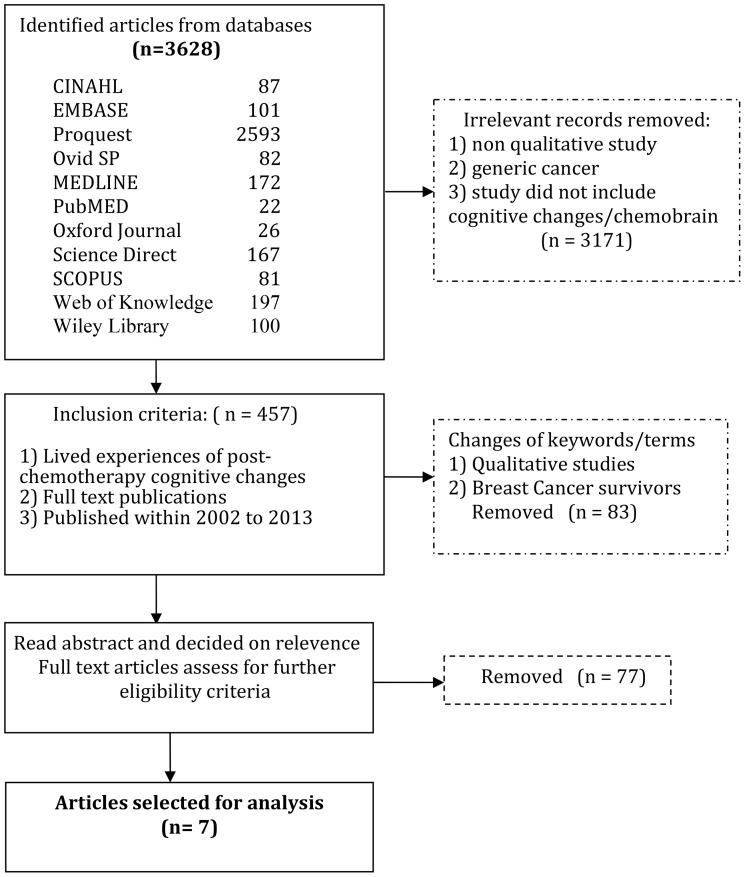
Using keywords, we searched ten electronic databases (CINAHL, EMBASE, Proquest, OVID SP, MEDLINE, Oxford Journal, Science Direct, PubMED).
Of 457 papers, seven relevant papers were included. Data was extracted and concepts were analysed using a meta ethnography approach. Four second order intepretations were identified, on the basis of which, four third order intrepretations were constructed. Linked together in a line of argument, was a consistent account on their struggles to self-manage the chemobrain impairments that impact their daily lives. Five concepts emerged from the analysis of the primary findings: i) real experiences of cognitive changes, ii) calls for help, iii) impact of cognitive impairments, iv) coping and v) survivorship and meaning. Further synthesis resulted in four new order intepretations: i) The chemobrain struggle, ii) The substantial impact of chemobrain on life domains, iii) The struggle to readjust and to self manage, and iv) 'thankful yet fearful' representation.
Awareness of cognitive changes were context-dependent on healthcare settings and cultural contexts as strong determinants. Subjects verified the existence of chemobrain but healthcare providers mis-recognised, under-recognised, and sometimes negated it perhaps due to its unknown aetiology. Asian breast cancer survivors appear less vocal than their western counterparts.
The current literature on the lived experiences of how women experienced chemobrain provides a consistent report that chemobrain is real, persistent and with detrimental impacts on quality of life - manifested as a constant struggles. A greater awareness of the effects of chemobrain with improved functional assessment and interventions is warranted.
认知障碍,通俗地称为“化疗脑”,在所有癌症患者中发生率为10% - 40%,是癌症幸存者研究中一个新出现的目标。
本研究回顾已发表的定性研究,以探讨乳腺癌幸存者中的认知障碍或化疗脑,特别关注其对生活质量的影响。
使用关键词,我们检索了十个电子数据库(CINAHL、EMBASE、Proquest、OVID SP、MEDLINE、牛津期刊、科学Direct、PubMED)。
在457篇论文中,纳入了7篇相关论文。提取数据并使用元民族志方法分析概念。确定了四个二阶解释,并在此基础上构建了四个三阶解释。在一条论证线上联系在一起的是对他们努力自我管理影响日常生活的化疗脑损伤的一致描述。对主要研究结果的分析产生了五个概念:i)认知变化的真实经历,ii)寻求帮助的呼声,iii)认知障碍的影响,iv)应对方式,v)生存与意义。进一步的综合产生了四个新的阶解释:i)化疗脑的挣扎,ii)化疗脑对生活领域的重大影响,iii)重新调整和自我管理的挣扎,iv)“感恩却恐惧”的表现。
对认知变化的认识取决于医疗保健环境和文化背景等强有力的决定因素。受试者证实了化疗脑的存在,但医疗保健提供者可能由于其病因不明而误认、认识不足,有时甚至予以否定。亚洲乳腺癌幸存者似乎比西方同行表达得更少。
目前关于女性如何经历化疗脑的生活经历的文献提供了一致的报告,即化疗脑是真实存在的、持续的,并且对生活质量有不利影响——表现为持续的挣扎。有必要提高对化疗脑影响的认识,改进功能评估和干预措施。