Lee Yong-ho, Kown Mi Hyang, Kim Kwang Joon, Lee Eun Young, Kim Daham, Lee Byung-Wan, Kang Eun Seok, Cha Bong Soo, Lee Hyun Chul
Department of Internal Medicine, Yonsei University College of Medicine, Seoul, South Korea; Severance Hospital, Seoul, South Korea.
Severance Hospital, Seoul, South Korea.
PLoS One. 2014 Sep 29;9(9):e108772. doi: 10.1371/journal.pone.0108772. eCollection 2014.
Glycated albumin (GA) has been increasingly used as a reliable index for short-term glycemic monitoring, and is inversely associated with β-cell function. Because the pathophysiologic nature of type 2 diabetes (T2D) is characterized by progressive decline in insulin secretion, the aim was to determine whether GA levels were affected by diabetes duration in subjects with T2D.
To minimize the effect of glucose variability on GA, subjects with stably maintained HbA1c levels of <0.5% fluctuation across 6 months of measurements were included. Patients with newly diagnosed T2D (n = 1059) and with duration>1 year (n = 781) were recruited and categorized as New-T2D and Old-T2D, respectively. Biochemical, glycemic, and C-peptide parameters were measured.
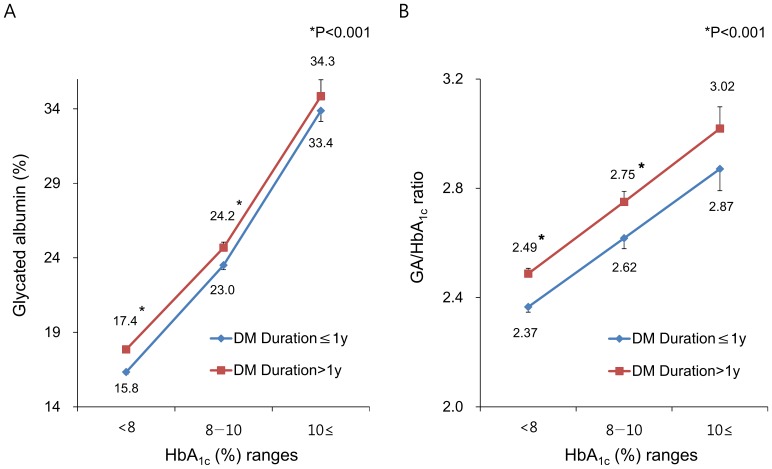
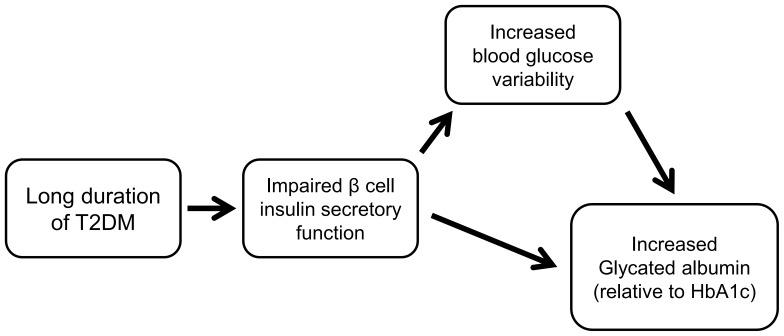
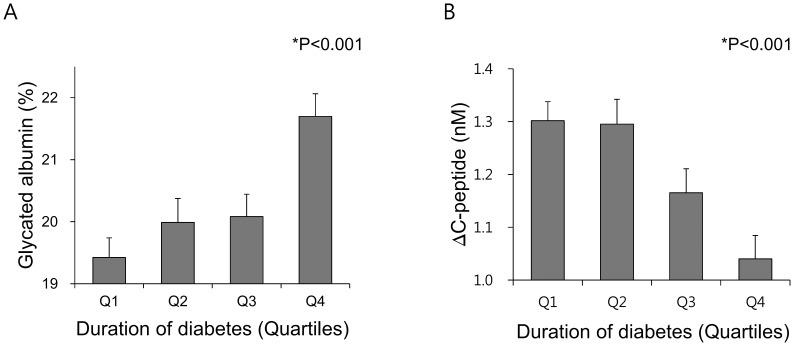
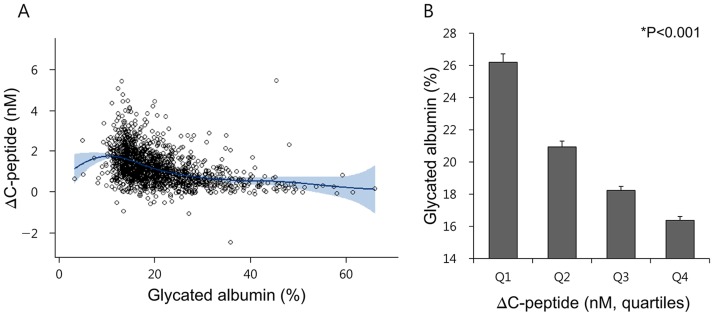
GA levels were significantly elevated in HbA1c-matched Old-T2D subjects compared to New-T2D subjects. Duration of diabetes was positively correlated with GA, whereas a negative relationship was found with C-peptide increment (ΔC-peptide). Among insulin secretory indices, dynamic parameters such as ΔC-peptide were inversely related to GA (r = -0.42, p<0.001). Multiple linear regression analyses showed that duration of diabetes was associated with GA (standardized β coefficient [STDβ] = 0.05, p<0.001), but not with HbA1c (STDβ = 0.04, p<0.095). This association disappeared after additional adjustment with ΔC-peptide (STDβ = 0.02, p = 0.372), suggesting that β-cell function might be a linking factor of close relationship between duration of diabetes and GA values.
The present study showed that GA levels were significantly increased in subjects with longer duration T2D and with decreased insulin secretory function. Additional caution should be taken when interpreting GA values to assess glycemic control status in these individuals.
糖化白蛋白(GA)已越来越多地被用作短期血糖监测的可靠指标,且与β细胞功能呈负相关。由于2型糖尿病(T2D)的病理生理本质特征是胰岛素分泌逐渐下降,因此本研究旨在确定GA水平是否受T2D患者糖尿病病程的影响。
为尽量减少血糖变异性对GA的影响,纳入了在6个月测量期间糖化血红蛋白(HbA1c)水平稳定维持、波动<0.5%的受试者。招募了新诊断的T2D患者(n = 1059)和病程>1年的患者(n = 781),分别归类为新诊断T2D组和病程较长T2D组。测量生化、血糖和C肽参数。
与新诊断T2D组相比,HbA1c匹配的病程较长T2D组受试者的GA水平显著升高。糖尿病病程与GA呈正相关,而与C肽增量(ΔC肽)呈负相关。在胰岛素分泌指标中,诸如ΔC肽等动态参数与GA呈负相关(r = -0.42,p<0.001)。多元线性回归分析显示,糖尿病病程与GA相关(标准化β系数[STDβ]=0.05,p<0.001),但与HbA1c无关(STDβ=0.04,p<0.095)。在加入ΔC肽进行进一步校正后,这种相关性消失(STDβ=0.02,p = 0.372),这表明β细胞功能可能是糖尿病病程与GA值之间密切关系的一个关联因素。
本研究表明,T2D病程较长且胰岛素分泌功能下降的受试者GA水平显著升高。在解释这些个体的GA值以评估血糖控制状态时应格外谨慎。