Di Giuseppe Daniela, Crippa Alessio, Orsini Nicola, Wolk Alicja
Arthritis Res Ther. 2014 Sep 30;16(5):446. doi: 10.1186/s13075-014-0446-8.
The association between fish consumption and rheumatoid arthritis (RA) is unclear. The aim of this paper was to summarize the available evidence on the association between fish consumption and risk of RA using a dose-response meta-analysis.
Relevant studies were identified by a search of MEDLINE and EMBASE through December 2013, with no restrictions. A random-effects dose-response meta-analysis was conducted to combine study specific relative risks. Potential non-linear relation was investigated using restricted cubic splines. A stratified analysis was conducted by study design.
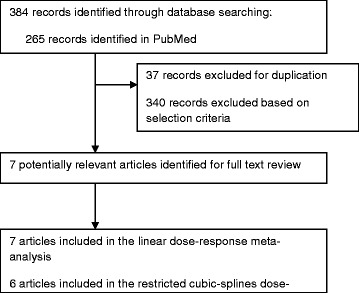
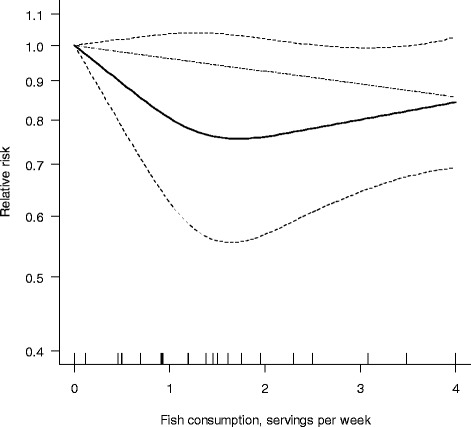
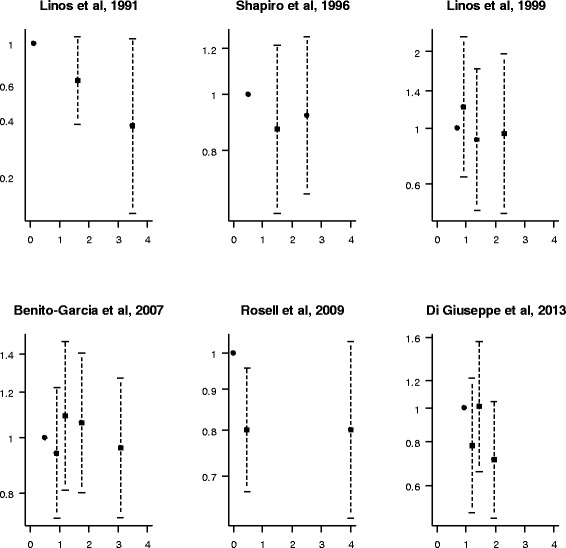
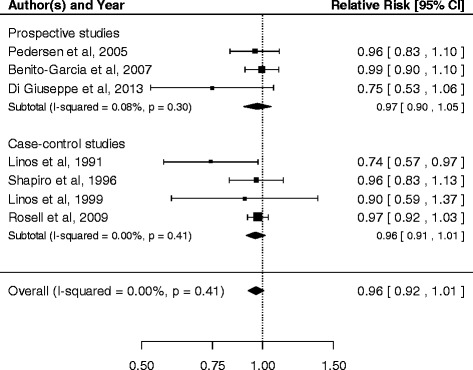
Seven studies (four case-controls and three prospective cohorts) involving a total of 174 701 participants and 3346 cases were included in the meta-analysis. For each one serving per week increment in fish consumption, the relative risk (RR) of RA was 0.96 (95% confidence interval (CI) 0.91 to 1.01). Results did not change when stratifying by study design. No heterogeneity or publication bias was observed. When fish consumption was modeled using restricted cubic splines, the risk of RA was 20 to 24% lower for 1 up to 3 servings per week of fish (RR =0.76, 95% CI: 0.57 to 1.02) as compared to never consumption.
Results from this dose-response meta-analysis showed a non-statistically significant inverse association between fish consumption and RA.
鱼类消费与类风湿性关节炎(RA)之间的关联尚不清楚。本文旨在通过剂量反应荟萃分析总结鱼类消费与RA风险之间关联的现有证据。
通过检索截至2013年12月的MEDLINE和EMBASE来确定相关研究,无任何限制。进行随机效应剂量反应荟萃分析以合并各研究的特定相对风险。使用受限立方样条研究潜在的非线性关系。按研究设计进行分层分析。
荟萃分析纳入了7项研究(4项病例对照研究和3项前瞻性队列研究),共涉及174701名参与者和3346例病例。每周鱼类消费量每增加一份,RA的相对风险(RR)为0.96(95%置信区间(CI)0.91至1.01)。按研究设计分层时结果不变。未观察到异质性或发表偏倚。当使用受限立方样条对鱼类消费进行建模时,与从不食用鱼类相比,每周食用1至3份鱼类时RA风险降低20%至24%(RR =0.76,95%CI:0.57至1.02)。
该剂量反应荟萃分析的结果显示鱼类消费与RA之间存在非统计学显著的负相关。