Departments of Physiology, East Carolina University Greenville, NC, USA ; East Carolina Diabetes and Obesity Institute, East Carolina University Greenville, NC, USA.
East Carolina Diabetes and Obesity Institute, East Carolina University Greenville, NC, USA ; Pharmacology and Toxicology, Brody School of Medicine, East Carolina University Greenville, NC, USA.
Front Physiol. 2014 Sep 18;5:358. doi: 10.3389/fphys.2014.00358. eCollection 2014.
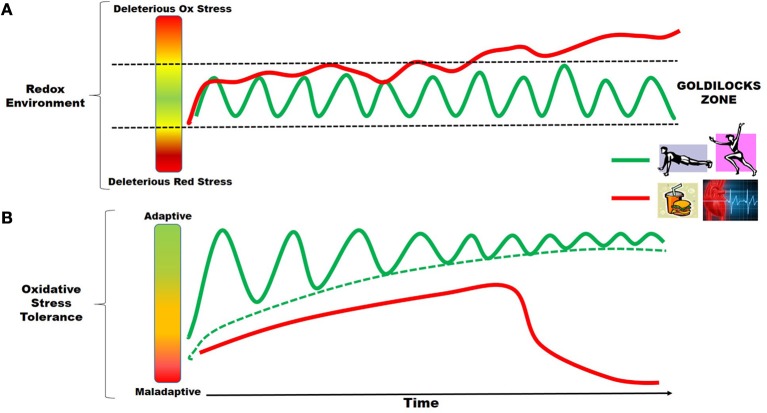
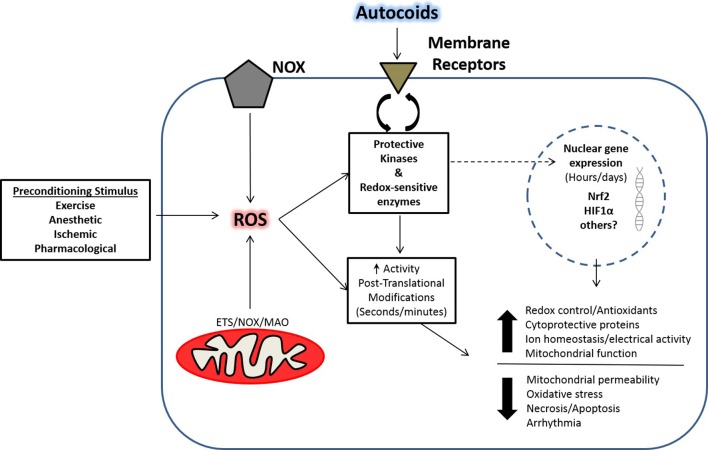
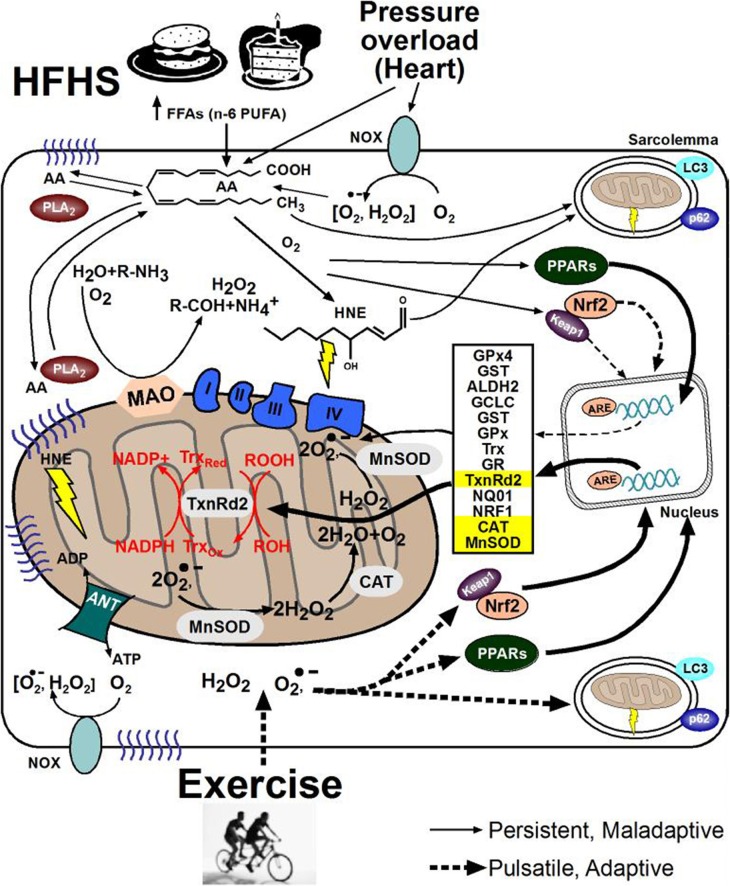
Consequences of oxidative stress may be beneficial or detrimental in physiological systems. An organ system's position on the "hormetic curve" is governed by the source and temporality of reactive oxygen species (ROS) production, proximity of ROS to moieties most susceptible to damage, and the capacity of the endogenous cellular ROS scavenging mechanisms. Most importantly, the resilience of the tissue (the capacity to recover from damage) is a decisive factor, and this is reflected in the disparate response to ROS in cardiac and skeletal muscle. In myocytes, a high oxidative capacity invariably results in a significant ROS burden which in homeostasis, is rapidly neutralized by the robust antioxidant network. The up-regulation of key pathways in the antioxidant network is a central component of the hormetic response to ROS. Despite such adaptations, persistent oxidative stress over an extended time-frame (e.g., months to years) inevitably leads to cumulative damages, maladaptation and ultimately the pathogenesis of chronic diseases. Indeed, persistent oxidative stress in heart and skeletal muscle has been repeatedly demonstrated to have causal roles in the etiology of heart disease and insulin resistance, respectively. Deciphering the mechanisms that underlie the divergence between adaptive and maladaptive responses to oxidative stress remains an active area of research for basic scientists and clinicians alike, as this would undoubtedly lead to novel therapeutic approaches. Here, we provide an overview of major types of ROS in striated muscle and the divergent adaptations that occur in response to them. Emphasis is placed on highlighting newly uncovered areas of research on this topic, with particular focus on the mitochondria, and the diverging roles that ROS play in muscle health (e.g., exercise or preconditioning) and disease (e.g., cardiomyopathy, ischemia, metabolic syndrome).
氧化应激的后果在生理系统中可能是有益的,也可能是有害的。一个器官系统在“适应原曲线”上的位置取决于活性氧(ROS)产生的来源和时间性、ROS 与最易受损部分的接近程度,以及内源性细胞 ROS 清除机制的能力。最重要的是,组织的弹性(从损伤中恢复的能力)是一个决定性因素,这反映在心脏和骨骼肌对 ROS 的不同反应上。在心肌细胞中,高氧化能力通常会导致大量的 ROS 负担,而在体内平衡中,强大的抗氧化网络会迅速将其中和。抗氧化网络中关键途径的上调是 ROS 适应原反应的一个核心组成部分。尽管有这些适应,在较长时间内(例如数月至数年)持续的氧化应激不可避免地会导致累积损伤、适应不良,最终导致慢性疾病的发病机制。事实上,心脏和骨骼肌中持续的氧化应激已被反复证明在心脏病和胰岛素抵抗的发病机制中分别具有因果作用。阐明适应和不适应氧化应激的机制之间的分歧的机制仍然是基础科学家和临床医生的一个活跃研究领域,因为这无疑将导致新的治疗方法。在这里,我们提供了横纹肌中主要类型的 ROS 以及对其的不同适应的概述。重点强调了这一主题新发现的研究领域,特别是线粒体,以及 ROS 在肌肉健康(例如运动或预处理)和疾病(例如心肌病、缺血、代谢综合征)中的不同作用。