Konstantinou George N, Bencharitiwong Ramon, Grishin Alexander, Caubet Jean-Christoph, Bardina Luda, Sicherer Scott H, Sampson Hugh A, Nowak-Węgrzyn Anna
Division of Allergy & Immunology and The Jaffe Food Allergy Research Institute, Icahn School of Medicine at Mount Sinai, New York, NY, USA; Department of Allergy and Clinical Immunology, 424 General Military Training Hospital, Thessaloniki, Greece.
Pediatr Allergy Immunol. 2014 Nov;25(7):651-6. doi: 10.1111/pai.12288. Epub 2014 Nov 21.
Food protein-induced enterocolitis syndrome (FPIES) is a gastrointestinal hypersensitivity disorder with a poorly understood pathophysiology and no biomarkers to aid in diagnosis.
To investigate humoral and cellular responses to casein in children with milk-FPIES, including the role of casein-specific (cs) IgA and T-cell mediated TGF-β responses.
Thirty-one children previously diagnosed with milk-FPIES were challenged with milk. Twelve age-matched children with FPIES to other foods and 6 milk-tolerant children without a history of FPIES were used as controls. Casein-specific IgE, IgG, IgG4, and IgA were measured in serum and TGF-β levels in supernatants of casein-stimulated PBMCs.
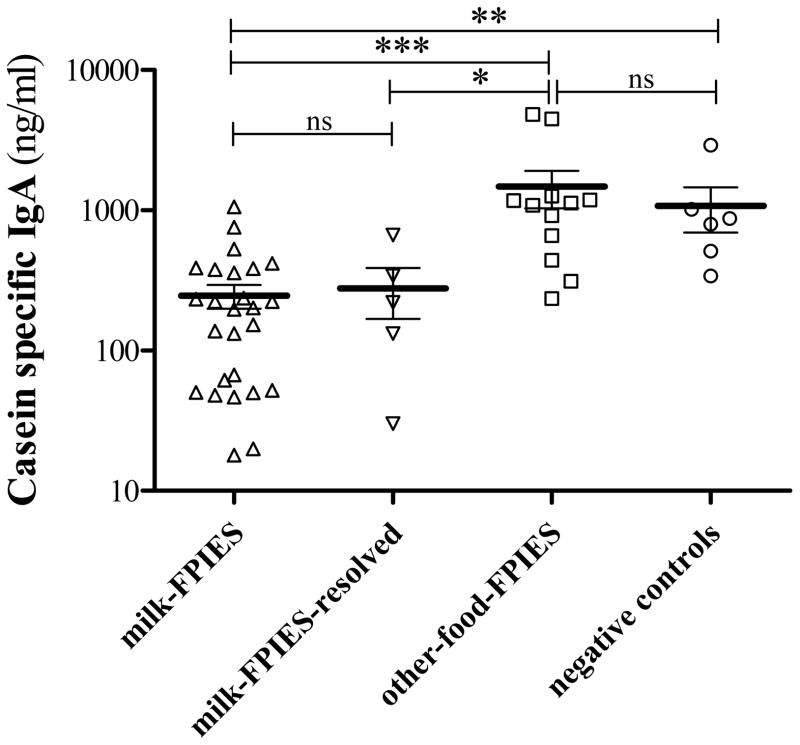
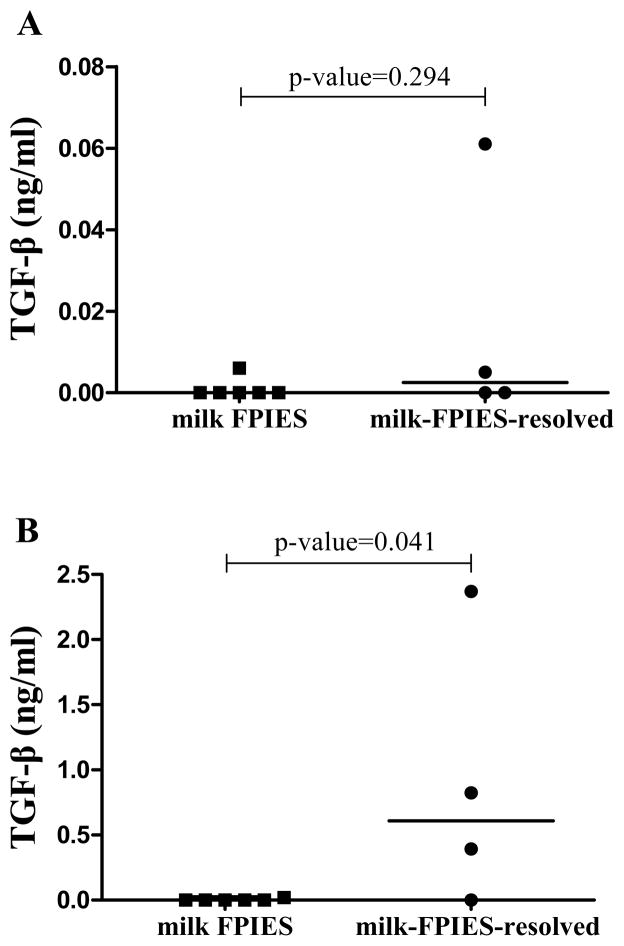
Twenty-six children with milk-FPIES reacted (active milk-FPIES) and five tolerated milk (milk-FPIES resolved) during food challenge. All of them had significantly lower levels of csIgG, csIgG4, and csIgA than control children (p-value<0.001). There were no TGF-β responses in supernatants of active milk-FPIES children.
Children with milk-FPIES have low levels of csIgG, csIgG4, and csIgA. In particular, children with active FPIES to cow's milk have deficient T-cell mediated TGF-β responses to casein, rendering TGF-β a promising biomarker in identifying children who are likely to experience FPIES reactions to this allergen. Prospective studies are needed to validate these findings, elucidate their role in FPIES pathophysiology, and establish the diagnostic utility of TGF-β in milk-induced FPIES.
食物蛋白诱导的小肠结肠炎综合征(FPIES)是一种胃肠道超敏性疾病,其病理生理学机制尚不清楚,且缺乏有助于诊断的生物标志物。
研究牛奶FPIES患儿对酪蛋白的体液和细胞反应,包括酪蛋白特异性(cs)IgA和T细胞介导的转化生长因子-β(TGF-β)反应的作用。
31名先前诊断为牛奶FPIES的儿童接受牛奶激发试验。12名年龄匹配的对其他食物有FPIES的儿童和6名无FPIES病史的牛奶耐受儿童作为对照。检测血清中酪蛋白特异性IgE、IgG、IgG4和IgA以及酪蛋白刺激的外周血单个核细胞(PBMCs)上清液中的TGF-β水平。
26名牛奶FPIES儿童在食物激发试验中有反应(活动性牛奶FPIES),5名耐受牛奶(牛奶FPIES缓解)。他们所有人体内的csIgG、csIgG4和csIgA水平均显著低于对照儿童(p值<0.001)。活动性牛奶FPIES儿童的上清液中没有TGF-β反应。
牛奶FPIES儿童体内的csIgG、csIgG4和csIgA水平较低。特别是,对牛奶有活动性FPIES的儿童对酪蛋白的T细胞介导的TGF-β反应不足,这使得TGF-β成为识别可能对这种过敏原发生FPIES反应儿童的有前景的生物标志物。需要进行前瞻性研究来验证这些发现,阐明它们在FPIES病理生理学中的作用,并确定TGF-β在牛奶诱导的FPIES中的诊断效用。