Li Jing, Rodnin Mykola V, Ladokhin Alexey S, Gross Michael L
Department of Chemistry, Washington University , St. Louis, Missouri 63130, United States.
Biochemistry. 2014 Nov 4;53(43):6849-56. doi: 10.1021/bi500893y. Epub 2014 Oct 23.
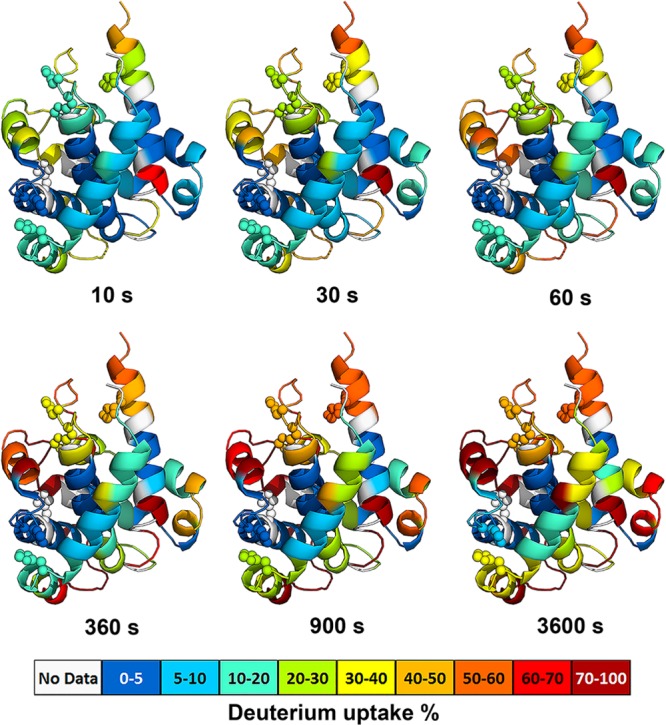
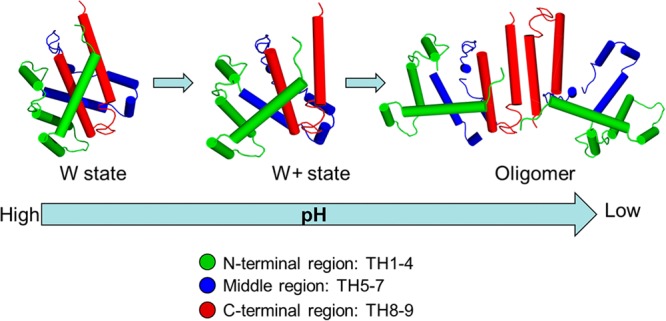
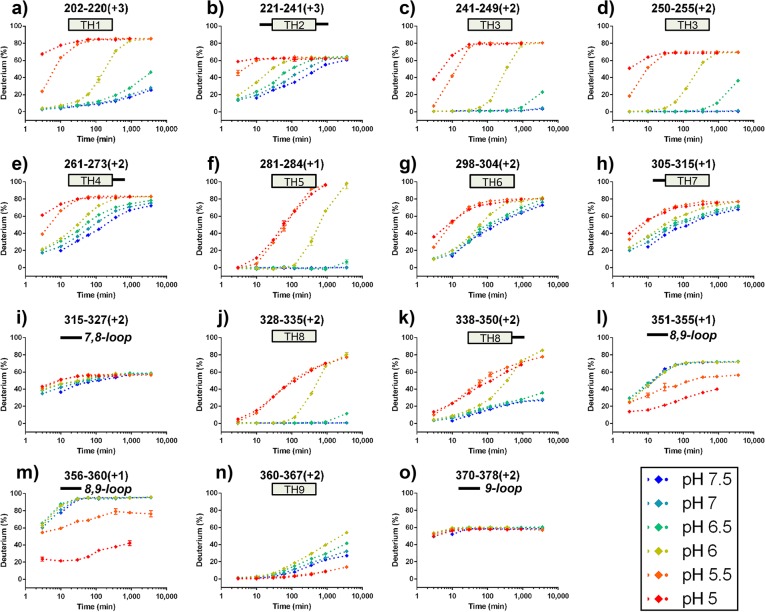
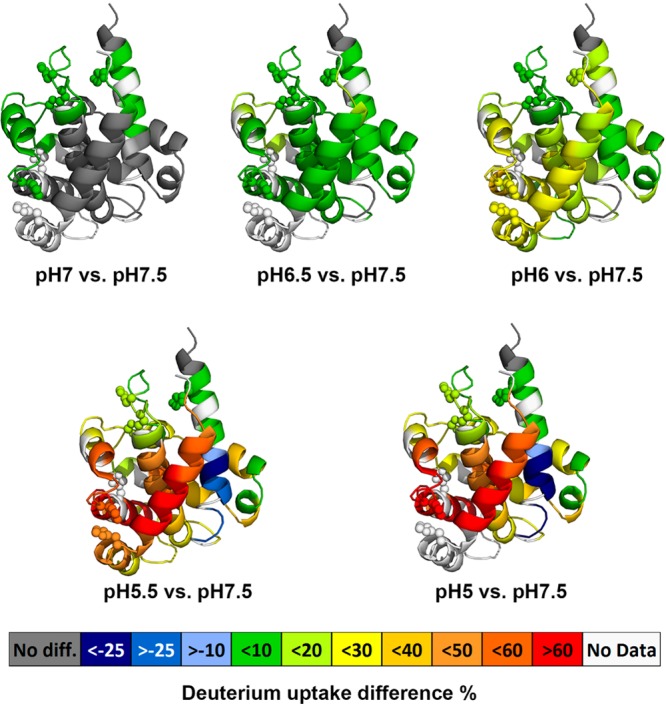
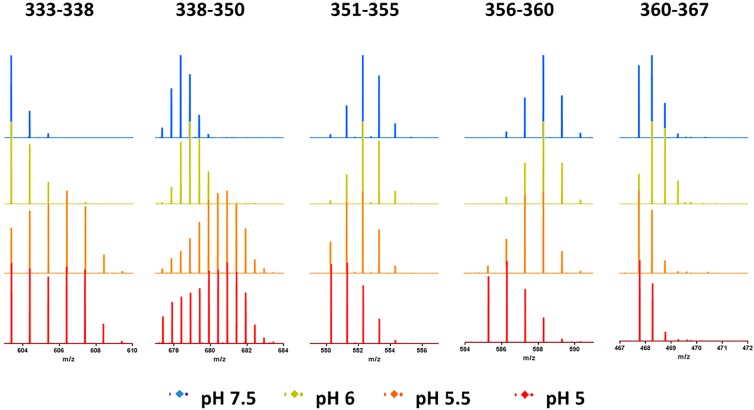
The translocation (T) domain of diphtheria toxin plays a critical role in moving the catalytic domain across the endosomal membrane. Translocation/insertion is triggered by a decrease in pH in the endosome where conformational changes of T domain occur through several kinetic intermediates to yield a final trans-membrane form. High-resolution structural studies are only applicable to the static T-domain structure at physiological pH, and studies of the T-domain translocation pathway are hindered by the simultaneous presence of multiple conformations. Here, we report the application of hydrogen-deuterium exchange mass spectrometry (HDX-MS) for the study of the pH-dependent conformational changes of the T domain in solution. Effects of pH on intrinsic HDX rates were deconvolved by converting the on-exchange times at low pH into times under our "standard condition" (pH 7.5). pH-Dependent HDX kinetic analysis of T domain clearly reveals the conformational transition from the native state (W-state) to a membrane-competent state (W(+)-state). The initial transition occurs at pH 6 and includes the destabilization of N-terminal helices accompanied by the separation between N- and C-terminal segments. The structural rearrangements accompanying the formation of the membrane-competent state expose a hydrophobic hairpin (TH8-9) to solvent, prepare it to insert into the membrane. At pH 5.5, the transition is complete, and the protein further unfolds, resulting in the exposure of its C-terminal hydrophobic TH8-9, leading to subsequent aggregation in the absence of membranes. This solution-based study complements high resolution crystal structures and provides a detailed understanding of the pH-dependent structural rearrangement and acid-induced oligomerization of T domain.
白喉毒素的转位(T)结构域在催化结构域穿过内体膜的过程中起着关键作用。转位/插入是由内体中pH值的降低触发的,在那里T结构域通过几种动力学中间体发生构象变化,产生最终的跨膜形式。高分辨率结构研究仅适用于生理pH值下的静态T结构域结构,并且由于多种构象同时存在,T结构域转位途径的研究受到阻碍。在这里,我们报告了氢-氘交换质谱(HDX-MS)在研究溶液中T结构域pH依赖性构象变化中的应用。通过将低pH值下的交换时间转换为我们的“标准条件”(pH 7.5)下的时间,反卷积了pH对内在HDX速率的影响。T结构域的pH依赖性HDX动力学分析清楚地揭示了从天然状态(W态)到膜活性状态(W(+)态)的构象转变。初始转变发生在pH 6时,包括N端螺旋的不稳定,伴随着N端和C端片段之间的分离。伴随膜活性状态形成的结构重排使一个疏水发夹(TH8-9)暴露于溶剂中,使其准备插入膜中。在pH 5.5时,转变完成,蛋白质进一步展开,导致其C端疏水的TH8-9暴露,在没有膜的情况下导致随后的聚集。这项基于溶液的研究补充了高分辨率晶体结构,并提供了对T结构域pH依赖性结构重排和酸诱导寡聚化的详细理解。