Chen Chi-Huang, Tan Shun-Jen, Tzeng Chii-Ruey
J Ovarian Res. 2014 Aug 15;7:81. doi: 10.1186/s13048-014-0081-7.
Cryopreservation of ovarian tissue has been suggested as an alternative to restore fertility for ovarian failure before chemotherapy.
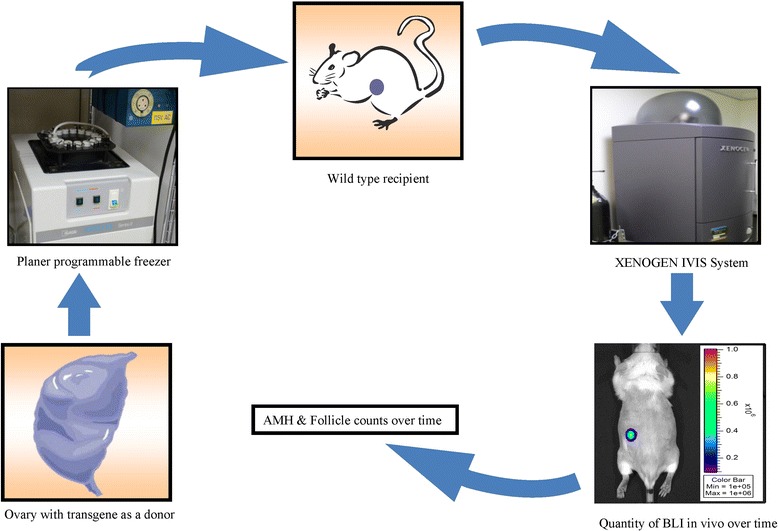
Ovaries of donor FVB/N-Tg (PolII-Luc) Ltc transgenic mice (n = 5) were cryopreserved and transplanted to the back muscles of recipient FVB/NJNarl wild-type mice that had undergone bilateral oophorectomy. We evaluated the fate of cryopreserved murine ovarian grafts by in vivo bioluminescent imaging (BLI), AMH mRNA expression and follicle counts.
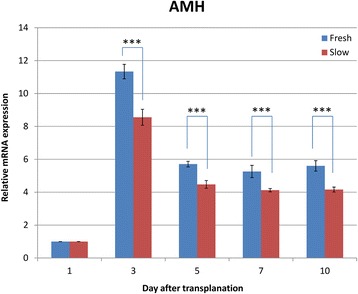
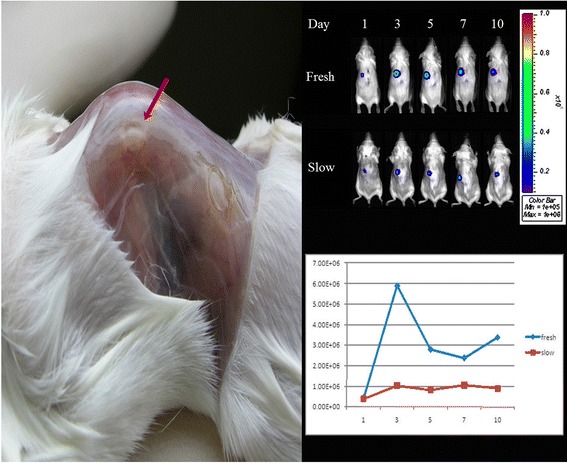
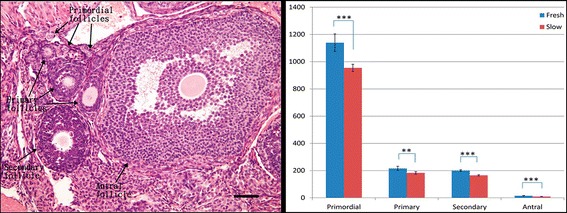
There were significantly stronger BLI signals in the fresh ovaries than in the frozen-thawed ones. The number of primordial follicles was significantly lower in frozen-thawed ovaries at 10 days after transplantation (P < 0.001). The AMH mRNA expression was significantly lower in the frozen-thawed ovaries (P < 0.001), showing that unavoidable harm occurs after transplantation.
Ovarian cryopreservation by slow freezing compromises ovarian reserve by cryoinjury and ischemia, evident at an early stage after transplantation.
卵巢组织冷冻保存已被提议作为化疗前卵巢功能衰竭恢复生育能力的一种替代方法。
将供体FVB/N-Tg (PolII-Luc) Ltc转基因小鼠(n = 5)的卵巢进行冷冻保存,然后移植到已接受双侧卵巢切除术的受体FVB/NJNarl野生型小鼠的背部肌肉中。我们通过体内生物发光成像(BLI)、抗缪勒管激素(AMH)mRNA表达和卵泡计数来评估冷冻保存的小鼠卵巢移植体的命运。
新鲜卵巢中的BLI信号明显强于冻融后的卵巢。移植后10天时,冻融卵巢中的原始卵泡数量显著减少(P < 0.001)。冻融卵巢中的AMH mRNA表达显著降低(P < 0.001),表明移植后会发生不可避免的损害。
通过慢速冷冻进行卵巢冷冻保存会因冷冻损伤和局部缺血而损害卵巢储备,这在移植后的早期阶段就很明显。