• 文献检索
  • 文档翻译
  • 深度研究
  • 学术资讯
  • Suppr Zotero 插件Zotero 插件
  • 邀请有礼
  • 套餐&价格
  • 历史记录
应用&插件
Suppr Zotero 插件Zotero 插件浏览器插件Mac 客户端Windows 客户端微信小程序
定价
高级版会员购买积分包购买API积分包
服务
文献检索文档翻译深度研究API 文档MCP 服务
关于我们
关于 Suppr公司介绍联系我们用户协议隐私条款
关注我们

Suppr 超能文献

核心技术专利:CN118964589B侵权必究
粤ICP备2023148730 号-1Suppr @ 2026

文献检索

告别复杂PubMed语法,用中文像聊天一样搜索,搜遍4000万医学文献。AI智能推荐,让科研检索更轻松。

立即免费搜索

文件翻译

保留排版,准确专业,支持PDF/Word/PPT等文件格式,支持 12+语言互译。

免费翻译文档

深度研究

AI帮你快速写综述,25分钟生成高质量综述,智能提取关键信息,辅助科研写作。

立即免费体验

缺血性中风后功能结局的统计预测与临床预测比较

Comparison of statistical and clinical predictions of functional outcome after ischemic stroke.

作者信息

Thompson Douglas D, Murray Gordon D, Sudlow Cathie L M, Dennis Martin, Whiteley William N

机构信息

Centre for Population Health Sciences, University of Edinburgh, Edinburgh, United Kingdom.

Centre for Clinical Brain Sciences, University of Edinburgh, Edinburgh, United Kingdom.

出版信息

PLoS One. 2014 Oct 9;9(10):e110189. doi: 10.1371/journal.pone.0110189. eCollection 2014.

DOI:10.1371/journal.pone.0110189
PMID:25299053
原文链接:https://pmc.ncbi.nlm.nih.gov/articles/PMC4192583/
Abstract

BACKGROUND

To determine whether the predictions of functional outcome after ischemic stroke made at the bedside using a doctor's clinical experience were more or less accurate than the predictions made by clinical prediction models (CPMs).

METHODS AND FINDINGS

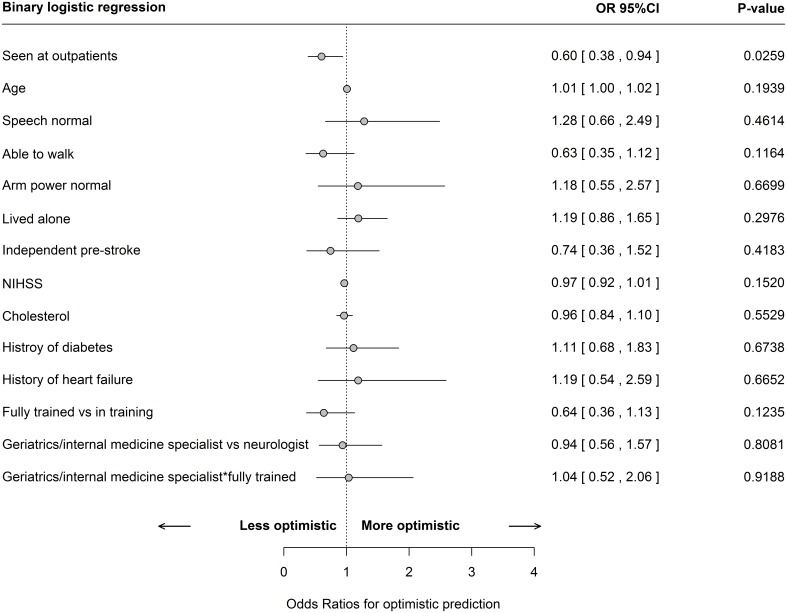
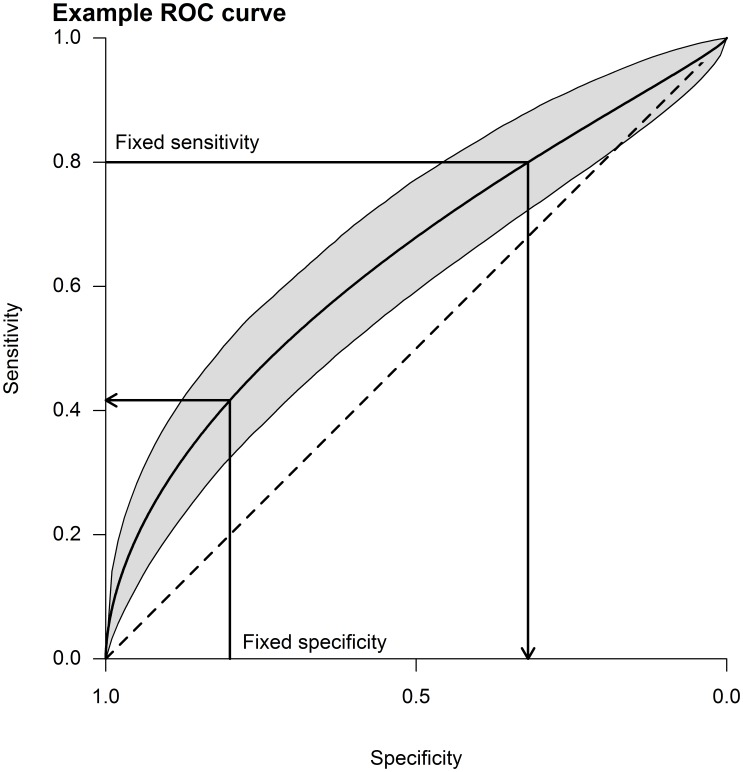
A prospective cohort study of nine hundred and thirty one ischemic stroke patients recruited consecutively at the outpatient, inpatient and emergency departments of the Western General Hospital, Edinburgh between 2002 and 2005. Doctors made informal predictions of six month functional outcome on the Oxford Handicap Scale (OHS). Patients were followed up at six months with a validated postal questionnaire. For each patient we calculated the absolute predicted risk of death or dependence (OHS≥3) using five previously described CPMs. The specificity of a doctor's informal predictions of OHS≥3 at six months was good 0.96 (95% CI: 0.94 to 0.97) and similar to CPMs (range 0.94 to 0.96); however the sensitivity of both informal clinical predictions 0.44 (95% CI: 0.39 to 0.49) and clinical prediction models (range 0.38 to 0.45) was poor. The prediction of the level of disability after stroke was similar for informal clinical predictions (ordinal c-statistic 0.74 with 95% CI 0.72 to 0.76) and CPMs (range 0.69 to 0.75). No patient or clinician characteristic affected the accuracy of informal predictions, though predictions were more accurate in outpatients.

CONCLUSIONS

CPMs are at least as good as informal clinical predictions in discriminating between good and bad functional outcome after ischemic stroke. The place of these models in clinical practice has yet to be determined.

摘要

背景

确定在床边使用医生临床经验对缺血性中风后功能结局的预测是否比临床预测模型(CPMs)做出的预测更准确或更不准确。

方法与结果

对2002年至2005年间在爱丁堡西部总医院门诊、住院部和急诊科连续招募的931例缺血性中风患者进行前瞻性队列研究。医生根据牛津残疾量表(OHS)对六个月的功能结局进行非正式预测。在六个月时通过一份经过验证的邮寄问卷对患者进行随访。对于每位患者,我们使用五个先前描述的CPMs计算死亡或依赖(OHS≥3)的绝对预测风险。医生对六个月时OHS≥3的非正式预测的特异性良好,为0.96(95%CI:0.94至0.97),与CPMs相似(范围为0.94至0.96);然而,非正式临床预测的敏感性为0.44(95%CI:0.39至0.49),临床预测模型的敏感性(范围为0.38至0.45)均较差。中风后残疾水平的预测在非正式临床预测(序数c统计量为0.74,95%CI为0.72至0.76)和CPMs(范围为0.69至0.75)方面相似。没有患者或临床医生特征影响非正式预测的准确性,尽管门诊患者的预测更准确。

结论

在区分缺血性中风后良好和不良功能结局方面,CPMs至少与非正式临床预测一样好。这些模型在临床实践中的地位尚未确定。
https://cdn.ncbi.nlm.nih.gov/pmc/blobs/8d31/4192583/366c4ae6b2f1/pone.0110189.g002.jpg
https://cdn.ncbi.nlm.nih.gov/pmc/blobs/8d31/4192583/d729d4588f84/pone.0110189.g001.jpg
https://cdn.ncbi.nlm.nih.gov/pmc/blobs/8d31/4192583/366c4ae6b2f1/pone.0110189.g002.jpg
https://cdn.ncbi.nlm.nih.gov/pmc/blobs/8d31/4192583/d729d4588f84/pone.0110189.g001.jpg
https://cdn.ncbi.nlm.nih.gov/pmc/blobs/8d31/4192583/366c4ae6b2f1/pone.0110189.g002.jpg

相似文献

1
Comparison of statistical and clinical predictions of functional outcome after ischemic stroke.缺血性中风后功能结局的统计预测与临床预测比较
PLoS One. 2014 Oct 9;9(10):e110189. doi: 10.1371/journal.pone.0110189. eCollection 2014.
2
Predicting functional outcome in acute stroke: comparison of a simple six variable model with other predictive systems and informal clinical prediction.预测急性中风的功能转归:简单六变量模型与其他预测系统及非正式临床预测的比较
J Neurol Neurosurg Psychiatry. 2004 Mar;75(3):401-5. doi: 10.1136/jnnp.2003.018085.
3
JURaSSiC: accuracy of clinician vs risk score prediction of ischemic stroke outcomes.JURaSSiC:临床医生与风险评分预测缺血性脑卒中结局的准确性。
Neurology. 2013 Jul 30;81(5):448-55. doi: 10.1212/WNL.0b013e31829d874e. Epub 2013 Jun 28.
4
Simple prediction scores predict good and devastating outcomes after stroke more accurately than physicians.简单的预测评分比医生更能准确预测中风后的良好和严重结局。
Age Ageing. 2017 May 1;46(3):421-426. doi: 10.1093/ageing/afw197.
5
Accuracy of physical therapists' early predictions of upper-limb function in hospital stroke units: the EPOS Study.物理治疗师在医院卒中单元对上肢功能早期预测的准确性:EPOS 研究。
Phys Ther. 2013 Apr;93(4):460-9. doi: 10.2522/ptj.20120112. Epub 2012 Nov 8.
6
Field Synopsis of the Role of Sex in Stroke Prediction Models.性别在中风预测模型中的作用概述
J Am Heart Assoc. 2016 May 5;5(5):e002809. doi: 10.1161/JAHA.115.002809.
7
Validation of two risk-prediction models for recurrent falls in the first year after stroke: a prospective cohort study.两种中风后第一年复发性跌倒风险预测模型的验证:一项前瞻性队列研究。
Age Ageing. 2017 Jul 1;46(4):642-648. doi: 10.1093/ageing/afw255.
8
External Validation of the Totaled Health Risks in Vascular Events Score to Predict Functional Outcome and Mortality in Patients Entered into the China National Stroke Registry.对中国国家卒中登记研究中纳入患者的血管事件总健康风险评分预测功能转归和死亡率的外部验证
J Stroke Cerebrovasc Dis. 2016 Oct;25(10):2331-7. doi: 10.1016/j.jstrokecerebrovasdis.2016.03.021. Epub 2016 Aug 17.
9
Accuracy of prediction of walking for young stroke patients by use of the FIM.使用功能独立性测量量表(FIM)对年轻中风患者步行能力的预测准确性。
Physiother Res Int. 2001;6(1):1-14. doi: 10.1002/pri.209.
10
Significance of large vessel intracranial occlusion causing acute ischemic stroke and TIA.大血管颅内闭塞导致急性缺血性卒中和 TIA 的意义。
Stroke. 2009 Dec;40(12):3834-40. doi: 10.1161/STROKEAHA.109.561787. Epub 2009 Oct 15.

引用本文的文献

1
Predicting 90-Day Prognosis in Ischemic Stroke Patients Post Thrombolysis Using Machine Learning.使用机器学习预测缺血性中风患者溶栓后的90天预后
J Pers Med. 2023 Oct 30;13(11):1555. doi: 10.3390/jpm13111555.
2
Comparison of outcome prediction models post-stroke for a population-based registry with clinical variables collected at admission . discharge.基于人群登记处的卒中后结局预测模型与入院、出院时收集的临床变量的比较 。 出院 。
Vessel Plus. 2021;5. Epub 2021 Jan 15.
3
Roles of circRNAs on tumor autophagy.环状RNA在肿瘤自噬中的作用。

本文引用的文献

1
Interdependence of stroke outcome scales: reliable estimates from the Virtual International Stroke Trials Archive (VISTA).中风结局量表的相互依赖性:来自虚拟国际中风试验档案库(VISTA)的可靠估计
Int J Stroke. 2014 Apr;9(3):328-32. doi: 10.1111/ijs.12178. Epub 2013 Nov 10.
2
JURaSSiC: accuracy of clinician vs risk score prediction of ischemic stroke outcomes.JURaSSiC:临床医生与风险评分预测缺血性脑卒中结局的准确性。
Neurology. 2013 Jul 30;81(5):448-55. doi: 10.1212/WNL.0b013e31829d874e. Epub 2013 Jun 28.
3
Multivariable risk prediction models: it's all about the performance.
Mol Ther Nucleic Acids. 2021 Jan 9;23:918-929. doi: 10.1016/j.omtn.2021.01.002. eCollection 2021 Mar 5.
4
The Association Between an Antecedent of Transient Ischemic Attack Prior to Onset of Stroke and Functional Ambulatory Outcome.卒中发病前短暂性脑缺血发作史与功能性步行结局的关系。
Clin Appl Thromb Hemost. 2020 Jan-Dec;26:1076029620906867. doi: 10.1177/1076029620906867.
5
Modified systemic inflammatory response syndrome and provider gestalt predicting adverse outcomes in children under 5 years presenting to an urban emergency department of a tertiary hospital in Tanzania.改良全身炎症反应综合征及医疗人员的整体判断对坦桑尼亚一家三级医院城市急诊科5岁以下儿童不良结局的预测作用
Trop Med Health. 2019 Feb 1;47:13. doi: 10.1186/s41182-019-0136-y. eCollection 2019.
6
Development of a decision analytic model to support decision making and risk communication about thrombolytic treatment.开发一种决策分析模型,以支持关于溶栓治疗的决策制定和风险沟通。
BMC Med Inform Decis Mak. 2015 Nov 11;15:90. doi: 10.1186/s12911-015-0213-z.
7
Classification algorithms with multi-modal data fusion could accurately distinguish neuromyelitis optica from multiple sclerosis.具有多模态数据融合的分类算法能够准确地区分视神经脊髓炎和多发性硬化症。
Neuroimage Clin. 2015 Jan 9;7:306-14. doi: 10.1016/j.nicl.2015.01.001. eCollection 2015.
多变量风险预测模型:关键在于性能。
Anesthesiology. 2013 Jun;118(6):1252-3. doi: 10.1097/ALN.0b013e31828e13e9.
4
External validation of the iScore for predicting ischemic stroke mortality in patients in China.中国人群中 iScore 预测缺血性脑卒中患者死亡率的外部验证。
Stroke. 2013 Jul;44(7):1924-9. doi: 10.1161/STROKEAHA.111.000172. Epub 2013 May 7.
5
ASTRAL score predicts 5-year dependence and mortality in acute ischemic stroke.ASTRAL 评分可预测急性缺血性脑卒中 5 年内的依赖和死亡率。
Stroke. 2013 Jun;44(6):1616-20. doi: 10.1161/STROKEAHA.113.001047. Epub 2013 Apr 4.
6
Discrimination ability of prediction models for ordinal outcomes: relationships between existing measures and a new measure.有序结局预测模型的判别能力:现有指标与新指标之间的关系
Biom J. 2012 Sep;54(5):674-85. doi: 10.1002/bimj.201200026. Epub 2012 Jun 19.
7
An integer-based score to predict functional outcome in acute ischemic stroke: the ASTRAL score.基于整数的评分预测急性缺血性脑卒中的功能结局:ASTRAL 评分。
Neurology. 2012 Jun 12;78(24):1916-22. doi: 10.1212/WNL.0b013e318259e221. Epub 2012 May 30.
8
Early prediction of outcome of activities of daily living after stroke: a systematic review.早期预测卒中后日常生活活动能力的结局:系统评价。
Stroke. 2011 May;42(5):1482-8. doi: 10.1161/STROKEAHA.110.604090. Epub 2011 Apr 7.
9
IScore: a risk score to predict death early after hospitalization for an acute ischemic stroke.IScore:一种用于预测急性缺血性脑卒中住院后早期死亡的风险评分。
Circulation. 2011 Feb 22;123(7):739-49. doi: 10.1161/CIRCULATIONAHA.110.983353. Epub 2011 Feb 7.
10
A simple scoring system for outcome prediction of ischemic stroke.一种用于预测缺血性脑卒中结局的简单评分系统。
Acta Neurol Scand. 2011 Nov;124(5):334-42. doi: 10.1111/j.1600-0404.2010.01479.x. Epub 2011 Jan 17.