Barnoud Jonathan, Rossi Giulia, Marrink Siewert J, Monticelli Luca
IBCP, CNRS UMR 5086, Lyon, France; Université Claude Bernard Lyon I, Lyon, France.
Dept of Physics, University of Genoa, Genoa, Italy.
PLoS Comput Biol. 2014 Oct 9;10(10):e1003873. doi: 10.1371/journal.pcbi.1003873. eCollection 2014 Oct.
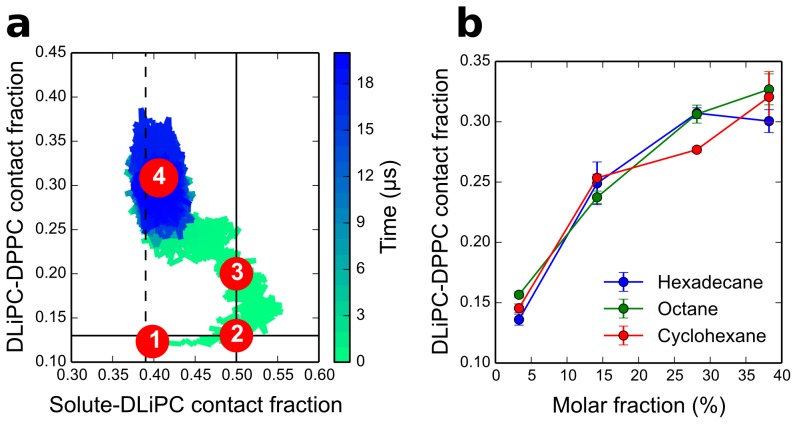
Cell membranes have a complex lateral organization featuring domains with distinct composition, also known as rafts, which play an essential role in cellular processes such as signal transduction and protein trafficking. In vivo, perturbations of membrane domains (e.g., by drugs or lipophilic compounds) have major effects on the activity of raft-associated proteins and on signaling pathways, but they are difficult to characterize because of the small size of the domains, typically below optical resolution. Model membranes, instead, can show macroscopic phase separation between liquid-ordered and liquid-disordered domains, and they are often used to investigate the driving forces of membrane lateral organization. Studies in model membranes have shown that some lipophilic compounds perturb membrane domains, but it is not clear which chemical and physical properties determine domain perturbation. The mechanisms of domain stabilization and destabilization are also unknown. Here we describe the effect of six simple hydrophobic compounds on the lateral organization of phase-separated model membranes consisting of saturated and unsaturated phospholipids and cholesterol. Using molecular simulations, we identify two groups of molecules with distinct behavior: aliphatic compounds promote lipid mixing by distributing at the interface between liquid-ordered and liquid-disordered domains; aromatic compounds, instead, stabilize phase separation by partitioning into liquid-disordered domains and excluding cholesterol from the disordered domains. We predict that relatively small concentrations of hydrophobic species can have a broad impact on domain stability in model systems, which suggests possible mechanisms of action for hydrophobic compounds in vivo.
细胞膜具有复杂的侧向组织,其特征是具有不同组成的结构域,也称为筏,它们在细胞过程如信号转导和蛋白质运输中起着至关重要的作用。在体内,膜结构域的扰动(例如通过药物或亲脂性化合物)对筏相关蛋白的活性和信号通路有重大影响,但由于这些结构域尺寸小,通常低于光学分辨率,因此难以表征。相反,模型膜可以显示出液相有序和液相无序结构域之间的宏观相分离,并且它们经常被用于研究膜侧向组织的驱动力。对模型膜的研究表明,一些亲脂性化合物会扰动膜结构域,但尚不清楚哪些化学和物理性质决定了结构域的扰动。结构域稳定和不稳定的机制也尚不清楚。在这里,我们描述了六种简单的疏水化合物对由饱和和不饱和磷脂以及胆固醇组成的相分离模型膜侧向组织的影响。通过分子模拟,我们确定了两组具有不同行为的分子:脂肪族化合物通过分布在液相有序和液相无序结构域之间的界面来促进脂质混合;相反,芳香族化合物通过分配到液相无序结构域并将胆固醇排除在无序结构域之外来稳定相分离。我们预测,相对低浓度的疏水物质可能会对模型系统中的结构域稳定性产生广泛影响,这提示了疏水化合物在体内可能的作用机制。