Vermandere Heleen, Naanyu Violet, Mabeya Hillary, Vanden Broeck Davy, Michielsen Kristien, Degomme Olivier
International Centre for Reproductive Health, Ghent University, Ghent, Belgium.
Department of Behavioral Sciences, School of Medicine, College of Health Sciences, Moi University, Eldoret, Kenya.
PLoS One. 2014 Oct 9;9(10):e109353. doi: 10.1371/journal.pone.0109353. eCollection 2014.
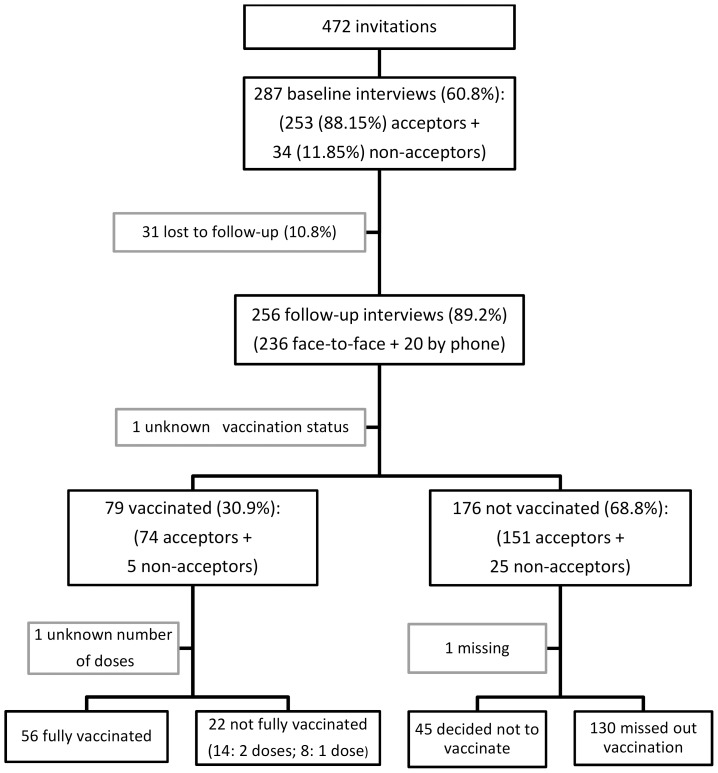
The development of Human Papillomavirus (HPV) vaccines provides new opportunities in the fight against cervical cancer. Many acceptability studies have revealed high interest in these vaccines, but acceptance is only a precursor of behavior, and many factors, at personal, community and provider level, may inhibit the translation of willingness to vaccinate into actual uptake. Through a longitudinal study in Eldoret, Kenya, HPV vaccine acceptability was measured before a vaccination program (n = 287) and vaccine uptake, as reported by mothers, once the program was finished (n = 256). In between baseline and follow-up, a pilot HPV vaccination program was implemented via the GARDASIL Access Program, in which parents could have their daughter vaccinated for free at the referral hospital. The program was promoted at schools: Health staff informed teachers who were then asked to inform students and parents. Even though baseline acceptance was very high (88.1%), only 31.1% of the women reported at follow-up that their daughter had been vaccinated. The vaccine was declined by 17.7%, while another 51.2% had wanted the vaccination but were obstructed by practical barriers. Being well-informed about the program and baseline awareness of cervical cancer were independently associated with vaccine uptake, while baseline acceptance was correlated in bivariate analysis. Side effects were of great concern, even among those whose daughter was vaccinated. Possible partner disapproval lowered acceptance at baseline, and women indeed reported at follow-up that they had encountered his opposition. In Kenya, women prove to be very willing to have their daughter vaccinated against cervical cancer. However, in this study, uptake was more determined by program awareness than by HPV vaccine acceptance. School-based vaccination might improve coverage since it reduces operational problems for parents. In addition, future HPV vaccination campaigns should address concerns about side effects, targeting men and women, given both their involvement in HPV vaccination decision-making.
人乳头瘤病毒(HPV)疫苗的研发为抗击宫颈癌带来了新机遇。许多可接受性研究表明人们对这些疫苗兴趣颇高,但接受只是行为的前奏,个人、社区和提供者层面的诸多因素可能会阻碍将接种意愿转化为实际接种行为。通过在肯尼亚埃尔多雷特开展的一项纵向研究,在疫苗接种项目开展前对HPV疫苗可接受性进行了测量(n = 287),项目结束后由母亲报告疫苗接种情况(n = 256)。在基线和随访期间,通过加德西准入项目实施了一项HPV疫苗接种试点项目,父母可让女儿在转诊医院免费接种。该项目在学校进行了推广:卫生工作人员告知教师,然后由教师告知学生和家长。尽管基线时的接受率很高(88.1%),但随访时只有31.1%的女性报告称其女儿已接种疫苗。17.7%的人拒绝接种,另有51.2%的人虽希望接种但受到实际障碍的阻碍。对项目充分了解以及对宫颈癌的基线认知与疫苗接种独立相关,而在双变量分析中基线接受度与之相关。副作用备受关注,即使在其女儿已接种疫苗的人群中也是如此。可能来自伴侣的反对在基线时降低了接受度,女性在随访时确实报告称遇到了伴侣的反对。在肯尼亚,女性非常愿意让女儿接种宫颈癌疫苗。然而,在本研究中,接种情况更多地取决于对项目的了解程度,而非HPV疫苗的接受度。基于学校的疫苗接种可能会提高覆盖率,因为这减少了家长面临操作问题。此外,未来的HPV疫苗接种活动应针对男性和女性对副作用的担忧,因为他们都参与HPV疫苗接种决策。