Xing Guoqiang, Ren Ming, Verma Ajay
Department of Neurology, Uniformed Services University of the Health Sciences , Bethesda, MD , USA.
Front Neurol. 2014 Sep 11;5:173. doi: 10.3389/fneur.2014.00173. eCollection 2014.
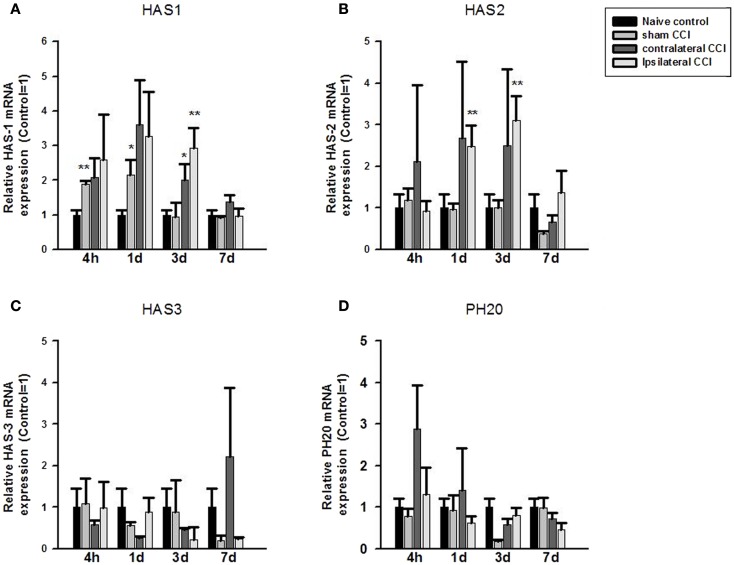
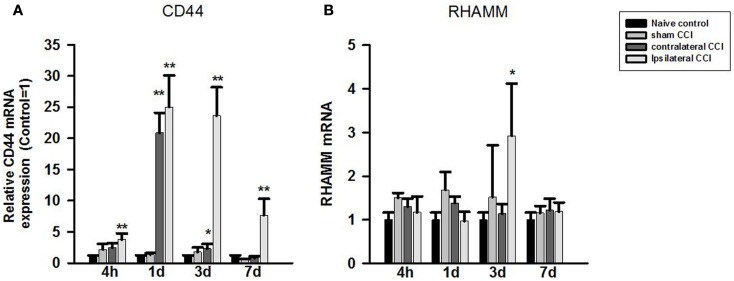
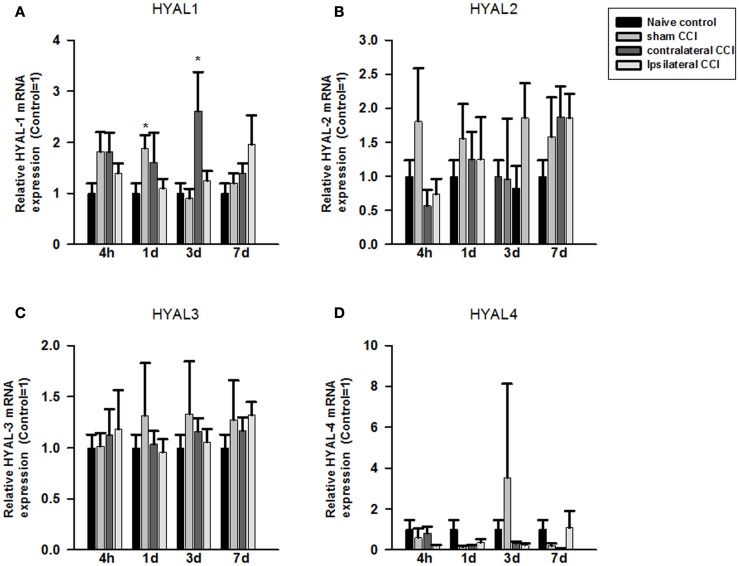
Traumatic brain injury (TBI) triggers many secondary changes in tissue biology, which ultimately determine the extent of injury and clinical outcome. Hyaluronan [hyaluronic acid (HA)] is a protective cementing gel present in the intercellular spaces whose degradation has been reported as a causative factor in tissue damage. Yet little is known about the expression and activities of genes involved in HA catabolism after TBI. Young adult male Sprague-Dawley rats were assigned to three groups: naïve control, craniotomy, and controlled-cortical impact-induced TBI (CCI-TBI). Four animals per group were sacrificed at 4 h, 1, 3, and 7 days post-CCI. The mRNA expression of hyaluronan synthases (HAS1-3), hyaluronidases (enzymes for HA degradation, HYAL 1-4, and PH20), and CD44 and RHAMM (membrane receptors for HA signaling and removal) were determined using real-time PCR. Compared to the naïve controls, expression of HAS1 and HAS2 mRNA, but not HAS3 mRNA increased significantly following craniotomy alone and following CCI with differential kinetics. Expression of HAS2 mRNA increased significantly in the ipsilateral brain at 1 and 3 days post-CCI. HYAL1 mRNA expression also increased significantly in the craniotomy group and in the contralateral CCI at 1 and 3 days post-CCI. CD44 mRNA expression increased significantly in the ipsilateral CCI at 4 h, 1, 3, and 7 days post-CCI (up to 25-fold increase). These data suggest a dynamic regulation and role for HA metabolism in secondary responses to TBI.
创伤性脑损伤(TBI)会引发组织生物学中的许多继发性变化,这些变化最终决定损伤的程度和临床结果。透明质酸(HA)是一种存在于细胞间隙的保护性胶状物质,据报道其降解是组织损伤的一个致病因素。然而,关于TBI后参与HA分解代谢的基因的表达和活性知之甚少。将年轻成年雄性Sprague-Dawley大鼠分为三组:未处理对照组、开颅手术组和控制性皮质撞击诱导的TBI(CCI-TBI)组。每组4只动物在CCI后4小时、1天、3天和7天处死。使用实时PCR测定透明质酸合酶(HAS1-3)、透明质酸酶(HA降解酶,HYAL 1-4和PH20)以及CD44和RHAMM(HA信号传导和清除的膜受体)的mRNA表达。与未处理对照组相比,仅开颅手术后以及CCI后HAS1和HAS2 mRNA的表达显著增加,但HAS3 mRNA没有增加,且具有不同的动力学。CCI后1天和3天,同侧脑内HAS2 mRNA的表达显著增加。在开颅手术组以及CCI后1天和3天的对侧脑内,HYAL1 mRNA的表达也显著增加。CCI后4小时、1天、3天和7天,同侧CCI中CD44 mRNA的表达显著增加(最多增加25倍)。这些数据表明HA代谢在TBI的继发性反应中具有动态调节作用。