Rich Alison Mary, Hussaini Haizal Mohd, Parachuru Venkata P B, Seymour Gregory J
Faculty of Dentistry, Sir John Walsh Research Institute, University of Otago , Dunedin , New Zealand.
Faculty of Dentistry, Department of Oral Pathology and Oral Medicine, National University of Malaysia , Kuala Lumpur , Malaysia.
Front Immunol. 2014 Sep 24;5:464. doi: 10.3389/fimmu.2014.00464. eCollection 2014.
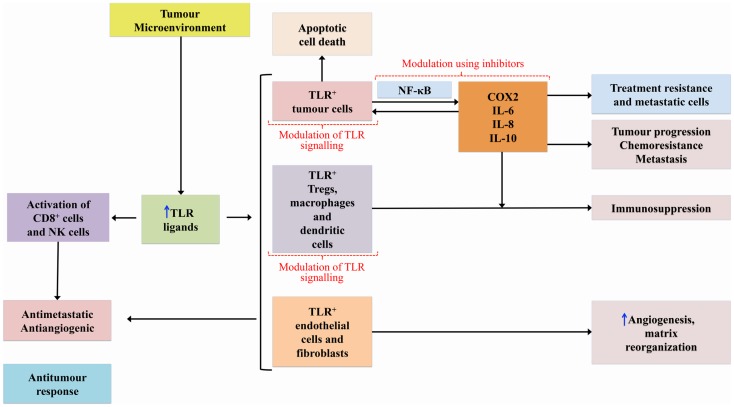
It is becoming increasingly apparent that the tumor microenvironment plays an important role in the progression of cancer. The microenvironment may promote tumor cell survival and proliferation or, alternatively may induce tumor cell apoptosis. Toll-like receptors (TLRs) are transmembrane proteins, expressed on immune cells and epithelial cells, that recognize exogenous and endogenous macromolecules. Once activated, they initiate signaling pathways leading to the release of cytokines and chemokines, which recruit immune cells inducing further cytokine production, the production of angiogenic mediators and growth factors, all of which may influence tumor progression. This paper examines the actions of TLRs in carcinogenesis with particular emphasis on their role in oral squamous cell carcinoma.
肿瘤微环境在癌症进展中发挥着重要作用,这一点正变得越来越明显。微环境可能促进肿瘤细胞的存活和增殖,或者诱导肿瘤细胞凋亡。Toll样受体(TLRs)是跨膜蛋白,在免疫细胞和上皮细胞上表达,可识别外源性和内源性大分子。一旦被激活,它们就会启动信号通路,导致细胞因子和趋化因子的释放,这些因子会招募免疫细胞,诱导进一步的细胞因子产生、血管生成介质和生长因子的产生,所有这些都可能影响肿瘤进展。本文研究了TLRs在致癌过程中的作用,特别强调了它们在口腔鳞状细胞癌中的作用。