Houghton Lauren C, Cooper Gillian D, Booth Mark, Chowdhury Osul A, Troisi Rebecca, Ziegler Regina G, Katki Hormuzd A, Hoover Robert N, Bentley Gillian R
Division of Cancer Epidemiology and Genetics, National Cancer Institute, National Institutes of Health, Bethesda, Maryland, United States of America; Department of Anthropology and Wolfson Research Institute for Health and Wellbeing, Durham University, Durham, United Kingdom.
Department of Anthropology and Wolfson Research Institute for Health and Wellbeing, Durham University, Durham, United Kingdom.
PLoS One. 2014 Oct 13;9(10):e109200. doi: 10.1371/journal.pone.0109200. eCollection 2014.
Adrenarche is a key early life event that marks middle childhood at approximately 7 years of age. Earlier work with British-Bangladeshi migrant women suggested that environmental conditions experienced before adrenarche influence adult reproductive function. We therefore investigated whether Bangladeshi children who migrate to the United Kingdom (UK) reach adrenarche earlier than non-migrants in Bangladesh or the United Kingdom.
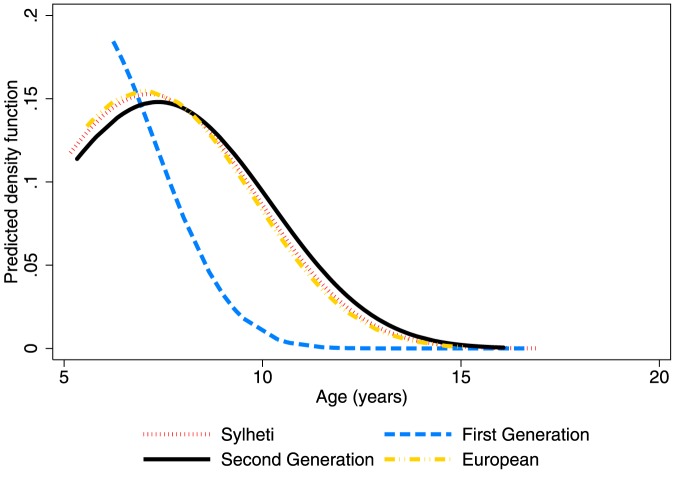
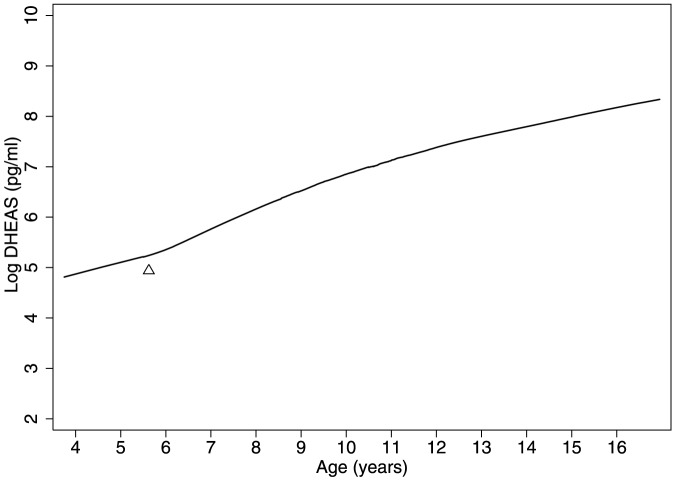
Healthy girls, aged 5-16 years, were recruited from schools in Sylhet, Bangladesh and London, England comprising four groups: Sylhetis (n = 165), first-generation migrants to the United Kingdom (n = 42), second-generation girls (n = 162), and British girls of European origin (n = 50). Anthropometric measurements were collected together with questionnaire data for migration and socioeconomic characteristics. Saliva samples were assayed for dehydroepiandrosterone (DHEAS) using enzyme-linked immunosorbent assays. Multiple linear regressions tested for group differences in anthropometric and socioeconomic variables and DHEAS levels. Median ages at adrenarche (DHEAS>400 pg/ml) were estimated using Weibull regression models for parametric survival analysis. Hazard ratios for reaching adrenarche earlier and 95% confidence intervals (CI), both unadjusted and adjusted for anthropometric variables, were estimated from the survival analyses. First-generation migrants had a median age at adrenarche (5.3 years) that was significantly earlier than Sylheti (7.2), second-generation (7.4), and European (7.1) girls. In univariate analyses, first-generation girls reached adrenarche significantly earlier than Sylhetis [HR (CI): 2.8 (1.4-5.5]. In multivariate models, first generation girls still reached adrenarche earlier than Sylhetis after adjusting for height [HR(CI): 1.9 (0.9-4.1)] and weight [HR(CI):1.7 (0.8-3.8)], but these results were attenuated.
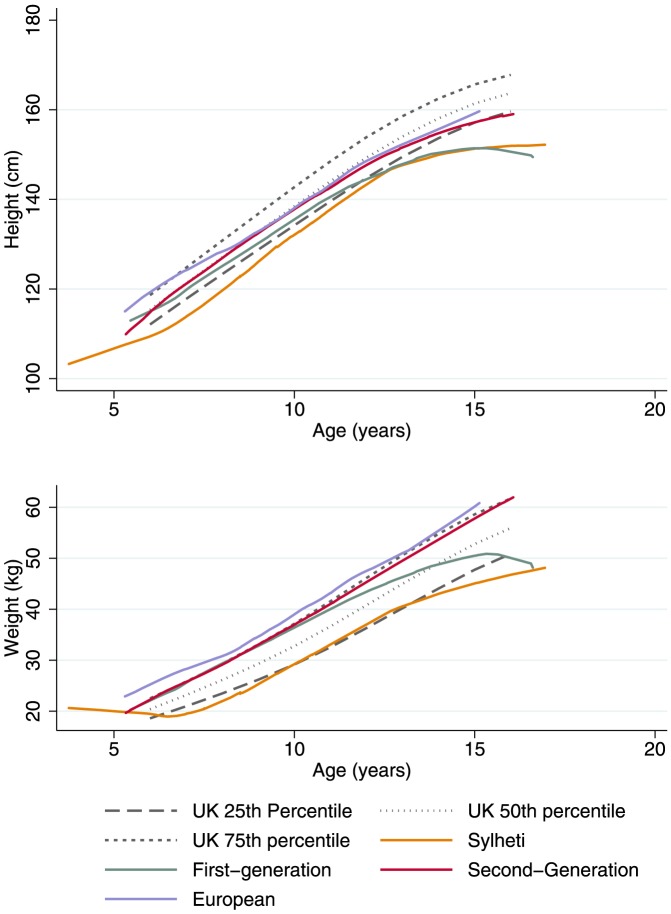
We suggest that rapid catch-up growth experienced by first generation girls during early childhood may explain their advanced adrenarche. The environmental conditions leading to an earlier adrenarche, as well as the health implications of this early transition, merit further exploration.
肾上腺功能初现是儿童早期的一个关键事件,标志着大约7岁的童年中期。早期对英裔孟加拉裔移民女性的研究表明,肾上腺功能初现之前经历的环境条件会影响成年后的生殖功能。因此,我们调查了移民到英国的孟加拉裔儿童是否比留在孟加拉国或英国的非移民儿童更早进入肾上腺功能初现阶段。
从孟加拉国锡尔赫特和英国伦敦的学校招募了5至16岁的健康女孩,分为四组:锡尔赫特女孩(n = 165)、第一代移民到英国的女孩(n = 42)、第二代女孩(n = 162)和欧洲裔英国女孩(n = 50)。收集了人体测量数据以及关于移民和社会经济特征的问卷数据。使用酶联免疫吸附测定法检测唾液样本中的脱氢表雄酮(DHEAS)。多元线性回归测试了人体测量和社会经济变量以及DHEAS水平的组间差异。使用威布尔回归模型进行参数生存分析,估计肾上腺功能初现(DHEAS>400 pg/ml)的中位年龄。根据生存分析估计未调整和调整人体测量变量后较早进入肾上腺功能初现的风险比及95%置信区间(CI)。第一代移民的肾上腺功能初现中位年龄(5.3岁)明显早于锡尔赫特女孩(7.2岁)、第二代女孩(7.4岁)和欧洲裔女孩(7.1岁)。在单变量分析中,第一代女孩进入肾上腺功能初现的时间明显早于锡尔赫特女孩[风险比(CI):2.8(1.4 - 5.5)]。在多变量模型中,第一代女孩在调整身高[风险比(CI):1.9(0.9 - 4.1)]和体重[风险比(CI):1.7(0.8 - 3.8)]后仍比锡尔赫特女孩更早进入肾上腺功能初现阶段,但这些结果有所减弱。
我们认为第一代女孩在幼儿期经历的快速追赶性生长可能解释了她们较早进入肾上腺功能初现阶段的原因。导致肾上腺功能初现提前的环境条件以及这种早期转变对健康的影响值得进一步探索。