Lee Hoonsoo, Kim Moon S, Jeong Danhee, Delwiche Stephen R, Chao Kuanglin, Cho Byoung-Kwan
Department of Biosystems Machinery Engineering, College of Agricultural and Life Science, Chungnam National University, 99 Daehak-ro, Yuseong-gu, Daejeon 305-764, Korea.
Environmental Microbiology and Food Safety Laboratory, Agricultural Research Service, U.S. Department of Agriculture, Powder Mill Rd. Bldg. 303, BARC-East, Beltsville, MD 20705, USA.
Sensors (Basel). 2014 Oct 10;14(10):18837-50. doi: 10.3390/s141018837.
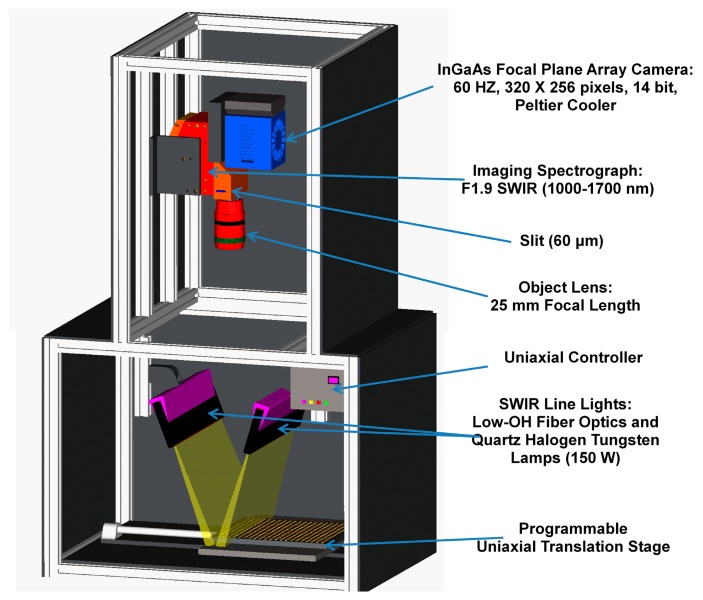
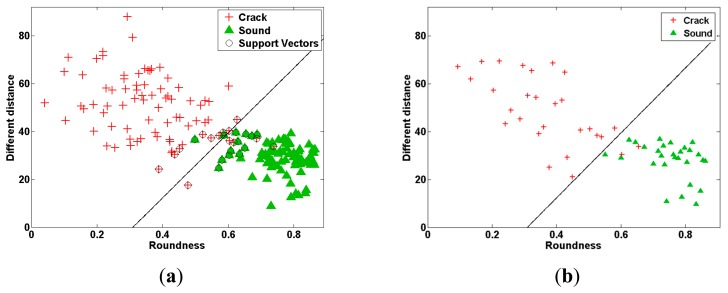
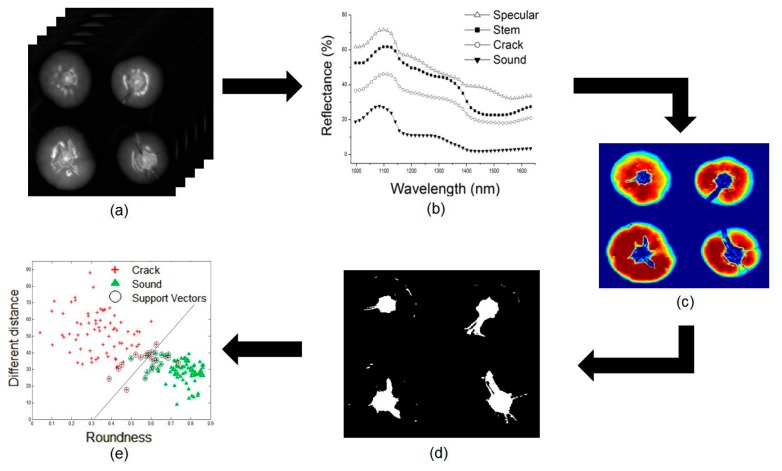
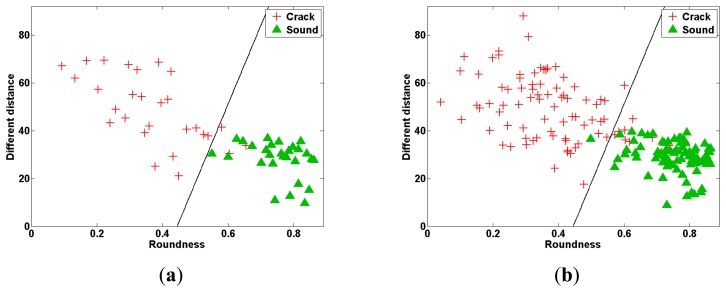
The objective of this study was to evaluate the use of hyperspectral near-infrared (NIR) reflectance imaging techniques for detecting cuticle cracks on tomatoes. A hyperspectral NIR reflectance imaging system that analyzed the spectral region of 1000-1700 nm was used to obtain hyperspectral reflectance images of 224 tomatoes: 112 with and 112 without cracks along the stem-scar region. The hyperspectral images were subjected to partial least square discriminant analysis (PLS-DA) to classify and detect cracks on the tomatoes. Two morphological features, roundness (R) and minimum-maximum distance (D), were calculated from the PLS-DA images to quantify the shape of the stem scar. Linear discriminant analysis (LDA) and a support vector machine (SVM) were then used to classify R and D. The results revealed 94.6% and 96.4% accuracy for classifications made using LDA and SVM, respectively, for tomatoes with and without crack defects. These data suggest that the hyperspectral near-infrared reflectance imaging system, in addition to traditional NIR spectroscopy-based methods, could potentially be used to detect crack defects on tomatoes and perform quality assessments.
本研究的目的是评估使用高光谱近红外(NIR)反射成像技术检测番茄表皮裂纹的情况。使用一个分析1000 - 1700 nm光谱区域的高光谱NIR反射成像系统,获取了224个番茄的高光谱反射图像:其中112个在茎痕区域有裂纹,112个没有裂纹。对这些高光谱图像进行偏最小二乘判别分析(PLS - DA),以对番茄上的裂纹进行分类和检测。从PLS - DA图像中计算出两个形态特征,即圆度(R)和最小 - 最大距离(D),以量化茎痕的形状。然后使用线性判别分析(LDA)和支持向量机(SVM)对R和D进行分类。结果显示,对于有裂纹缺陷和无裂纹缺陷的番茄,使用LDA和SVM进行分类的准确率分别为94.6%和96.4%。这些数据表明,除了传统的基于近红外光谱的方法外,高光谱近红外反射成像系统有可能用于检测番茄上的裂纹缺陷并进行质量评估。