Bläsi U, Nam K, Hartz D, Gold L, Young R
Department of Biochemistry and Biophysics, Texas A and M University, College Station 77843.
EMBO J. 1989 Nov;8(11):3501-10. doi: 10.1002/j.1460-2075.1989.tb08515.x.
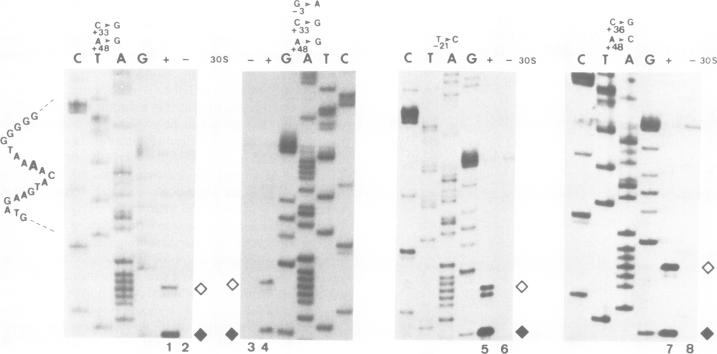
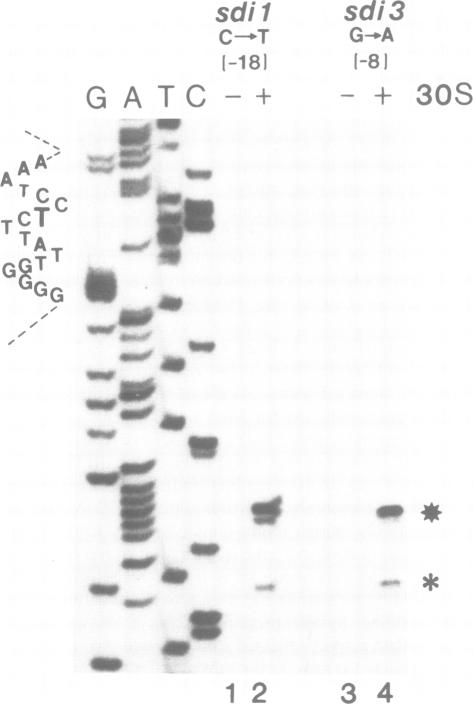
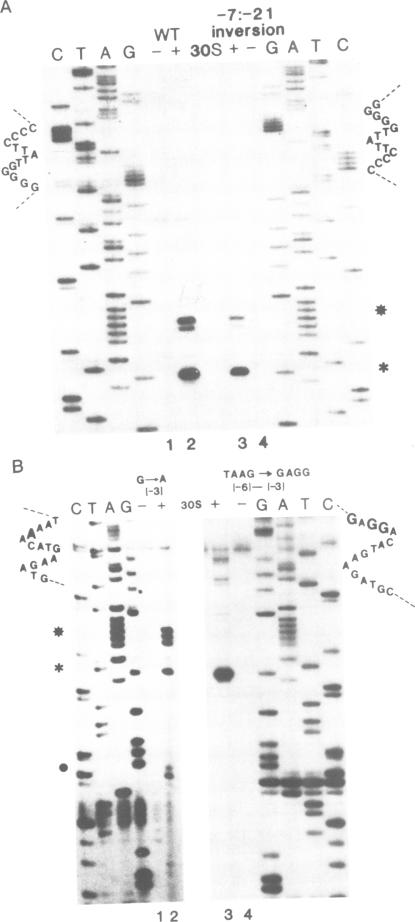
Lysis gene S of phage lambda has a 107 codon reading frame beginning with the codons Met1-Lys2-Met3. Genetic data have suggested that translational initiation occurs at both Met1 and Met3, generating two polypeptides, S107 and S105 respectively. We have proposed a model in which the proper scheduling of lysis depends on the partition of translational initiations between the two start codons. Here, using in vitro methods, we show that two stem-loop structures, one immediately upstream of the reading frame and a second approximately 10 codons within the gene, control the partitioning event. Utilizing primer-extension inhibition or 'toeprinting', we show that the two S start codons are served by two adjacent Shine-Dalgarno sequences. Moreover, the timing of lysis supported by the wild-type and a number of mutant alleles in vivo can be correlated with the ratio of ternary complex formation over Met1 and Met3 in vitro. Thus the regulation of the S gene is unique in that the products of two adjacent in-frame initiation events have opposing function.
噬菌体λ的裂解基因S有一个107个密码子的阅读框,起始密码子为Met1-Lys2-Met3。遗传数据表明,翻译起始发生在Met1和Met3处,分别产生两种多肽,即S107和S105。我们提出了一个模型,其中裂解的正确调度取决于两个起始密码子之间翻译起始的分配。在这里,我们使用体外方法表明,两个茎环结构,一个位于阅读框上游紧邻处,另一个位于基因内大约10个密码子处,控制着分配事件。利用引物延伸抑制或“足迹法”,我们表明两个S起始密码子由两个相邻的Shine-Dalgarno序列提供服务。此外,体内野生型和许多突变等位基因支持的裂解时间可以与体外Met1和Met3上三元复合物形成的比例相关联。因此,S基因的调控是独特的,因为两个相邻的框内起始事件的产物具有相反的功能。