Nguyen Vi, Nguyen-Viet Hung, Pham-Duc Phuc, Stephen Craig, McEwen Scott A
Department of Population Medicine, Ontario Veterinary College, University of Guelph, 2509 Stewart Building (#45), Guelph, N1G 2W1 ON Canada ; Public Health Risk Sciences Division, Laboratory for Foodborne Zoonoses, Public Health Agency of Canada, 160 Research Lane, Unit 206, Guelph, ON N1G 5B2 Canada ; Center for Public Health and Ecosystem Research, Hanoi School of Public Health (HSPH), 138 Giang Vo Street, Hanoi, Vietnam.
Center for Public Health and Ecosystem Research, Hanoi School of Public Health (HSPH), 138 Giang Vo Street, Hanoi, Vietnam ; Swiss Tropical and Public Health Institute (Swiss TPH), and International Livestock Research Institute (ILRI), Socinstrasse 57, CH-4002 Basel, Switzerland and Hanoi, Vietnam ; Swiss Federal Institute of Aquatic Science and Technology (ESWAG), Sandec - Department of Water and Sanitation in Developing Countries, P.O. Box, CH-8600, Dübendorf, Switzerland.
Infect Dis Poverty. 2014 Oct 1;3(1):36. doi: 10.1186/2049-9957-3-36. eCollection 2014.
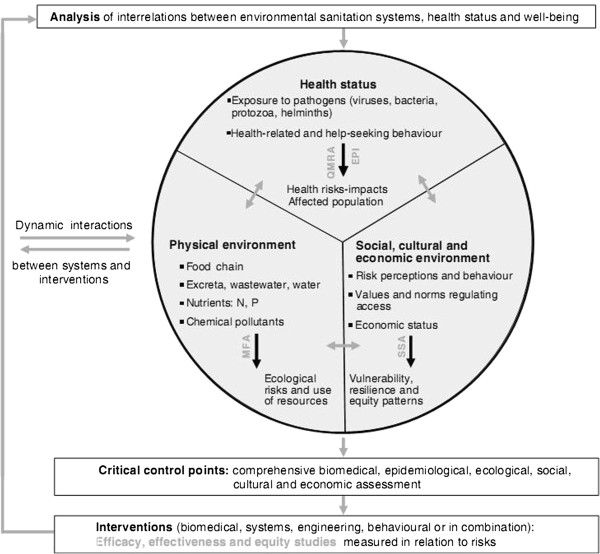
To date, research has shown an increasing use of the term "ecohealth" in literature, but few researchers have explicitly described how it has been used. We investigated a project on health and environmental sanitation (the conceptual framework of which included the pillars of ecohealth) to identify the impediments and enablers of ecohealth and investigate how it can move from concept to practice.
A case study approach was used. The interview questions were centred on the nature of interactions and the sharing of information between stakeholders.
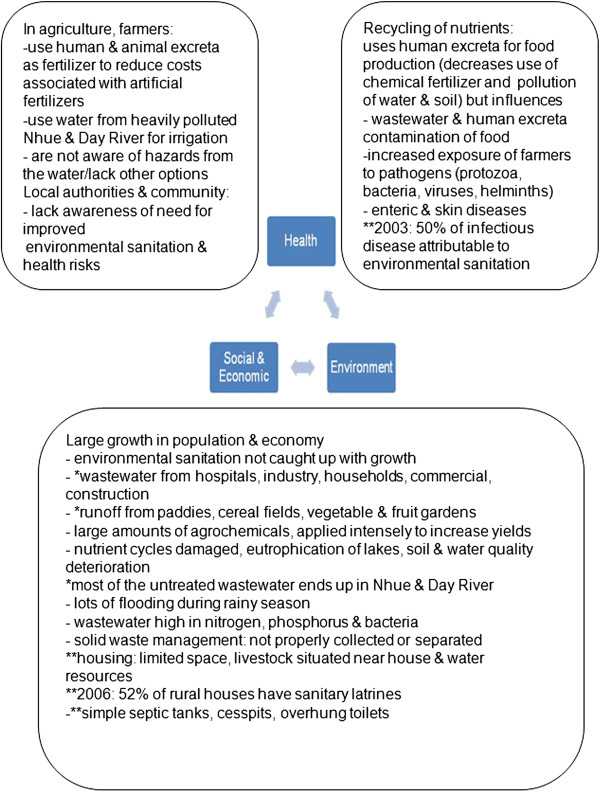
The analysis identified nine impediments and 15 enablers of ecohealth. Three themes relating to impediments, in particular-integration is not clear, don't understand, and limited participation-related more directly to the challenges in applying the ecohealth pillars of transdisciplinarity and participation. The themes relating to enablers-awareness and understanding, capacity development, and interactions-facilitated usage of the research results. By extracting information on the environmental, social, economic, and health aspects of environmental sanitation, we found that the issue spanned multiple scales and sectors.
The challenge of how to integrate these aspects should be considered at the design stage and throughout the research process. We recommend that ecohealth research teams include a self-investigation of their processes in order to facilitate a comparison of moving from concept to practice, which may offer insights into how to evaluate the process.
迄今为止,研究表明文献中“生态健康”一词的使用频率不断增加,但很少有研究人员明确描述其使用方式。我们调查了一个关于健康与环境卫生的项目(其概念框架包括生态健康的支柱),以确定生态健康的障碍和推动因素,并研究它如何从概念转化为实践。
采用案例研究方法。访谈问题集中在利益相关者之间互动的性质和信息共享上。
分析确定了生态健康的九个障碍和十五个推动因素。与障碍相关的三个主题,特别是——整合不明确、不理解和参与有限——更直接地与应用跨学科性和参与性的生态健康支柱所面临的挑战相关。与推动因素相关的主题——意识和理解、能力发展以及互动——促进了研究结果的应用。通过提取关于环境卫生的环境、社会、经济和健康方面的信息,我们发现这个问题跨越了多个尺度和部门。
在设计阶段和整个研究过程中都应考虑如何整合这些方面的挑战。我们建议生态健康研究团队对其过程进行自我调查,以便于比较从概念到实践的转变,这可能为如何评估该过程提供见解。